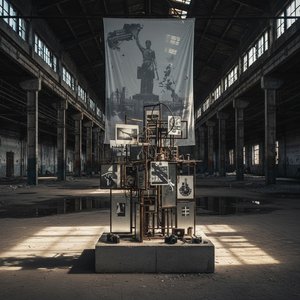
The Weaver of Myths: The Life and Legacy of Grigol Robakidze
Grigol Robakidze, a name that resonates with the profound echoes of Georgian identity and the haunting beauty of exile, was far more than a mere man of letters; he was a visionary who sought to bridge the ancient soul of the Caucasus with the modern intellectual currents of Europe. Born on October 28, 1880, in the serene village of Sviri, nestled within the Imereti region of Georgia, his early years were steeped in the rich, mythological landscape of his homeland. This primordial connection to the earth and its legends would later become the bedrock of his literary universe. His education, spanning from the Kutaisi Classical Gymnasium to the prestigious halls of Tartu University in Estonia and Leipzig University in Germany, provided him with a sophisticated linguistic and philosophical toolkit. It was through this rigorous academic journey that he encountered the radical, transformative ideas of
Friedrich Nietzsche, an encounter that would forever alter his perception of truth, power, and the individual spirit.
As he matured, Robakidze emerged as a central figure in the Georgian symbolist movement, a period marked by a departure from the starkness of realism toward a more evocative, dreamlike exploration of existence. In 1915, he became a founding leader of the
Blue Horns (
Tsisperqnatslebi), a group of poets and writers who sought to infuse Georgian literature with a new, avant-garde sensibility. His work during this era was characterized by an intense preoccupation with archetypes and the search for a lost, primordial identity. This creative impulse found its most enduring expression in his masterpiece,
The Snake's Skin (
Das Schlangenhemd). In this profound narrative, Robakidze weaves together themes of metamorphosis and the quest for selfhood, drawing inspiration from the legendary tales of Vazha-Pshavela to create a tapestry of symbolic depth that transcends national borders.
A Voice in Exile: Resistance and Philosophical Depth
The trajectory of Robakidze’s life was irrevocably altered by the political upheavals of the 20th century. As the Soviet regime tightened its grip on Georgia, Robakidze’s commitment to intellectual freedom and his vocal opposition to dictatorial oppression forced him into a long and poignant period of exile. Moving through Germany and eventually settling in Geneva, Switzerland, he became a prominent voice among the Georgian émigré community. This displacement, while physically isolating him from his native soil, allowed him to cultivate a unique perspective—one that viewed the corrosive effects of totalitarianism through a lens of philosophical tragedy. His prose during these years, including works such as
The Killed Soul and
The Goddess' Call, continued to grapple with the tension between the individual soul and the crushing weight of political machinery.
His literary output was not merely a record of political resistance but an ongoing dialogue between East and West. Robakidze possessed a rare ability to introduce Western philosophical ideals to the Georgian consciousness while simultaneously presenting the deep-seated customs and spiritual richness of the East to a European audience. His essays were often masterful portraits of the intellectuals and statesmen of his era, capturing the fleeting essence of human character amidst the chaos of history. Even in the twilight of his life, living in the quietude of Geneva, his mind remained anchored to the mythological roots of Sviri, constantly seeking the eternal truths hidden beneath the surface of modern reality.
The Enduring Resonance of a Symbolist Master
When Grigol Robakidze passed away on November 19, 1962, he left behind a legacy that continues to inspire scholars and lovers of literature alike. His significance lies not only in his contributions to Georgian prose and drama but in his role as a cultural bridge-builder. He transformed the local legends of Georgia into universal symbols of human struggle and spiritual rebirth. Today, his name is honored through institutions such as the
Grigol Robakidze University in Tbilisi, ensuring that his pursuit of knowledge and his defense of free thought remain central to the Georgian academic identity.
To study Robakidze is to embark on a journey through:
- The exploration of mythological archetypes as tools for understanding modern human consciousness.
- The intersection of Nietzschean philosophy and the development of a new, symbolic literary language.
- The profound impact of political exile on the creation of an émigré literature defined by loss and resistance.
- The synthesis of Eastern traditions and Western modernity within a single, cohesive artistic vision.
His life remains a testament to the power of the written word to preserve the essence of a culture even when its people are scattered across the globe.