Elizabeth Butterworth: A Celebration of Ornithological Detail
Elizabeth Butterworth (born 1949) stands apart as an English artist, distinguished primarily by her mesmerizing depictions of parrots and macaws—birds that hold a special fascination for her gaze and translate into exquisitely rendered paintings. Born in Rochdale, Lancashire, she embarked on her artistic journey at the Rochdale School of Art in 1966–1968 before honing her skills at Maidstone College of Art (1968–1971) and culminating in a formative period at the Royal College of Art in London (1971–1974). These foundational experiences instilled within her an unwavering dedication to observation—a characteristic that would become central to her artistic practice.
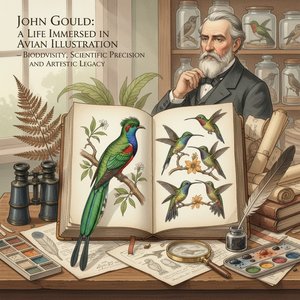
Butterworth’s approach to portraying birds is marked by meticulous attention to anatomical detail and textural nuance. Unlike many artists of her time who favored idealized representations, Butterworth sought to capture the essence of avian life with remarkable accuracy. Influenced by luminaries like John Gould and Archibald Thorburn—renowned ornithologists and painters—she adopted a technique rooted in scientific observation combined with artistic sensitivity. Her studio became a haven for macaws, which she cared for diligently, studying their behavior and meticulously sketching them both indoors and outdoors. This immersive engagement with her subjects fueled her ability to translate complex visual information into captivating artworks.
Her early exhibitions at Fischer Fine Art (1978 & 1983) and Rodolphe d’Erlanger cemented her reputation as a visionary artist, showcasing her mastery of watercolor and gouache—media she skillfully employed to convey the vibrancy of tropical plumage and the subtle movements of birds in flight. Critically acclaimed publications like “Parrots and Cockatoos” (text by Rosemary Low), "Amazon Parrots" (with Rosemary Low), and “Macaws” solidified Butterworth’s position as a pioneer in capturing the beauty of avian subjects on canvas. These works were subsequently presented at prestigious venues including the Metropolitan Museum of Art, New York, and the Chrysler Museum, Norfolk, Virginia, demonstrating her enduring appeal to discerning collectors.
Butterworth's artistic legacy extends beyond individual paintings; she actively participated in collaborative projects with fellow artists like Hugh Stoneman, contributing to exhibitions focused on printmaking techniques and exploring themes related to conservation. Her work has been recognized by institutions worldwide—museums, libraries, contemporary art collections—spanning continents from England to the United States, Australia, Venezuela, and South Africa—a testament to her enduring influence within the artistic community.
Her dedication to portraying birds with unparalleled realism earned her recognition as “without rival this century” according to Ian Dunlop, a celebrated art historian who championed Butterworth’s distinctive style. Today, Elizabeth Butterworth continues to inspire artists and admirers alike, ensuring that her captivating depictions of parrots—a celebration of meticulous observation and artistic virtuosity—remain treasured expressions of the natural world.