The Disciplined Eye: The Life and Legacy of Harold Cresswell
Born in the historic enclave of Chiswick, Middlesex, in 1945, Harold Stanley Janersen Cresswell developed a perspective on the world that was shaped as much by military precision as by artistic sensitivity. Before he became a celebrated voice in the British watercolor tradition, Cresswell served with distinction in the Royal Artillery and later volunteered for the airborne forces. This period of his life, characterized by the rigors of discipline and the necessity of acute observation, provided a foundational layer to his creative psyche. The ability to scan a horizon, to note the subtle shifts in light and the structural integrity of a landscape, became a skill he would later translate from the battlefield to the canvas, imbuing his art with an unmistakable sense of clarity and truth.
As his artistic journey unfolded, Cresswell found his true calling not in the movement of troops, but in the stillness of the Isle of Man. His fascination with the Manx landscape led him to master the delicate medium of watercolor, a choice that allowed him to explore the ephemeral qualities of light and atmosphere. Through years of dedicated practice, he developed a technique capable of capturing both the monumental weight of ancient stone and the fleeting translucency of a misty morning. His work is characterized by an unwavering commitment to fidelity, where every brushstroke serves to document the architectural heritage of the island with a reverence that borders on the poetic.
A Watercolor Chronicle of the Isle of Man
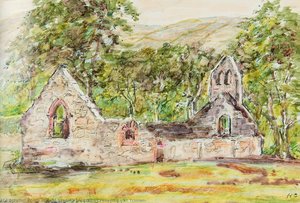
The heart of Cresswell’s oeuvre lies in his profound connection to the Isle of Man, a place he transformed into a living gallery through his meticulous compositions. His paintings are far more than mere topographical records; they are emotional landscapes that invite the viewer to step into a world of quiet grandeur. By focusing on historic sites and weathered structures, he captured the very soul of the island's heritage. In works such as St Adamnan, Old Lonan, and Spanish Head, one can sense the weight of history pressing against the present moment.
His mastery of the watercolor medium allowed him to navigate the complexities of tonal variation and atmospheric perspective with ease. He possessed a rare ability to use the transparency of the paint to suggest depth, making the rugged cliffs of Derelict Tholtan or the tranquil vistas of Phurt feel tangible and immersive. The significance of his work lies in this delicate balance between technical accuracy and emotional resonance; he did not simply paint buildings, he painted the memory of them, preserving the fading echoes of Manx history through a vibrant, fluid medium.
Artistic Significance and Enduring Impression
The legacy of Harold Cresswell is defined by his role as a visual custodian of the Isle of Man’s architectural and natural splendor. His contribution to the British watercolor tradition is marked by a unique synthesis of military-honed observational precision and a deeply romantic appreciation for the landscape. While many artists seek to transform their subjects, Cresswell sought to reveal them, stripping away the unnecessary to expose the enduring character of his chosen locales.
Today, his body of work stands as a vital historical document, offering a window into a period of architectural and environmental serenity. His achievements can be summarized through the following hallmarks of his career:
- Mastery of Medium: An expert utilization of watercolor to convey complex atmospheric effects and structural detail.
- Architectural Preservation: A dedicated focus on documenting the historic and often vanishing landmarks of the Isle of Man.
- Observational Depth: The integration of a disciplined, military-trained eye with a sensitive, artistic temperament.
- Cultural Impact: Establishing a significant presence within the British watercolor tradition through evocative and faithful landscape painting.
Through his eyes, the Isle of Man remains eternally captured in a state of grace, a testament to an artist who found beauty in the permanence of stone and the fleeting nature of light.