The Genesis of Light and Perception
Born in the vibrant atmosphere of Berkeley, California, in 1945, Mary Corse emerged as a pivotal voice during one of the most transformative eras in American art history. Her journey began amidst the intellectual ferment of the 1960s, a period where the boundaries of artistic expression were being radically redrawn by the Light and Space movement. Studying at UC Santa Barbara and later the Chouinard Art Institute, Corse immersed herself in the profound dialogues of phenomenology and the burgeoning mysteries of quantum physics. This academic foundation allowed her to move beyond mere representation, seeking instead to capture the very essence of how we perceive the world around us. Her early explorations were not merely about what is seen, but about the interaction between light, matter, and the human eye, setting the stage for a career defined by luminous discovery.The Alchemy of Materiality and Motion
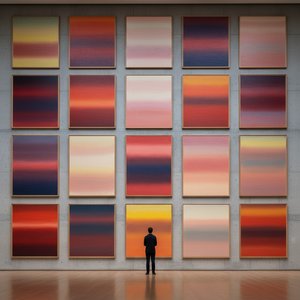
At the heart of Corse’s practice lies a revolutionary approach to the canvas, where the distinction between subject and medium dissolves into a shimmering dance of light. She is perhaps most renowned for her ingenious use of glass microspheres—tiny, reflective beads typically found in highway lane markings—which she meticulously integrates into acrylic paint. This technique creates a surface that is never truly static; as a viewer moves before her works, the paintings appear to breathe, with bands of light oscillating and shifting across the surface.Her evolution through various series demonstrates a masterful command over this luminous vocabulary:
- The White Light Series: These early works utilize radiant surfaces to create an ethereal, almost weightless presence.
- The Black Light Series: A darker, more intense exploration where black acrylic and microspheres create a striking contrast of depth and reflection.
- The Black Earth Works: Large-scale ceramic slabs that extend her investigation into texture and fired glaze.