Håndmalet olie på lærred i din valgte størrelse og ramme, udført efter bestilling af vores kunstnere. ( Skift til print Skift til billede)





























Vælg mellem vores forudindstillede størrelser, der matcher kunstværkets originale proportioner.

Du kan indtaste dine egne mål for at passe til en bestemt ramme eller plads. Hvis den valgte størrelse ikke stemmer overens med det originale billedes proportioner, vil vi enten beskære kunstværket eller udvide maleriet med yderligere håndmalede elementer. En digital skitse sendes til din godkendelse, før produktionen påbegyndes.
Bemærk venligst, at forhåndsvisningen på skærmen ikke afspejler den faktiske beskæring eller udvidelse. Kun skitsen vil nøjagtigt vise den endelige komposition.
Selvom specialmål er mulige, anbefaler vi at vælge en dimension fra den foruddefinerede liste for at bevare de originale proportioner.
Levering i hele verden () på 3/4 uger i stedet for de standard 5 uger. (10 august). Ingen kompromiser med kvaliteten.


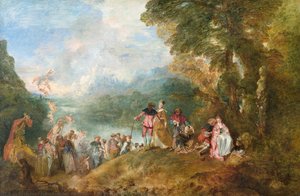
Party of Four
Størrelse på reproduktion
Jean-Antoine Watteau, a name synonymous with the ethereal beauty of Rococo art, gifted us with a series of paintings that transcend mere representation. His work wasn't simply about depicting scenes; it was about capturing a fleeting mood, a whispered secret, and a sense of profound tranquility. “Party of Four,” painted in 1713 and now residing within the Fine Arts Museums of San Francisco, stands as perhaps his most poignant example – an invitation to step into a world where leisure is not merely an activity but a state of being. The painting immediately draws the eye with its soft palette, dominated by muted greens, blues, and creams, creating a dreamlike atmosphere that feels both familiar and utterly distant.
At first glance, “Party of Four” presents a seemingly simple tableau: four figures seated on a rustic bench amidst a verdant woodland. However, Watteau’s genius lies in the subtle details and the unspoken narrative he weaves. The central figure, dressed in a vibrant red gown, is immediately captivating – her pose suggests a moment of quiet contemplation, perhaps a shared secret or a fleeting glance exchanged with one of her companions. Beside her, a young man plays a guitar, his expression suggesting both amusement and gentle melancholy. The other two figures, partially obscured by the dappled sunlight filtering through the trees, contribute to the sense of intimacy and mystery. Notice how Watteau masterfully uses light and shadow to create depth and volume, lending a remarkable three-dimensionality to this seemingly static scene.
Watteau’s technique is characterized by his loose brushstrokes and delicate layering of color – a hallmark of Rococo painting. He eschewed the rigid formality of earlier Baroque styles in favor of a more fluid and expressive approach. The figures are rendered with an almost ethereal quality, their forms dissolving into the surrounding landscape. This blurring of boundaries between subject and setting is a key element of Watteau’s style, creating a sense of immersion for the viewer. The inclusion of two birds soaring overhead adds to this feeling of lightness and freedom, suggesting a world unbound by earthly concerns.
“Party of Four” is deeply rooted in its historical context – the opulent yet understated leisure culture of 18th-century France. The painting reflects the *fête galante*, a popular trend during this period, which celebrated aristocratic gatherings held outdoors amidst picturesque landscapes. These events were not simply social occasions; they represented a deliberate escape from the constraints of courtly life, offering a space for conversation, flirtation, and artistic appreciation. Interestingly, the year 1713 was also significant as the year the Merchant’s House Museum was built in Paris, showcasing the architectural advancements and cultural flourishing of the era.
The inclusion of musical instruments – specifically the guitar – further reinforces this connection to aristocratic entertainment. Music played a vital role in these gatherings, providing a backdrop for conversation and creating an atmosphere of refined enjoyment. Watteau’s ability to capture not just the visual appearance but also the spirit of these social rituals is what makes “Party of Four” such a compelling work of art.
Watteau was renowned for his masterful blending of reality and fantasy, a technique that elevates his paintings beyond mere portraiture. In "Party of Four," he doesn’t simply depict four individuals; he creates an entire world – a dreamlike realm where time seems to slow down and the boundaries between observer and participant dissolve. The figures appear lost in their own thoughts, oblivious to the presence of the viewer, inviting us to become silent witnesses to their intimate moment. This deliberate detachment is characteristic of Watteau’s style and contributes significantly to the painting's enduring appeal.
Furthermore, the subtle references to classical mythology – particularly the figure playing the guitar – hint at deeper symbolic meanings. Watteau was a keen student of art history, and he frequently incorporated allusions to ancient themes into his work, adding layers of complexity and intellectual richness. The painting is not merely a depiction of leisure; it’s a meditation on beauty, friendship, and the fleeting nature of time.
Watteau's influence extends far beyond his own lifetime. His innovative use of color, composition, and atmospheric perspective has inspired countless artists throughout history. George Romney’s “Percivall Pott (1713–1788),” for example, demonstrates a similar attention to detail and character portrayal, reflecting Watteau’s emphasis on capturing the essence of human interaction. The delicate brushwork and evocative lighting in "Party of Four" can also be seen as precursors to Impressionism, foreshadowing the shift towards capturing fleeting moments and subjective experiences.
Today, “Party of Four” continues to captivate audiences with its timeless beauty and profound emotional resonance. It’s a reminder that art has the power to transport us to another time and place, allowing us to experience a moment of quiet contemplation amidst the chaos of modern life. Explore a high-quality reproduction of Jean Antoine Watteau’s “Party of Four” at BuyPopArt.com and immerse yourself in the enchanting world of this Rococo masterpiece.
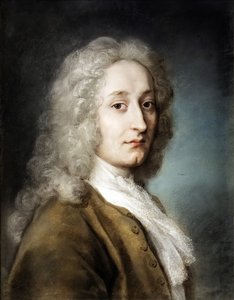
1684 - 1721 , Frankrig

Oplev Rokoko kunstens pragt! Dyk ned i 10 mesterværker fra Boucher, Watteau og Fragonard. Historier, teknikker & inspiration til dit hjem. Find museumskvalitets reproduktioner på BuyPopArt.com

Discover the captivating world of Jean-Antoine Watteau, master of the Fête Galante! Explore his iconic paintings, symbolism, and lasting influence on Rococo art. A deep dive for classic art enthusiasts.

Explore the opulent world of Rococo art! Discover its origins, key artists like Watteau & Boucher, and lasting influence on design. Expert insights for collectors & enthusiasts.

Explore the exquisite world of Rococo art! Discover its history, masters (Watteau, Boucher & more), and defining elegance. Expert insights for collectors seeking museum-quality reproductions & custom portraits.

Explore the opulent world of Rococo art! Discover Watteau, Boucher & Nattier's masterpieces. Expert insights for collectors seeking museum-quality reproductions and custom portraits at BuyPopArt.


Hold dig opdateret med de seneste kunstnyheder, eksklusive tilbud og indretningsideer.
Fortæl os om dit projekt, og vores kunsteksperter vil give dig 3 personlige kunstforslag.
Vi kuraterer 3 valgmuligheder kun til dig – Gratis!


 Se i fuld skala
 Del
Del Del
Del
 Detaljer

 Download
 Lignende værker
 Røntgenundersøgelse
 Diasshow


 Se mere







 Glasmulighed er kun tilgængelig i størrelser under 110 cm