Vorschau anzeigenVorschau anzeigen In AR erlebenIn AR erleben Druck bestellen Druck bestellenBild kaufen Bild kaufen VersendenVersenden
Details anzeigenDetails anzeigen Zu Favoriten hinzufügen Zu Favoriten hinzufügen HerunterladenHerunterladen Ähnliche ObjekteÄhnliche Objekte RöntgenaufnahmeRöntgenaufnahme DiashowDiashow

St. John The Baptist Preaching

Rembrandt's ikonische Darstellung von Johannes dem Täufer predigt vor seinen Anhängern im Wald. Ein Meisterwerk der Lichtführung und Symbolik des Goldenen Zeitalters. Entdecken Sie Kunstgeschichte!

Erkunden Sie Rembrandt van Rijn (1606-1669), den niederländischen Barockmeister des Lichts und der Schatten! Entdecken Sie ikonische Selbstporträts, biblische Szenen und bahnbrechende Radierungen. Erleben Sie die goldene Ära der Niederlande.

Handgefertigte Ölreproduktion

Handgemaltes Ölgemälde auf Leinwand in Ihrer Wunschgröße und mit Rahmen, auf Bestellung von unseren Künstlern angefertigt. (Druck bestellen Druck bestellenBild kaufen Bild kaufen)

P118B $10
P118H $10
P118W $10
P438Z $10
P508JH $12
P508YH $12
P805H $10
P805Z $10
P919BZ $10
P919G $10
P919XJ $10
P959ZH $10
P968JZ $12
W106C $8
W218G $10
W218JH $8
W218Y $10
W307PJ $10
W316G $10
W316PJ $8
W316Y $10
W398PJ $8
W4111J $10
W500HY $15
W500JH $15
W692G $12
W849H $8
W940BG $15
W953PJ $8

Standard
custom
CM
INCH

Wählen Sie aus unseren vordefinierten Formaten, die den ursprünglichen Proportionen des Kunstwerks entsprechen.

Breite
Höhe

Sie können Ihre eigenen Maße eingeben, um einen bestimmten Rahmen oder Platz auszufüllen. Wenn die gewählte Größe nicht den Proportionen des Originalbildes entspricht, werden wir das Kunstwerk entweder beschneiden oder das Gemälde durch zusätzliche, handgemalte Elemente erweitern. Ein digitales Mockup wird Ihnen zur Genehmigung zugesandt, bevor die Produktion beginnt.
Bitte beachten Sie, dass die Bildschirmvorschau nicht die tatsächliche Beschneidung oder Erweiterung widerspiegelt. Nur das Mockup zeigt die endgültige Komposition exakt an.
Obwohl Sondermaße verfügbar sind, empfehlen wir, eine Größe aus der vordefinierten Liste zu wählen, um die ursprünglichen Proportionen beizubehalten.

Beispiele für Anpassungsmöglichkeiten: Gesicht durch Kundenfoto ersetzen; Haustier hinzufügen (z. B. Katze durch Hund ersetzen); eine versteckte Nachricht im Hintergrund einfügen; Hintergrundlandschaft oder -elemente ändern.
Nach der Bestellung wird das BuyPopArt.com-Team dem Kunden Anweisungen per E-Mail zusenden und eine Mockup-Vorschau bereitstellen.

Weltweiter Versand () in nur 3 bis 4 Wochen statt der üblichen 5 Wochen. (13 August). Keine Kompromisse bei der Qualität.

why_choose_icon
Kostenloser weltweiter Expressversand
why_choose_icon
Hochwertige Leinenleinwand
why_choose_icon
Umfassender Versicherungsschutz beim Versand
why_choose_icon
Zollgebühren-Rückerstattungsgarantie
why_choose_icon
Garantie für exakte Farbtreue
why_choose_icon
60 Tage Rückgaberecht (nur bei Mängeln)
why_choose_icon
100% Geld-zurück-Garantie
why_choose_icon
Mengenrabatt verfügbar

Gesamtpreis

$ 288

reproduction

St. John The Baptist Preaching

Art der Reproduktion

Format der Reproduktion

-

Gesamtpreis

$ 288

Eckdaten

  • Artistic style: Baroque
  • Artist: Paolo Veronese
  • Year: 1562
  • Title: St John The Baptist Preaching
  • Movement: Renaissance
  • Notable elements or techniques: Dramatic lighting; Detailed drapery
  • Location: Galleria Borghese, Rome

Kunst-Quiz

Jede Frage hat nur eine richtige Antwort.

Frage 1:
What is the primary subject matter of Rembrandt’s St. John The Baptist Preaching?
Frage 2:
Approximately how large is Rembrandt’s St. John The Baptist Preaching?
Frage 3:
What artistic technique is Rembrandt known for utilizing prominently in this painting?
Frage 4:
The painting portrays John the Baptist preaching to whom?
Frage 5:
What is the significance of the landscape setting in St. John The Baptist Preaching?

Beschreibung des Kunstwerks

St. John The Baptist Preaching: A Dialogue Between Light and Shadow

Rembrandt van Rijn’s *St. John The Baptist Preaching*, completed in 1634, stands as an emblem of the Dutch Golden Age's profound engagement with religious iconography—a testament to Rembrandt’s unparalleled ability to distill spiritual essence into visual form. Measuring 62 x 80 cm, this oil on canvas painting transcends mere depiction; it embodies a carefully orchestrated interplay of light and shadow that draws viewers into a contemplative meditation on faith and divine revelation. This monumental composition captures not only the biblical narrative but also the intellectual currents shaping seventeenth-century Europe, reflecting Rembrandt’s masterful understanding of human psychology and artistic innovation.

Composition and Setting: Wilderness Reverie

The scene unfolds in an ethereal wilderness landscape—a stylized representation of the Jordan Valley—dominated by spindly trees and a hazy pinkish-yellow sky suggestive of twilight or dawn. This backdrop isn’t merely decorative; it serves as a crucial element in conveying the painting’s overarching mood of solemn contemplation. Rembrandt skillfully employs atmospheric perspective, diminishing colors and details as they recede into the distance, creating an illusion of depth that enhances the sense of solitude and spiritual yearning. The central figure of St. John stands prominently at the center of the canvas, radiating authority yet imbued with vulnerability—a deliberate juxtaposition reflecting the complexities inherent in prophetic ministry. He is positioned against a backdrop that emphasizes his isolation, mirroring the profound introspection demanded by his role as herald of Christ’s imminent arrival.

The Figures: Narrative Tension

At the heart of the composition are two figures engaged in a dynamic dialogue. St. John, gesturing emphatically towards Jesus—who appears off-canvas to the left—delivers his sermon to a group of three rabbis who occupy the right side of the painting. Rembrandt’s masterful rendering captures the tension between faith and doubt, represented by the rabbi’s haughty gaze and posture – a challenge to St. John’s proclamation. The inclusion of a kneeling woman and a young child adds another layer of narrative richness, symbolizing humility and innocence amidst the grandeur of religious discourse. Each figure is meticulously crafted with painstaking attention to anatomical detail, demonstrating Rembrandt’s unwavering commitment to realism—a hallmark of his artistic style. The rabbi’s stance embodies skepticism—a stark contrast to St. John’s fervent conviction, highlighting the fundamental questions surrounding belief and divine revelation.

Technique: Rembrandt's Signature Light

Rembrandt’s technique—characterized by dramatic chiaroscuro—is arguably the painting’s defining feature. He employs a masterful manipulation of light and shadow to sculpt form and imbue the scene with emotional intensity. The luminous glow emanating from St. John’s figure illuminates his face and torso, highlighting his spiritual conviction, while deep shadows envelop the landscape and the rabbis’ robes, emphasizing their earthly concerns. This technique isn’t merely stylistic; it serves as a conduit for conveying profound psychological depth—reflecting Rembrandt’s belief that art should illuminate the human condition. The subtle gradations of tone achieved through layering thin glazes of paint contribute to the painting’s luminous quality and heighten its visual impact. This masterful use of light—a technique perfected by Rembrandt—creates a palpable sense of drama, mirroring the spiritual struggle at play within the scene.

Symbolism: Echoes of Biblical Narrative

Beyond its formal brilliance, *St. John The Baptist Preaching* resonates with symbolic significance rooted in Christian tradition. St. John represents repentance and baptism—the prelude to Jesus’ incarnation—while the rabbis embody Jewish skepticism and resistance to divine revelation. Rembrandt’s depiction underscores the importance of dialogue between faiths—a theme that aligns with the broader humanist spirit of the Dutch Golden Age. The painting’s serene landscape symbolizes the wilderness of spiritual contemplation, inviting viewers to contemplate the mysteries of faith and redemption. It speaks to the enduring human desire for understanding—for reconciling belief with reason—a preoccupation central to the intellectual debates of the era.
  • Provenance: Originally housed in Cardinal Scipione Borghese's collection
  • Style: Baroque
  • Medium: Oil on Canvas
  • Dimensions: 62 x 80 cm
For those seeking to experience the beauty of Rembrandt’s art firsthand, BuyPopArt.com offers exceptional hand-painted reproductions of *St. John The Baptist Preaching*, meticulously crafted by skilled artisans using archival pigments—a timeless tribute to a masterpiece of Dutch Baroque painting. Explore more stunning artworks at St. John The Baptist Preaching on BuyPopArt. Additionally, delve into the broader Christian Art Movement here: The Christian Art Movement on BuyPopArt. Photo Description: The painting is a religious scene featuring St. John the Baptist preaching to his followers. The main figure of St. John is standing in the center of the painting with his arms raised, giving a sermon to the crowd. There are several other people in the image, including some who appear to be listening intently and others who seem to be engaged in various activities. The setting appears to be an outdoor gathering or event, as there is a chair visible near the center of the painting. The overall atmosphere of the painting conveys a sense of spirituality and devotion, with St. John acting as the central figure guiding his followers towards a higher purpose. Size: 62 x 80 cm Date: 1634 ARTIST INFORMATION: ================== Artist: Rembrandt van Rijn Birth Year: 1606 Death Year: 1669 Birth City: Leiden Birth Country: Netherlands Biography: Rembrandt Harmenszoon van Rijn, a name synonymous with the Dutch Golden Age and the mastery of light and shadow, was born in Leiden, Netherlands, on July 15, 1606. His arrival coincided with a period of unprecedented prosperity and artistic flourishing for the young republic, a climate that would profoundly shape his life and work. The son of a miller, Harmen Gerritszoon van Rijn, and Neeltgen Willemsdochter van Zuytbrouck, from a family of bakers, Rembrandt received an education at Leiden’s Latin School, providing him with a foundation in classical learning that would later subtly inform his artistic narratives. His early artistic inclinations led to apprenticeships – first with Jacob van Swanenburg in Leiden around 1620, and then, crucially, a six-month period of study under Pieter Lastman in Amsterdam beginning in 1624. It was Lastman’s dramatic use of light and shadow, his dynamic compositions filled with historical and

Über den Künstler

Rembrandt van Rijn: Leben & Erbe

Frühes Leben und Ausbildung (1606-1625)

  • Rembrandt Harmenszoon van Rijn wurde am 15. Juli 1606 in Leiden, Niederlande – einem geschäftigen Zentrum der Holländischen Republik im Goldenen Zeitalter – geboren.
  • Sein Vater, Harmen Gerritszoon van Rijn, war Müller, und seine Mutter, Neeltgen Willemsdochter van Zuytbrouck, stammte aus einer Familie von Bäckerinnen. Dies ermöglichte Rembrandt den Zugang zur Bildung an der Lateinschule in Leiden.
  • Um 1620 begann er eine Lehre bei Jacob van Swanenburg in Leiden.
  • Ein entscheidender sechsmonatiger Zeitraum (1624) wurde unter Pieter Lastman in Amsterdam verbracht, dessen dramatische Verwendung von Licht und Schatten Rembrandts frühe Arbeit nachhaltig beeinflusste.
  • Nach seiner Rückkehr nach Leiden gründete er um 1625 sein eigenes Atelier, das er mit dem Künstler Jan Lievens teilte.

Früher Karriere und Umzug nach Amsterdam (1625-1642)

  • Rembrandt erlangte schnell in Leiden Anerkennung für seine historischen Gemälde und Porträts.
  • Im Jahr 1629 profitierte er vom Gönnertum von Constantijn Huygens und erhielt Aufträge vom Haagischen Hof – ein Wendepunkt in seiner Karriere.
  • Er zog 1631 nach Amsterdam und wurde als erfolgreicher Porträtist tätig, der wohlhabende Kunden anzog.
  • Im Jahr 1634 heiratete er Saskia van Uylenburgh, die Tochter eines einflussreichen Juristen und Bürgermeisters, wodurch er gesellschaftlichen Einfluss und anfängliche finanzielle Stabilität erlangte.

Künstlerische Entwicklung und Stil

  • Rembrandts künstlerische Entwicklung war durch ständige Experimente gekennzeichnet. Er ging von idealisierten Formen ab zu realistischen und emotional ausdrucksstarken Darstellungen.
  • Frühes Zeitalter (ca. 1625-1635): Geprägt von detaillierter Realismus und dem Einfluss von Lastman.
  • Reifes Zeitalter (ca. 1635-1650er): Charakterisiert durch die meisterhafte Verwendung von *Chiaroscuro* – dramatischem Licht und Schatten, das psychische Tiefe erzeugt. Seine Pinselstrichführung wurde lockerer und vermittelte Textur und Emotion.
  • Spätes Zeitalter (ca. 1650er-1669): Eine Rückkehr zu einer gedämpfteren Farbpalette, die sich auf intime Porträts und biblische Szenen konzentrierte, die persönliche Kämpfe und spirituelle Reflexionen widerspiegeln.

Wichtige Werke und Leistungen

  • Die Anatomie-Vorlesung von Dr. Nicolaes Tulp (1632): Pionierhaftes Gruppenporträt, das menschliche Anatomie und Persönlichkeit zeigt.
  • Belshazzars Festmahl (1635): Dramatische biblische Szene, die meisterhafte Verwendung von Licht, Schatten und Komposition demonstriert.
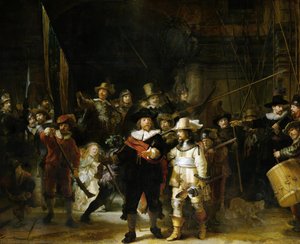
  • Die Wache (1642) – offiziell Militärkompanie des Bezirks II unter dem Kommando von Kapitän Frans Banninck Cocq: Ein dynamisches Gruppenporträt, das das Genre mit innovativer Komposition und Beleuchtung neu definierte.
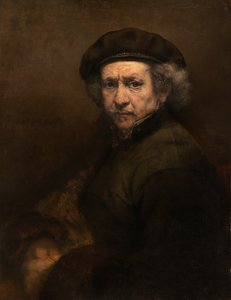
  • Selbstporträts: Ungefähr 40 Selbstporträts, die ein einzigartiges visuelles Zeugnis seines Alterns und seiner künstlerischen Vision bieten.

Einflüsse und Vermächtnis

  • Italienische Meister: Studierte Werke von Titian, Caravaggio durch Drucke und Reproduktionen.
  • Caravaggio: Die dramatische Verwendung von Licht und Schatten hatte einen tiefgreifenden Einfluss auf Rembrandts Stil.
  • Niederländische und flämische Künstler: Von zeitgenössischen Künstlern beeinflusst, die in der Holländischen Republik und Flandern wirkten.
  • Rembrandt revolutionierte das Porträtmalerei, erhob die Radierung zu einer Kunstform von Rang und erforschte tiefgründige psychologische Themen.
  • Trotz persönlicher Tragödien und finanzieller Schwierigkeiten dauerte sein Ruf an. Er gilt heute als Eckpfeiler der holländischen Kunst und als universelles Symbol des künstlerischen Genies.

Historische Bedeutung

  • Rembrandts Werk spiegelt den Geist der Holländischen Goldenen Zeit wider – wirtschaftliche Prosperität, intellektuelles Aufblühen und künstlerische Innovation.
  • Er erfasste die Essenz dieser Epoche durch Porträts, biblische Szenen, die bei den Zuschauern Anklang fanden, und die Erforschung universeller menschlicher Emotionen.
  • Seine Lebensgeschichte – geprägt von Erfolg und Widrigkeiten – hat ihn zu einer faszinierenden Figur in der Kunstgeschichte gemacht. Er bleibt ein dauerhaftes Symbol für Hingabe zum Handwerk, selbst inmitten persönlicher Herausforderungen. Rembrandts Einfluss auf nachfolgende Generationen von Künstlern ist unermesslich.
Rembrandt van Rijn

Rembrandt van Rijn

1606 - 1669 , Niederlande

Kurzinfos

  • Beeinflusste Künstler:
    • Pieter Lastman
    • Caravaggio
    • Italienische Meister
  • Bemerkenswerte Werke:
    • Anatomie-Vorlesung Dr. Tulp
    • Belshazzars Festmahl
    • Die Nachtwache
    • Selbstporträts
  • Geburtsdatum: 15. Juli 1606
  • Geburtsort: Leiden, Niederlande
  • Künstlerische Richtung: Barockmalerei
  • Nationalität: Niederländisch
  • Sterbedatum: 1669
  • Vollständiger Name: Rembrandt van Rijn
Entdecken Sie Kunstwerke, die nach Themen, Stilen und Merkmalen sortiert sind.