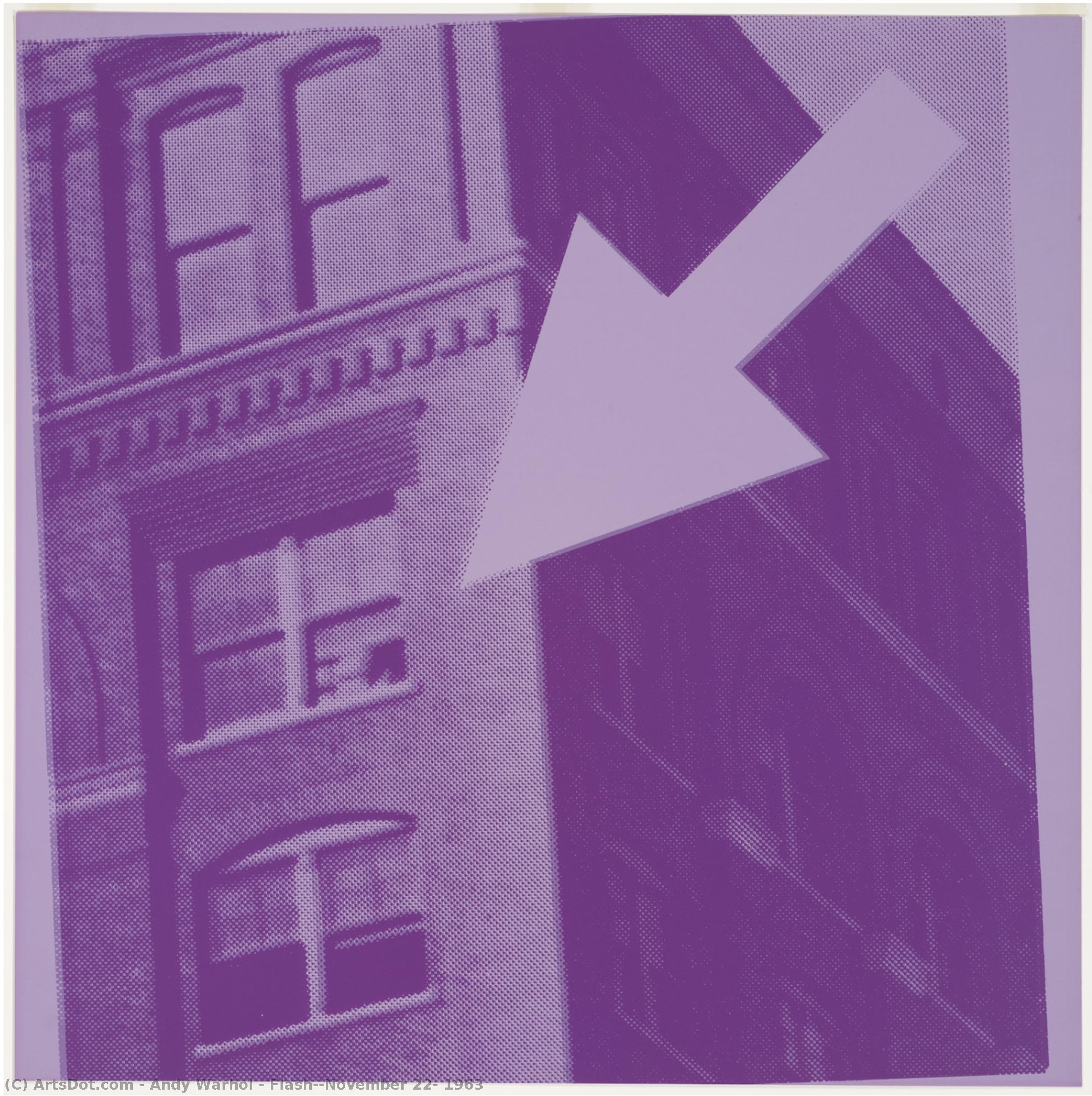
Andy Warhol’s ‘Flash—November 22, 1963’ is a striking Pop Art screenprint reflecting JFK's assassination. Explore its purple hues & disruptive arrow – iconic & unsettling.
Explore Andy Warhol's iconic Pop Art (1928-1987) – silkscreens of Marilyn, Campbell’s Soup Cans & celebrity culture. Discover his lasting impact on art.
A Moment Frozen in Time: Decoding Andy Warhol’s ‘Flash—November 22, 1963’
This striking artwork by Andy Warhol, created in 1968, is far more than a stylized architectural depiction; it's a poignant meditation on tragedy, media saturation, and the American psyche. ‘Flash—November 22, 1963’ directly confronts the national trauma of President John F. Kennedy’s assassination, transforming a horrific event into a powerful visual statement emblematic of Pop Art.
Subject & Style: The Architecture of Grief
The image presents a flattened, almost abstract facade of a building – a stark representation of urban life disrupted by sudden loss. Dominated by vertical lines and rectangular shapes reminiscent of Art Deco design, the composition is intentionally rigid, mirroring the shock and disbelief that gripped the nation. A large, white arrow aggressively pierces through this structure, acting as a disruptive force and drawing the eye upwards. This isn’t simply an architectural study; it's a symbolic representation of the abruptness and directionlessness felt in the wake of Kennedy’s death. The limited depth and simplified perspective contribute to a sense of unease and detachment.
Technique & Materials: Seriality and the Screenprint
Warhol masterfully employed the silkscreen printing technique – a hallmark of his style – to create this work. This method allowed for repetition and mechanical reproduction, reflecting the relentless media coverage that followed the assassination. The dense, dotted texture gives the image a grainy quality, evoking the flickering images broadcast on television screens across America. While appearing digitally rendered in some aspects, it’s crucial to remember Warhol's foundational use of screenprinting, layering color and form with deliberate imprecision. The monochromatic purple palette further enhances the dreamlike, unsettling atmosphere.
Historical Context: A Nation in Mourning
‘Flash—November 22, 1963’ is part of a series Warhol created responding to the Kennedy assassination. It's important to understand that this work wasn’t intended as a literal depiction of events but rather an exploration of how those events were *mediated* – experienced through newspapers, television, and radio. The “flash” in the title refers directly to the news bulletins that interrupted everyday life on November 22nd, 1963. Warhol was fascinated by the way mass media transformed personal tragedy into a public spectacle.
Symbolism & Emotional Impact: Disruption and Remembrance
The arrow is arguably the most potent symbol in this artwork. It can be interpreted as representing the suddenness of the event, the direction of national grief, or even the relentless march of time. The building itself could symbolize American stability shaken to its core. The overall effect is one of profound sadness and disorientation. While visually striking, the work avoids sentimentality, instead offering a cool, detached observation of collective trauma.
For Collectors & Designers
‘Flash—November 22, 1963’ is an iconic piece of Pop Art history, representing a pivotal moment in both American culture and artistic expression. A high-quality reproduction of this work would serve as a compelling focal point in any modern or contemporary interior. Its bold graphic style and thought-provoking subject matter make it ideal for collectors seeking pieces that are both visually arresting and intellectually stimulating. The artwork’s subdued color palette allows it to integrate seamlessly into various design schemes, adding a touch of sophisticated melancholy and historical resonance.