PreviewPreview AR previewAR preview Switch to Print Switch to PrintSwitch to Image Switch to Image SendSend
DetailsDetails Add to favorites Add to favorites DownloadDownload SimilarsSimilars X-RayX-Ray DiaporamaDiaporama

Navire dans la Tempête (Ship in the Storm), 1899

Henri Rousseau’s ‘Navire dans la Tempête,’ painted in 1899, captures the drama of a storm at sea with bold colors and simplified forms. Inspired by Théophile Poilpot's panorama and the D’Encastreux cruiser, this painting exemplifies Rousseau’s distinctive style—a blend of observation and fantastical vision.

Explore Henri Rousseau (Le Douanier), the celebrated French Post-Impressionist & Naïve artist. Discover his unique jungle scenes, dreamlike symbolism, and lasting influence on modern art. View works at BuyPopArt!

Hand Made Oil Reproduction

Hand-painted oil on canvas in your size and frame, made to order by our artists. (Switch to Print Switch to PrintSwitch to Image Switch to Image)

P118B $10
P118H $10
P118W $10
P438Z $10
P508JH $12
P508YH $12
P805H $10
P805Z $10
P919BZ $10
P919G $10
P919XJ $10
P959ZH $10
P968JZ $12
W106C $8
W218G $10
W218JH $8
W218Y $10
W307PJ $10
W316G $10
W316PJ $8
W316Y $10
W398PJ $8
W4111J $10
W500HY $15
W500JH $15
W692G $12
W849H $8
W940BG $15
W953PJ $8

Standard
custom
CM
INCH

Pick from our preset sizes that match the artwork's original proportions.

width
height

You may enter your own dimensions to fit a specific frame or space. If your selected size does not match the original image's proportions, we will either crop the artwork or extend the painting with additional hand-painted elements. A digital mockup will be sent for your approval before production begins.
Please note that the on-screen preview does not reflect the actual cropping or extension. Only the mockup will accurately show the final composition.
While custom sizes are available, we recommend selecting a dimension from the predefined list to preserve the original proportions.

Examples of what can be changed: Replace face with customer photo; Add pet (e.g., replace cat with dog); Include hidden message in background; Change background landscape or elements.
After order, BuyPopArt.com team will email client for instructions and provide a mockup preview

Worldwide Delivery () in 3/4 weeks instead of standard 5 weeks. (10 August). No compromise on quality.

why_choose_icon
Free Worldwide Express Shipping
why_choose_icon
High-Quality Linen Canvas
why_choose_icon
Full Shipping Insurance
why_choose_icon
Customs Tax Refund Guarantee
why_choose_icon
True Color Matching Guarantee
why_choose_icon
60-Day Return Policy (Defects Only)
why_choose_icon
100% Money-Back Guarantee
why_choose_icon
Bulk Discount Offer

Total Price

$ 288

reproduction

Navire dans la Tempête (Ship in the Storm), 1899

Reproduction Medium

Reproduction Size

-

Total Price

$ 288

Quick Facts

  • Year: 1899
  • Artistic style: Naive painting
  • Title: Navire dans la Tempête
  • Location: Private Collection
  • Medium: Oil on canvas
  • Movement: Impressionism
  • Artist: Henri Julien Félix Rousseau

Artwork Description

Henri Rousseau’s “Navire dans la Tempête”: A Vision of Primitive Beauty

Henri Rousseau (1844–1910), a French painter who defied academic conventions, stands as one of the most distinctive figures in Impressionism and Symbolism. Though largely self-taught, Rousseau achieved international acclaim for his fantastical jungle landscapes and marine paintings—particularly “Navire dans la Tempête” (“Ship in the Storm”), completed around 1899. This monumental canvas transcends mere depiction; it’s an immersive experience of primal emotion rendered with a breathtaking simplicity that continues to captivate audiences today.

The Inspiration Behind the Canvas

“Navire dans la Tempête” wasn't born from meticulous observation but rather from memory and imagination—specifically inspired by a panoramic painting created for the Compagnie Transatlantique during the 1889 Universal Exposition in Paris, or perhaps by the D’Encastreux cruiser. Rousseau sought to capture not just what he saw, but what he *felt*, channeling the turbulent energy of the sea into an arresting visual drama. The artist meticulously studied photographs and sketches of the seascape, transforming them into a powerfully stylized representation.

A Style Defined by Naïve Simplicity

Rousseau’s artistic approach is undeniably “naive,” characterized by flattened perspectives, simplified forms, and vibrant colors that prioritize emotional impact over scientific accuracy. Unlike Impressionists who aimed to capture fleeting moments of light, Rousseau deliberately eschewed realism, opting instead for a style reminiscent of primitive art—a deliberate rejection of academic training and convention. The brushstrokes are bold and expressive, conveying movement and texture without striving for photographic detail. This technique lends the painting an otherworldly quality, transporting viewers into a realm of dreamlike beauty.

Symbolism Within the Storm

Beyond its visual splendor, “Navire dans la Tempête” is laden with symbolic significance. The ship itself represents humanity confronting the forces of nature—a motif prevalent in Romantic art and reflecting Rousseau’s fascination with mythology and folklore. The towering waves dominate the composition, symbolizing chaos and uncertainty, yet they are rendered with a serene calmness that suggests resilience and acceptance. The dominant blues and whites evoke the vastness of the ocean and convey a sense of tranquility amidst turbulence. The red flag fluttering atop one of the sails serves as a visual anchor, highlighting the drama of the scene and hinting at danger—yet it’s balanced by the overall harmonious palette.

A Legacy of Emotional Resonance

“Navire dans la Tempête” remains profoundly moving for its ability to evoke feelings of awe and wonder. Rousseau's masterful use of color and form transcends mere representation, tapping into universal themes of courage, vulnerability, and the sublime beauty of the natural world. It’s a testament to the power of imagination and artistic vision—a reminder that true art doesn’t merely depict reality but invites us to contemplate its deeper meanings and emotional truths. Its enduring appeal speaks volumes about Rousseau's genius and his contribution to the history of modern art.

Artist Biography

Henri Julien Félix Rousseau: A Life in Art

Early Life and Background

  • Born on May 21, 1844, in Laval, France, Henri Julien Félix Rousseau led an unconventional life before becoming a renowned artist.
  • His early years were marked by modest circumstances; his father was a tinsmith, and Rousseau himself worked various jobs throughout his youth.
  • He received some formal education, showing aptitude for drawing, but ultimately pursued a career as a toll collector – earning him the nickname “Le Douanier” (the customs officer).
  • Rousseau served in the military for four years before settling into his role at the Paris octroi, collecting taxes on goods entering the city.

Artistic Development and Style

  • Rousseau was largely self-taught as an artist, beginning to paint seriously in his early forties after receiving encouragement from a friend.
  • His style is characterized by its naïve or primitive quality, marked by flat perspectives, simplified forms, and vibrant, often unrealistic colors.
  • He drew inspiration from botanical gardens, illustrated magazines, and visits to the Jardin des Plantes in Paris, rather than direct observation of nature.
  • Rousseau’s paintings often feature lush jungle scenes, exotic animals, portraits, and depictions of everyday life, all rendered with a unique sense of wonder and imagination.

Influences and Artistic Context

  • While largely self-taught, Rousseau was aware of the artistic movements of his time – Impressionism and Post-Impressionism – but developed a distinctly personal style that set him apart.
  • He admired artists like Eugène Delacroix and drew inspiration from their use of color and exotic subject matter.
  • Rousseau’s work predates and anticipates aspects of Surrealism and other early 20th-century avant-garde movements.

Major Works and Achievements

  • Some of Rousseau's most celebrated paintings include:
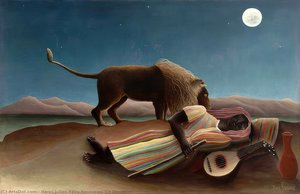
  • The Sleeping Gypsy (1897) – a dreamlike depiction of a woman asleep in a jungle setting.
  • Tiger in a Tropical Storm (Surprised!) (1891) – showcasing his dramatic use of color and composition.
  • Self-Portrait (1890) - A formal portrait showing the artist with a palette and brushes.
  • The Carnival Evening (1886) – capturing a festive scene with intricate details.
  • He exhibited regularly at the Salon des Indépendants, gaining recognition among fellow artists and gradually attracting critical attention.

Historical Significance and Legacy

  • Initially ridiculed by many critics for his unconventional style, Rousseau’s work eventually gained appreciation as a unique expression of artistic vision.
  • He became an inspiration to several prominent artists, including Pablo Picasso and other members of the avant-garde movement.
  • In 1908, Picasso famously organized “Le Banquet Rousseau,” a celebratory event honoring the artist and acknowledging his influence.
  • Rousseau’s paintings continue to captivate audiences today with their dreamlike quality, vibrant colors, and imaginative subject matter.
  • His work remains a testament to the power of self-expression and the enduring appeal of naïve art.

Death and Posthumous Recognition

  • Henri Rousseau died on September 2, 1910, in Paris.
  • His legacy continued to grow after his death, solidifying his place as a significant figure in modern art history.
  • Today, his works are displayed in major museums worldwide and continue to inspire artists and art lovers alike.

Quick Facts

  • Birth Date: April 17, 1844
  • Birth Place: Laval, France
  • Death Date: September 2, 1910
  • Influenced:
    • Vincent van Gogh
    • Paul Gauguin
  • Influenced By: Impressionist and Post-Impressionist contemporaries
  • Movement: Post-Impressionism, Naive art
  • Name: Henri Julien Félix Rousseau
  • Nationality: French
  • Notable Works:
    • Sleeping Gypsy
    • The Dream
    • Carnival Evening
    • Tiger in a Tropical Storm
    • The Toll House
Explore artworks organized by themes, styles, and characteristics.