PreviewPreview AR previewAR preview Switch to Print Switch to PrintSwitch to Image Switch to Image SendSend
DetailsDetails Add to favorites Add to favorites DownloadDownload SimilarsSimilars X-RayX-Ray DiaporamaDiaporama

Study for The Portrait of Miss Emily Sartain

A captivating portrait of a woman in a vibrant yellow dress by American Realist master Thomas Eakins captures timeless elegance and grace from 1890, inviting you to explore this exquisite piece for your collection.

Discover Thomas Eakins (1844-1916), the pivotal American realist painter renowned for unflinching portraits, dynamic rowing scenes & anatomical precision. Explore his legacy now!

Hand Made Oil Reproduction

Hand-painted oil on canvas in your size and frame, made to order by our artists. (Switch to Print Switch to PrintSwitch to Image Switch to Image)

Standard
custom
CM
INCH

Pick from our preset sizes that match the artwork's original proportions.

width
height

You may enter your own dimensions to fit a specific frame or space. If your selected size does not match the original image's proportions, we will either crop the artwork or extend the painting with additional hand-painted elements. A digital mockup will be sent for your approval before production begins.
Please note that the on-screen preview does not reflect the actual cropping or extension. Only the mockup will accurately show the final composition.
While custom sizes are available, we recommend selecting a dimension from the predefined list to preserve the original proportions.

Examples of what can be changed: Replace face with customer photo; Add pet (e.g., replace cat with dog); Include hidden message in background; Change background landscape or elements.
After order, BuyPopArt.com team will email client for instructions and provide a mockup preview

Worldwide Delivery () in 3/4 weeks instead of standard 5 weeks. (9 August). No compromise on quality.

why_choose_icon
Free Worldwide Express Shipping
why_choose_icon
High-Quality Linen Canvas
why_choose_icon
Full Shipping Insurance
why_choose_icon
Customs Tax Refund Guarantee
why_choose_icon
True Color Matching Guarantee
why_choose_icon
60-Day Return Policy (Defects Only)
why_choose_icon
100% Money-Back Guarantee
why_choose_icon
Bulk Discount Offer

Total Price

$ 288

reproduction

Study for The Portrait of Miss Emily Sartain

Reproduction Medium

Reproduction Size

-

Total Price

$ 288

Quick Facts

  • Artistic style: American Realism
  • Year: 1890
  • Subject or theme: Portrait of Miss Emily Sartain
  • Title: Study for The Portrait of Miss Emily Sartain
  • Artist: Thomas Eakins

Artwork Description

A Vision of Grace: The Soul of Emily Sartain

In the vast tapestry of American Realism, few threads are as luminous and delicately woven as Thomas Eakins’s Study for The Portrait of Miss Emily Sartain. Created in 1890, this evocative oil on canvas serves as more than a mere preparatory sketch; it is a profound meditation on character, poise, and the quiet dignity of the individual. At the heart of the composition stands Miss Emily Sartain, draped in a vibrant yellow dress that seems to capture and radiate light from within. As she stands upon a wooden floor, her hands outstretched in a gesture of openness, the viewer is immediately drawn into an intimate dialogue with her presence. Eakins, a master of capturing the psychological depth of his subjects, uses this study to explore the interplay between light and form, creating a sense of movement that suggests a moment frozen in time—a breath held, a spirit poised on the threshold of an event.

The technical brilliance of Eakins is on full display through his meticulous application of paint. Eschewing the overly polished finish of many of his contemporaries, Eakins employs a technique that honors the physical reality of his subject. The texture of the yellow fabric, the subtle shadows cast by the doorway in the background, and the grounded stability of the wooden floorboards all contribute to a sense of tangible existence. There is an anatomical honesty here that was a hallmark of his career; even in this study, one can sense the artist's dedication to the structural truth of the human figure. The backdrop, featuring the soft silhouettes of other figures, provides a narrative depth that prevents the scene from feeling isolated, instead placing Miss Sartain within a living, breathing social context.

Historical Resonance and Timeless Elegance

To behold this work is to step into the late 19th-century American experience, an era defined by a burgeoning sense of identity and a shift toward unflinching realism. Thomas Eakins, a titan of the Philadelphia art scene, brought a scientific rigor to his portraiture that challenged the romanticized conventions of his day. In this study, we see the intersection of high society and artistic truth. The attire of Miss Sartain suggests an occasion of significance, perhaps a gala or a formal gathering, yet Eak_ins strips away the superficiality of the era to reveal the person beneath the finery. This tension between the decorative and the real is what gives the painting its enduring emotional impact.

For the discerning collector or the interior designer, this piece offers an unparalleled opportunity to introduce a sense of historical gravity and sophisticated warmth into a space. The radiant yellow of the subject's gown acts as a focal point of energy, while the muted, earthy tones of the setting provide a grounding stability. Whether displayed in a sunlit gallery or a curated private study, a high-quality reproduction of this masterpiece brings with it the prestige of American art history. It is an invitation to contemplate the elegance of the past and to surround oneself with a work that celebrates the enduring beauty of the human spirit.


Artist Biography

A Life Devoted to Reality

Thomas Cowperthwait Eakins, born in Philadelphia on July 25, 1844, stands as a monumental figure in American art—a painter of unflinching realism who dedicated his life to capturing the essence of human experience. He wasn’t merely interested in *representing* the world; he sought to dissect it, understand its anatomy, both physical and psychological, and then reconstruct it on canvas with an honesty that often bordered on provocation. Eakins's path was not one of immediate acclaim, but rather a slow burn of dedication, controversy, and ultimately, enduring recognition as perhaps the most profound realist in 19th and early 20th-century American art. His Philadelphia wasn’t a city of grand landscapes or romantic ideals; it was a world of doctors, rowers, hunters, and everyday individuals—and these were his subjects, rendered with an almost scientific precision.

Early Influences and Artistic Formation

Eakins's upbringing fostered both intellectual curiosity and artistic inclination. His father, Benjamin Eakins, a writing master and calligrapher, instilled in him a love of discipline and meticulous observation. This foundation was further strengthened by his education at Central High School and the Pennsylvania Academy of the Fine Arts, where he excelled in drawing and anatomy—a fascination that would permeate his entire oeuvre. However, it was his time in Europe, particularly under the tutelage of Jean-Léon Gérôme in Paris, that truly shaped his artistic approach. Gérôme’s emphasis on precise draftsmanship and historical accuracy resonated with Eakins's own inclinations, but he quickly moved beyond mere imitation. A sojourn in Spain further refined his understanding of light, shadow, and the power of direct observation. He wasn’t content to simply copy Old Masters; he wanted to understand *how* they achieved their effects, and then apply that knowledge to his own unique vision. This period was crucial in solidifying his commitment to painting directly from life, a practice that would define his career.

The Pursuit of Truth: Themes and Techniques

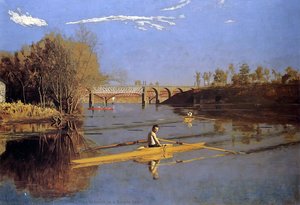
Eakins’s work is characterized by an unwavering commitment to realism—a refusal to idealize or romanticize his subjects. His portraits, numbering several hundred, are not flattering representations designed to appease the sitter; they are penetrating studies of character, revealing both strength and vulnerability. He painted individuals engaged in their professions – surgeons at work in *The Gross Clinic*, rowers straining against the current in *Max Schmitt in a Single Scull*—capturing not just their physical appearance but also the intensity of their focus and the demands of their craft. This dedication to truth extended to his technique. Eakins was fascinated by motion, and he employed innovative methods to capture it accurately. He studied anatomy meticulously, often dissecting cadavers to understand the underlying structure of the human body. He even experimented with photography, using it as a tool for analyzing movement and achieving greater accuracy in his paintings. His use of chiaroscuro—the dramatic contrast between light and dark—further enhanced the sense of realism and psychological depth in his work.

Controversy and Legacy

Despite his artistic brilliance, Eakins’s career was marked by controversy. His insistence on painting directly from life, often including nude models, clashed with the conservative sensibilities of Victorian Philadelphia. His teaching methods at the Pennsylvania Academy were equally unconventional; he emphasized the importance of studying the human form from life and encouraged his students to challenge traditional artistic conventions. This led to friction with his colleagues and ultimately resulted in his forced resignation in 1886. Personal scandals further damaged his reputation during his lifetime, leaving him largely ostracized by the art establishment. However, Eakins remained undeterred, continuing to paint and teach privately until his health began to fail. After his death in 1916, his work gradually gained recognition, and he is now celebrated as a pivotal figure in American art history. His unflinching realism, his dedication to anatomical accuracy, and his profound understanding of the human condition continue to inspire artists and captivate audiences today. He left behind not just paintings, but a legacy of artistic integrity and a relentless pursuit of truth—a testament to the power of observation and the enduring beauty of the human form.

Key Works and Enduring Influence

Several works stand as hallmarks of Eakins’s genius. *Max Schmitt in a Single Scull* (1871), with its masterful depiction of movement and light, is arguably his most iconic painting. *The Gross Clinic* (1875)*, though controversial at the time for its unflinching portrayal of surgery, remains a powerful testament to the dedication and skill of medical professionals. *William Rush and His Model* (1908) showcases his later style, blending portraiture with allegorical elements. Beyond these specific paintings, Eakins’s influence can be seen in the work of countless artists who followed him—those who sought to capture the world around them with honesty, precision, and a deep understanding of the human spirit. His commitment to realism paved the way for later movements such as Ashcan School and continues to resonate with contemporary artists today. He remains a vital force in American art, a reminder that true artistry lies not in imitation or embellishment, but in the courageous pursuit of truth.
Thomas Eakins

Thomas Eakins

1844 - 1916 , United States of America

Quick Facts

  • Artistic Movement Or Style: Realism
  • Artists Or Movements Influenced By This Artist: ['American Realism']
  • Artists Who Influenced This Artist: ['Jean-Léon Gérôme']
  • Date Of Birth: July 25, 1844
  • Date Of Death: June 25, 1916
  • Full Name: Thomas Eakins
  • Nationality: American
  • Notable Artworks:
    • Max Schmitt in a Single Scull
    • The Gross Clinic
    • The Swimming Hole
    • The Agnew Clinic
  • Place Of Birth: Philadelphia, USA
Explore artworks organized by themes, styles, and characteristics.