The Spectrum of Abstraction: Understanding the Visual Language
To enter the world of abstract art is to embark on a journey where the familiar boundaries of representation dissolve, leaving behind a pure, visceral dialogue between the viewer and the canvas. Unlike representational art, which seeks to mirror the physical world through recognizable forms, abstraction speaks in a language of rhythm, weight, and chromatic tension. For the discerning collector, understanding this spectrum is not merely an academic exercise but a way to decode the emotional frequencies embedded within a work. It begins with the realization that every line, every smudge of pigment, and every void of negative space carries intentionality. The beauty of this visual language lies in its ambiguity, allowing for a profound personal resonance that changes with the light of day or the mood of the observer. One might find themselves drawn to the structural integrity of geometric abstraction, where balance and proportion evoke a sense of cosmic order, or perhaps captivated by the organic fluidity of shapes that seem to pulse with life. As we navigate this landscape, we move from the structured logic of form to the raw, unbridably emotive power of color and texture, discovering that abstraction is not an absence of meaning, but rather an invitation to find meaning within the essence of perception itself.Minimalist Serenity: The Power of Color Field and Reductionism
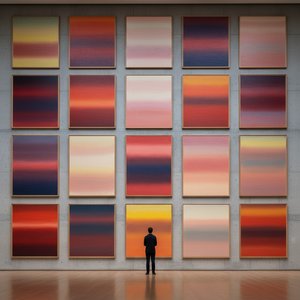
There exists a profound, almost meditative stillness found in the most reductive forms of abstraction. This is the realm of Color Field painting, a movement that stripped away the frantic energy of the brushstroke to focus on the overwhelming presence of color itself. In these works, the canvas becomes an environment rather than a window. When observing a masterpiece like Barnett Newman’s Be I, one does not simply look at the painting; one experiences the weight of its chromatic depth. The use of large, uninterrupted planes of color creates a sense of infinite space, inviting the collector into a state of contemplative quietude. This minimalist approach relies heavily on the subtle interplay of edges and the subtle vibration of adjacent hues. It is a sophisticated form of reductionism where the removal of detail serves to amplify the spiritual or psychological impact of the work. The mastery lies in the artist's ability to command attention through restraint, using scale and saturation to envelop the viewer. For an interior defined by modern elegance, such pieces act as anchors of calm, providing a sophisticated backdrop that breathes life into a room without demanding it. It is art that does not shout, but rather humponders, exerting a quiet, undeniable authority over the space it inhabits.Dynamic Energy: Navigating Gestural Abstraction and Expressive Chaos
In stark contrast to the stillness of minimalism lies the exhilarating turbulence of gestural abstraction. Here, the artist’s physical movement is recorded permanently upon the canvas—a dance of impulse, energy, and controlled chaos. This style, often associated with Abstract Expressionism, celebrates the "action" of painting. One can trace the trajectory of a sweep of paint or the violent splatter of a drip, feeling the raw emotion of the moment of creation. Works such as those by Willem Joseph Laquy or the vibrant, rhythmic compositions of Gene Davis demonstrate how color and motion can coalesce into a powerful, kinetic experience. To collect in this vein is to embrace the unpredictable. The texture often becomes as vital as the color; the impasto technique, where paint is applied thickly, creates a topographical landscape of ridges and valleys that catch the light and cast miniature shadows. This expressive chaos is not without its discipline; even in the most frenetic compositions, there is an underlying structural tension that prevents the work from collapsing into mere noise. For the collector, these pieces offer a sense of vitality and drama, injecting a pulse of human passion and unbridled creativity into even the most curated environments.Curating the Collection: Matching Abstract Styles to Architectural Spaces
The integration of abstract art into an architectural setting requires a sophisticated understanding of scale, light, and spatial flow. A large-scale, minimalist Color Field painting can transform a vast, high-ceilinged hall into a sanctuary of focus, acting as a singular, monumental focal point that directs the eye and settles the spirit. Conversely, a series of smaller, more energetic gestural works can be utilized to create a rhythmic progression along a corridor or staircase, guiding movement through a home with visual cadence. One must also consider the "multi-panel" trend, where a single composition is split across three, four, or even five panels. This technique is particularly effective for wide architectural expanses, allowing the artwork to become an integral part of the wall itself, blurring the line between decoration and structure. When selecting pieces, the collector must weigh the visual weight of the work against the surrounding textures—the smoothness of marble, the warmth of wood, or the industrial edge of concrete. The goal is a harmonious dialogue where the art does not merely hang upon the wall but actively participates in the definition of the space.The Collector's Eye: Evaluating Texture, Composition, and Emotional Resonance
Ultimately, the true measure of an abstract work lies in its ability to evoke a lasting emotional resonance. For the serious collector, evaluation transcends the superficial; it involves a deep dive into the technical execution and the tactile quality of the medium. One looks for the "soul" of the piece—the visible evidence of the artist's hand, whether through delicate glazes that create luminosity or heavy, sculptural brushstrokes that provide physical depth. The interplay of light across these textures is what distinguishes a true masterpiece from a mere reproduction. As you build your collection, seek works that challenge and reward your gaze. Consider how the composition directs your eye—does it lead you into a central void, or does it push your vision toward the edges of the frame? Does the color palette harmonize with your existing aesthetic, or does it provide a necessary, sophisticated tension? Collecting abstract art is an intimate process of self-discovery. It is about finding those rare pieces that mirror your own internal complexities, providing a permanent, tangible connection to the infinite possibilities of human expression.About BuyPopArt.com
BuyPopArt.com is a global leader in fine art accessibility, specializing in high-quality, hand-painted reproductions and custom commissions. Since 2004, we have bridged the gap between historical mastery and modern collectors, offering everything from museum-grade oil paintings to bespoke "period shifts" where personal memories are transformed into classical masterpieces. With a curated network of academy-trained artists and a commitment to 100% satisfaction, we ensure that every brushstroke serves to elevate your space and your collection.