

Introduction
Imagine stepping into a world bathed in the warm embrace of 'Chrome Yellow' – a hue that has captivated artists and viewers alike for centuries. It’s a color brimming with life, optimism, and a touch of the divine. From the sun-drenched fields of Van Gogh to the intimate interiors of Vermeer, this pigment has held a unique power, capable of evoking joy, contemplation, and even a hint of melancholy.
The story of 'Chrome Yellow' itself is fascinating. Discovered in 1809 by Louis Nicolas Vauquelin, it was one of the first synthetic pigments, offering artists a brighter, more stable yellow than those previously available – derived from natural sources like ochre and saffron which often faded or shifted over time. Its arrival coincided with a period of immense artistic change: the rise of Romanticism, the burgeoning Impressionist movement, and a growing fascination with light and color as subjects in their own right.
But 'Chrome Yellow' is more than just a technical innovation; it’s a cultural touchstone. It speaks to our enduring connection with sunlight, warmth, and vitality. These paintings aren’t simply beautiful objects; they are windows into the minds of masters who sought to capture the essence of human experience – love, loss, beauty, and the fleeting nature of time.
In the following list, we'll explore ten iconic artworks where 'Chrome Yellow' takes center stage. Prepare to be transported through centuries of artistic brilliance, as we uncover the stories behind these masterpieces and delve into the enduring legacy of this remarkable color. Each painting offers a unique perspective on the power of yellow, inviting us to see the world anew.
Modular Painting with Four Panels -1 - Roy Lichtenstein
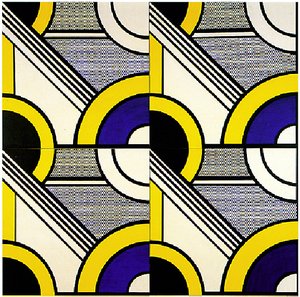 Modular Painting with Four Panels -1 - Roy Lichtenstein
Imagine standing before a quartet of canvases, each pulsing with an internal rhythm – Roy Lichtenstein’s ‘Modular Painting with Four Panels -1’. Created in 1969, this work isn't about *what* is depicted, but rather the very language of depiction itself. A commanding blue anchors the composition, acting as both a unifying force and a space for dynamic interplay.
What truly captivates are the energetic bursts of 'Chrome Yellow' circles that punctuate each panel. They aren’t haphazardly placed; they’re meticulously arranged to explore balance, repetition, and the power of simple forms. One panel features a bold blue circle embraced by varying sizes of yellow orbs, while others showcase larger central shapes similarly surrounded, creating a visual echo.
Lichtenstein strips away narrative, leaving us with pure color and geometry. This is Pop Art distilled – an investigation into the building blocks of imagery that once defined his iconic comic strip paintings. The absence of Ben-Day dots isn’t a regression, but a deliberate evolution, focusing instead on shape, color, and composition. The smooth surfaces achieved through oil and magna paint invite close contemplation, revealing a precision that belies its seemingly simple aesthetic.
‘Modular Painting with Four Panels -1’ offers more than just visual appeal; it's an invitation to consider the fundamental principles of design. Imagine this piece gracing a modern living space – its bold colors and clean lines injecting energy and sophistication, sparking conversation and inspiring a renewed appreciation for the art of seeing.
Composition with Yellow and Blue - Piet Mondrian
 Composition with Yellow and Blue - Piet Mondrian
Imagine a world distilled to its purest essence – a realm of perfect balance and harmonious tension. This is the experience offered by Piet Mondrian’s *Composition with Yellow and Blue*. Emerging from the early days of abstract art, this painting isn't simply an image; it’s a philosophical exploration rendered in color and line.
Mondrian sought to transcend representation, believing that true art could reveal underlying universal truths. He stripped away the complexities of the natural world, arriving at a rigorously controlled vocabulary of black lines, rectangular planes of primary colors – most notably the vibrant 'Chrome Yellow' and deep blue – and expanses of white. These aren’t random choices; they represent opposing forces brought into equilibrium.
The black grid acts as a structural framework, containing and defining the energetic interplay of hues. The yellow, in particular, radiates warmth and activity, balanced by the coolness of the blue. This dynamic tension creates a sense of visual harmony that feels both intellectually precise and emotionally resonant. It’s a testament to Mondrian's belief in Neoplasticism – a “New Plastic Art” focused on essential forms.
‘Composition with Yellow and Blue’ remains profoundly influential today, shaping modern design and inspiring a sense of calm clarity. Imagine this piece gracing a contemporary space – its bold simplicity injecting energy and sophistication, reminding us that beauty can be found in the most fundamental elements of existence.
July - Gerhard Richter
 July - Gerhard Richter
To stand before Gerhard Richter’s “July” is to encounter a memory – not sharply defined, but felt as an echo of warmth and light. Created in 1983, this large-scale abstract painting isn't about depicting a specific place or event; it’s about capturing the *sensation* of summer itself.
Richter masterfully layers color and texture across the canvas, creating a dynamic composition anchored by a vertical element – a suggestion of a pole or stick. Hints of foliage, avian life, even figures emerge from the swirling paint, evoking a waterscape without ever fully resolving into representation. A vibrant 'Chrome Yellow' plays a crucial role in this interplay, radiating warmth and energy amidst the more subdued tones.
Richter’s technique is as compelling as the image itself. Employing squeegees to drag and manipulate layers of paint, he creates surfaces that are both chaotic and controlled – a visual metaphor for the complexities of memory and perception. This isn't about precision; it’s about exploring the inherent instability of representation.
“July” earns its place among the Top 10 not simply for its aesthetic beauty, but for its philosophical depth. It invites us to contemplate the nature of reality itself – how we perceive and remember the world around us. Imagine this piece gracing a modern space – its layered complexity sparking conversation and inspiring a sense of contemplative calm.
Laughing cat - Roy Lichtenstein
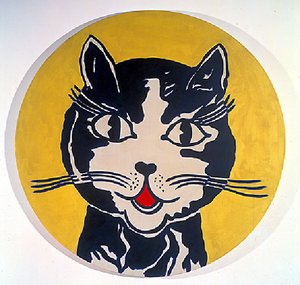 Laughing cat - Roy Lichtenstein
A playful grin frozen in time – Roy Lichtenstein’s 1961 “Laughing Cat” radiates a simple joy that belies its profound impact on the art world. This early work, often overshadowed by his later masterpieces, is where the seeds of Pop Art truly began to blossom.
Set against a vibrant 'Chrome Yellow' background, the black cat isn’t a naturalistic depiction but rather an echo of mass-produced imagery – lifted from children’s books or vintage advertisements. Its bold outlines and flat planes of color feel deliberately artificial, challenging traditional notions of artistic skill.
While predating his signature Ben-Day dots, “Laughing Cat” demonstrates Lichtenstein's growing fascination with mechanical reproduction. He wasn’t simply copying images; he was meticulously recreating the *look* of commercial printing – the slightly imperfect registration, the simplified forms. This approach questioned what constituted “high art” in a society saturated with visual stimuli.
“Laughing Cat” is more than just a charming image; it’s a pivotal moment in artistic history. Imagine this piece gracing a modern living space – its bold simplicity and playful energy injecting warmth and sophistication, reminding us that beauty can be found in the everyday.
Sponge - Roy Lichtenstein
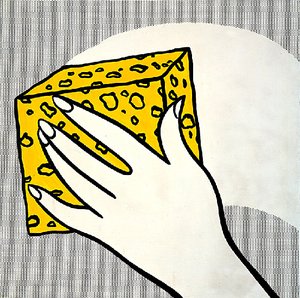 Sponge - Roy Lichtenstein
A moment suspended – a hand poised above a vibrant yellow square, playfully blurring the line between cheese and cake. Roy Lichtenstein’s 1962 “Sponge” isn't about the object itself; it’s about elevating the everyday to the realm of artistic contemplation.
This deceptively simple painting embodies the spirit of Pop Art, challenging traditional hierarchies and embracing the imagery of mass culture. The stark contrast of the checkered black-and-white background – reminiscent of newspaper print – further emphasizes the object’s presence, while subtle textural variations hint at Lichtenstein's meticulous technique.
Though not as overtly showcasing his signature Ben-Day dots, “Sponge” is undeniably characteristic of his style. He deliberately flattened form and eliminated painterly brushstrokes, mirroring the impersonal aesthetic of commercial production. This wasn’t simply replication; it was a critical examination of visual language.
“Sponge” earns its place among the Top 10 for redefining beauty in unexpected places. At WikiOO, we believe art should be accessible – transforming spaces and inspiring conversation. Imagine this piece gracing your home, injecting a playful energy and reminding us that even the simplest moments can hold profound artistic value.
Mujer acostada - Pablo Picasso
 Mujer acostada - Pablo Picasso
A world fractured and reassembled – Pablo Picasso’s *Mujer Acostada* (Woman Lying Down) isn't simply a portrait, but an exploration of perception itself. Painted in 1932, this oil on canvas invites us into a realm where form dissolves and reforms, mirroring the complexities of human experience.
The painting immediately commands attention with its muted palette – predominantly blues and browns – creating an atmosphere of quiet contemplation. Picasso masterfully employs geometric shapes to dismantle the figure, presenting her not as a unified whole but as interlocking planes. While subtle, hints of 'Chrome Yellow' appear in the composition, adding warmth and depth.
This is analytical cubism at its finest – a deliberate distortion of perspective that challenges our traditional understanding of space and representation. The fragmented background elements—a chair, table, bowls—contribute to the overall sense of disorientation, forcing us to actively reconstruct the image in our minds.
*Mujer Acostada* earns its place among the Top 10 for redefining beauty through fragmentation. Imagine this piece gracing a modern space – its complex composition sparking conversation and inspiring a renewed appreciation for the power of abstract thought.
.Friso Beethoven. Alegría, inspiración divina (detalle), 1902 (17) - Gustav Klimt
 .Friso Beethoven. Alegría, inspiración divina (detalle), 1902 (17) - Gustav Klimt
Imagine a world shimmering with gold, infused with divine inspiration – Gustav Klimt’s *Friso Beethoven. Alegría, inspiración divina (detalle), 1902* is more than just a painting; it's a symphony rendered in color and symbolism.
Commissioned for the Fourteenth Vienna Secession exhibition, this monumental panel embodies Klimt’s artistic vision and enduring legacy. The work draws heavily from Beethoven’s Ninth Symphony, specifically its triumphant finale—a deliberate choice to express themes of joy and transcendence. Hints of 'Chrome Yellow' subtly illuminate the composition, adding warmth and depth to the opulent gold leaf.
Klimt’s signature style is instantly recognizable through his meticulous application of gold, creating shimmering surfaces that dominate the scene. This isn’t merely decoration; it reflects a fascination with Byzantine mosaics and Japanese art, highlighting Klimt's mastery of ornamentation. The central panel depicts a female figure embodying joy, surrounded by putti symbolizing divine inspiration.
“Friso Beethoven” earns its place among the Top 10 for its innovative use of color and symbolism. Imagine this piece gracing a modern space – its radiant beauty inspiring contemplation and reminding us of the transformative power of art.
Picnic 7 - Pablo Picasso
 Picnic 7 - Pablo Picasso
A picnic amongst shadows – Pablo Picasso’s “Picnic 7” isn't a simple depiction of an outdoor gathering, but a carefully constructed meditation on fleeting joy and the encroaching darkness. Painted in 1961, it reflects a period of personal loss for Picasso, transforming a seemingly idyllic scene into something profoundly unsettling.
The painting’s immediate impact lies in its audacious color palette: a riot of reds, yellows – including vibrant 'Chrome Yellow' – and blues clashes with muted greens and browns. This deliberate discord reflects Picasso’s signature Cubist approach, fracturing forms and presenting multiple perspectives within a single frame.
While rooted in Cubism, “Picnic 7” leans more heavily into expressive abstraction. The figures are distorted and simplified, dissolving into planes that echo the surrounding landscape. This blurring of boundaries between subject and environment invites us to actively participate in constructing meaning.
“Picnic 7” earns its place among the Top 10 for its emotional resonance and innovative use of color. Imagine this piece gracing a modern space – its dynamic composition sparking conversation and reminding us that beauty can coexist with unease, reflecting the complexities of life itself.
Girl's Back, 1926 - Salvador Dalí
 Girl's Back, 1926 - Salvador Dalí
A back turned, a gaze averted – Salvador Dalí’s “Girl’s Back,” painted in 1926, isn't simply an image; it’s an invitation into the labyrinthine corridors of the subconscious. This arresting black and white oil on wood panel embodies the core tenets of Surrealism while hinting at the artist’s deeply personal anxieties.
The painting immediately draws the viewer in with its stark simplicity – a woman's back, radiating an undeniable presence. It’s a deliberate choice that forces us to project our own interpretations onto the scene, transforming it into a mirror reflecting our desires and uncertainties. Subtle hints of 'Chrome Yellow' appear in the shadows, adding depth and intrigue.
Dalí’s early work was heavily influenced by personal trauma, permeating his art with themes of duality and loss. This painting can be viewed as an exploration of this fractured self – the woman’s back representing a hidden aspect, her averted gaze suggesting a deliberate refusal to fully reveal herself.
“Girl’s Back” earns its place among the Top 10 for its unsettling beauty and enduring mystery. At WikiOO, we believe in making such masterpieces accessible – preserving the emotion and texture of the original so you can invite this enigmatic presence into your own home.
Sorcery - Salvador Dalí
 Sorcery - Salvador Dalí
Unveiling “Sorcery,” a painting that doesn’t simply depict a scene but invites you to descend into the captivating realm of Salvador Dalí’s subconscious. Executed in 1957, this artwork transcends representation, presenting a meticulously constructed landscape of anxieties and symbolic resonance.
Dalí’s mastery is evident in his unwavering commitment to capturing the fluidity of dreams—a pursuit he termed “paranoiac-critical method.” Notice how he utilizes a muted palette dominated by earthy tones – browns, ochres, and creams – creating a sense of desolate grandeur. Subtle hints of 'Chrome Yellow' illuminate key elements, adding depth and intrigue.
The decaying banana peel—a motif frequently revisited by Dalí—represents vulnerability and the disintegration of rational thought. Juxtaposed against this are fractured clocks, symbolizing time’s subjective experience. A solitary figure echoes Michelangelo’s Adam, representing humanity's yearning for transcendence.
“Sorcery” earns its place among the Top 10 for its innovative use of symbolism and emotional intelligence. Imagine this piece gracing a modern space – its dreamlike quality sparking conversation and reminding us of the power of art to unlock hidden depths within ourselves.
Conclusion
As the last echoes of these ten masterpieces—each bathed in the golden light of 'Chrome Yellow'—linger in our minds, we’re reminded that art is not merely a relic of the past. These paintings are living presences, continuing to move hearts, shape interiors, and ignite creativity across generations.
They speak to universal human experiences – joy and sorrow, love and loss, the search for meaning in a chaotic world—and their enduring power lies in their ability to transcend time and culture. To gaze upon Van Gogh’s sunflowers or Dalí's surreal landscapes is to connect with something deeply personal, a shared thread of emotion woven through the fabric of humanity.
At WikiOO.org , we believe that everyone deserves to experience this connection firsthand. Our skilled artists meticulously recreate these iconic works—not as mere copies, but as reborn expressions of their original soul and detail. Each hand-painted reproduction is a testament to the enduring legacy of these masters, bringing their vision into your home with unparalleled authenticity.
Explore our full collection and discover the artwork that speaks to you. Let these timeless treasures illuminate your space and inspire a deeper appreciation for the beauty and power of art—a journey we are honored to share with you.