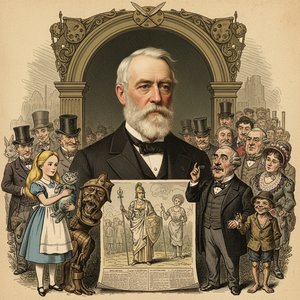
Introduction: The Rise of Victorian Satire & John Leech’s Pioneering Role
Satire is a genre of the visual, literary, and performing arts, usually in the form of fiction and less frequently non-fiction, in which vices, follies, abuses, and shortcomings are held up to ridicule, often with the intent of exposing or shaming t...
The mid-19th century witnessed a burgeoning appetite for social critique, fueled by rapid industrialization, stark class divisions, and the perceived inadequacies of established institutions. This era gave rise to a particularly potent form of visual commentary: satire. At its forefront stood John Leech (1817-1864), an artist whose name became synonymous with witty observation, biting irony, and remarkably detailed depictions of Victorian life. More than simply a caricaturist, Leech was a social historian wielding a pen and brush, capturing the anxieties, hypocrisies, and absurdities of his time with unparalleled skill. His work wasn’t merely about making people laugh; it was about prompting reflection, challenging norms, and ultimately, advocating for change – often subtly veiled within layers of artistic complexity.
Leech's Early Life & Artistic Development: From Rural Beginnings to Punch Magazine
Born in London in 1817, Leech’s path to becoming a celebrated artist wasn’t paved with privilege. His early life was marked by modest circumstances and a burgeoning talent for drawing, nurtured through informal lessons and self-study. He initially pursued a career as a medical student, but his artistic inclinations proved too strong, leading him to abandon medicine in favor of illustration. This decision proved pivotal. Leech quickly found work contributing to various periodicals, honing his skills in wood engraving and developing a distinctive style characterized by meticulous detail and expressive characterizations. The true turning point arrived in 1841 when he joined the staff of Punch, the newly established humorous magazine that would become his primary platform for over two decades. Punch provided Leech with an unprecedented outlet for his satirical talents, and a receptive audience eager for commentary on contemporary events.
Punch and Political Commentary: A Platform for Social Critique Through Caricature
 Caricature Of The Mulready Envelope
Explore John Leech’s satirical ‘Caricature of the Mulready Envelope’! A complex print showcasing political commentary & Victorian artistry. Discover its unique style & historical significance.
Punch magazine wasn’t simply a collection of jokes; it was a carefully curated space for social and political discourse. Under the editorship of Mark Lemon, the publication adopted a broadly liberal stance, advocating for reform while maintaining a distinctly middle-class perspective. Leech's cartoons were central to this mission. He masterfully employed caricature – exaggerating physical features and personality traits – not merely to ridicule individuals but to expose underlying flaws in systems and institutions. His depictions of politicians, lawyers, and members of the aristocracy often revealed their self-importance, greed, or incompetence. Consider his ‘Caricature of the Mulready Envelope’ (1840), a scathing indictment of Sir Rowland Hill's postal reforms and the perceived artistic failings of William Mulready’s envelope design. The print isn’t just funny; it’s a complex commentary on bureaucratic inefficiency, public taste, and the challenges of implementing large-scale social change. Leech understood that effective satire wasn’t about crude mockery but about insightful observation and nuanced storytelling.
Key Themes in Leech’s Work: Class, Poverty, and the Bureaucracy of Victorian England
 Appius Claudius Punished By The People
John Leech’s ‘Appius Claudius Punished’ captures a chaotic Roman riot in an etching print. Explore this satirical Victorian artwork's dynamic composition & symbolic details.
While Leech frequently tackled specific political events, his work was consistently underpinned by broader themes of class inequality, poverty, and the often-impersonal nature of Victorian bureaucracy. He possessed a remarkable ability to depict the hardships faced by the working classes with both empathy and critical awareness. His illustrations for Dickens’s A Christmas Carol (1843) are perhaps his most famous examples of this sensitivity, vividly portraying the plight of Tiny Tim and the transformative power of compassion. However, Leech's social commentary extended beyond individual stories of hardship. He frequently satirized the legal system, exposing its complexities and inherent biases. Works like ‘Appius Claudius Punished by the People’ (1846) – a reimagining of a Roman historical event – served as allegories for contemporary political corruption and the abuse of power. Even his depictions of seemingly innocuous social gatherings often contained subtle critiques of Victorian manners and pretensions. The artist's skill lay in embedding these messages within visually engaging compositions, making them accessible to a wide audience.
Beyond Politics: Leech's Illustrations for Dickens & His Broader Artistic Range
Although inextricably linked with Punch, John Leech’s artistic talents extended far beyond the realm of political caricature. His collaboration with Charles Dickens was particularly fruitful, resulting in iconic illustrations for novels such as A Christmas Carol, Martin Chuzzlewit, and Bleak House. These illustrations weren't simply decorative additions; they were integral to the storytelling process, shaping readers’ perceptions of characters and settings. Leech’s ability to capture atmosphere and emotion was exceptional, bringing Dickens’s vivid prose to life with remarkable detail and sensitivity. Beyond his work with Dickens, he also produced a wealth of independent illustrations, often depicting rural scenes and sporting events. These works reveal a different side of Leech – one that appreciated the beauty of the English countryside and celebrated the simple pleasures of everyday life. His engraving ‘His Excellency Q. Fabius Offering Peace Or War’ (1847) demonstrates his mastery of detailed linework and dramatic composition, even when tackling historical subjects.
Leech’s Legacy & Enduring Influence on Modern Satire and Illustration
John Leech died prematurely in 1864 at the age of 47, leaving behind a vast body of work that continues to resonate today. His influence on subsequent generations of cartoonists and illustrators is undeniable. He established many of the conventions of political caricature – the use of exaggeration, symbolism, and irony – that remain central to the genre. His ability to blend humor with social commentary paved the way for artists like George Cruikshank and David Low. More broadly, Leech’s work serves as a powerful reminder of the importance of visual satire in challenging authority and promoting social change. His illustrations offer invaluable insights into the complexities of Victorian society, capturing its anxieties, hypocrisies, and aspirations with remarkable clarity and wit. At BuyPopArt.com, we are proud to offer high-quality reproductions of Leech’s iconic works, allowing you to experience firsthand the brilliance of this pioneering artist and his enduring legacy. Explore our collection today and discover the satirical visions that continue to captivate and inspire.