Early Life & Influences: From Abstraction to the British Landscape
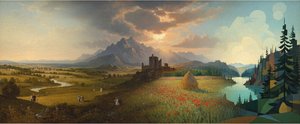
Landscape painting, also known as landscape art, is the depiction in painting of natural scenery such as mountains, valleys, rivers, trees, and forests, especially where the main subject is a wide view—with its elements arranged into a coherent compo...
John Piper’s artistic journey was one of fascinating evolution, a departure from early experiments with abstract forms towards an intensely personal and profoundly British vision. Born in 1903, his initial forays into art were marked by a fascination with Cubism and other avant-garde movements flourishing on the continent. However, this engagement proved fleeting. A pivotal moment arrived during the 1930s when Piper began to explore the landscapes of Britain – not as mere topographical representations, but as repositories of history, memory, and spiritual resonance. This shift wasn’t a rejection of modernism entirely; rather, it was a re-channeling of its principles through the lens of his own cultural heritage. He sought to capture the essence of England, its ancient sites, its weathered churches, and its rolling countryside, imbuing these subjects with a unique emotional weight. The influence of Paul Nash, another key figure in British modernism, is palpable in Piper’s early landscapes – a shared interest in myth, symbolism, and the power of place.
The Spiritual Core: Piper’s Response to Place and Faith
 Beach and Star Fish, Seven Sisters Cliff, Eastbourne
John Piper’s ‘Beach & Star Fish’ captures rugged Eastbourne coastline with vibrant expressionism. A dynamic landscape painting of a lighthouse & sea, evoking wildness & resilience.
Central to understanding Piper's work is his deep-seated spiritual sensibility. He wasn’t a conventionally religious artist, yet his paintings are imbued with a reverence for the sacred – not necessarily in a doctrinal sense, but in a broader appreciation of the enduring power of belief and tradition. This manifested most powerfully in his depictions of churches, particularly those threatened or damaged during World War II. He saw these structures as more than just architectural monuments; they were embodiments of community, history, and national identity. His paintings weren’t simply records of buildings, but elegies for a way of life, testaments to the resilience of the human spirit in the face of adversity. The thick impasto he employed, often building up layers of paint to create almost sculptural surfaces, can be interpreted as a visual metaphor for the accumulated weight of history and faith embedded within these ancient walls. Consider ‘Park Place’, with its brooding atmosphere and expressive brushwork – it’s not merely a landscape; it's an evocation of a specific place steeped in time and memory.
Wartime Witness: Documenting Britain's Resilience Through Art
The outbreak of World War II proved to be a defining moment for Piper. Commissioned as an official war artist, he turned his attention to documenting the impact of the conflict on the British landscape. Unlike many war artists who focused on scenes of battle or heroism, Piper chose to depict the aftermath – the bombed-out streets, the ruined churches, and the scars left upon the land. This wasn’t a glorification of war; it was a poignant and often unsettling portrayal of its destructive consequences. His paintings from this period are characterized by a stark realism tempered by his characteristic expressive style. He didn't shy away from depicting the devastation, but he also sought to find beauty even in the ruins – a testament to the enduring spirit of the British people. The series of watercolors documenting Coventry Cathedral before and after its destruction became particularly iconic, capturing both the tragedy of loss and the hope for eventual rebuilding.
Coventry Cathedral: A Monumental Expression of Hope and Renewal
Piper’s work on Coventry Cathedral transcends mere documentation; it is arguably his most significant artistic achievement. The cathedral, a symbol of faith and community, was almost completely destroyed during the Blitz in 1940. Piper's paintings captured the haunting beauty of the ruins, but more importantly, they documented the process of rebuilding – a powerful metaphor for national recovery. He wasn’t simply recording the physical structure; he was capturing the emotional weight of loss and the unwavering determination to rebuild. His designs for the new stained-glass window in the cathedral, completed in 1962, are particularly noteworthy. These vibrant, abstract compositions, inspired by medieval glassmaking techniques, became a focal point of the rebuilt cathedral, symbolizing hope and renewal. The window is a testament to Piper’s ability to synthesize his artistic vision with deeply felt spiritual values.
Beyond Churches: Landscapes, Tapestries & a Diverse Artistic Vision
While best known for his church paintings, Piper's artistic output was remarkably diverse. He worked in a wide range of media – including landscape painting, tapestry design, printmaking, and even stage sets. His landscapes continued to be a central theme throughout his career, often focusing on the rural beauty of Wales and the English countryside. ‘Moorland Cottages’, for example, exemplifies his ability to capture the evocative atmosphere of rural England with a classic sensibility. He also made significant contributions to tapestry design, bringing modern art principles to this traditional craft. His tapestries are characterized by bold colors, expressive forms, and a strong sense of narrative. Furthermore, Piper’s engagement extended beyond fine art; he designed book jackets, ceramics, and even fabrics, demonstrating his versatility and commitment to integrating art into everyday life.
Piper’s Legacy: Neo-Romanticism and the Enduring Power of British Identity
John Piper is often associated with the Neo-Romantic movement in British art – a reaction against the austerity of modernism and a renewed interest in myth, symbolism, and the power of nature. However, his work transcends easy categorization. He was a uniquely independent artist who forged his own path, blending traditional English sensibilities with modernist techniques. His enduring legacy lies in his ability to capture the essence of British identity – its history, its landscape, and its spiritual values. His paintings continue to resonate with audiences today because they speak to universal themes of loss, hope, and renewal. The power of Piper’s work isn't simply aesthetic; it is deeply emotional, inviting viewers to connect with a sense of place, memory, and the enduring spirit of the British landscape. At BuyPopArt, we are proud to offer high-quality reproductions of his iconic works, allowing you to experience the beauty and power of John Piper’s vision in your own home. Explore our collection today and discover the timeless appeal of this celebrated British artist.