Origins & Evolution: From Ancient Rome to the Dutch Golden Age
 Still-Life with Pie, Silver Ewer and Crab
Exquisite Baroque still life by Willem Claesz. Heda featuring a decadent table setting – pie, silver & crab. Explore the somber elegance and masterful realism of this Dutch Golden Age masterpiece.
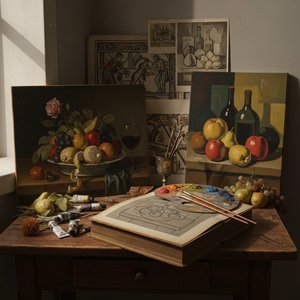
The quietude of a perfectly arranged bowl of fruit, the glint of silver against dark wood – these are not merely depictions of objects, but windows into centuries of artistic and cultural evolution. While often perceived as a distinctly Western tradition, the roots of still life stretch back surprisingly far. Fragments of remarkably lifelike food offerings adorn the walls of ancient Egyptian tombs, intended to nourish the deceased in the afterlife. Roman frescoes unearthed at Pompeii reveal a sophisticated appreciation for realistic depictions of everyday items, though these were less about symbolic weight and more about demonstrating technical skill. However, it wasn’t until the Renaissance that still life began its ascent as an independent genre, initially serving as ancillary details within larger religious or mythological compositions. The true flowering of still life occurred in 17th-century Holland during the Dutch Golden Age. A burgeoning merchant class fueled a demand for art reflecting their prosperity and refined tastes, and artists responded with breathtakingly detailed depictions of opulent table settings, lavish floral arrangements, and exotic imports. This period saw the rise of specialized still life painters – masters like Willem Claesz. Heda and Adriaen van Utrecht who dedicated their careers to capturing the ephemeral beauty and material richness of the world around them.
The Symbolism Within: Decoding Hidden Meanings in Still Life
To view a Dutch Golden Age still life as simply a beautiful arrangement is to miss its profound depth. These paintings are replete with symbolism, often subtle yet powerfully resonant. A half-peeled lemon wasn’t just a citrus fruit; it represented wealth and status due to its rarity. Wilting flowers served as poignant reminders of the transience of beauty and life itself – *memento mori* rendered in delicate petals. Insects, frequently depicted crawling on fruit or foliage, symbolized decay and the fleeting nature of earthly pleasures. Even seemingly innocuous objects like a silver goblet could allude to vanity or temperance depending on its context. The careful arrangement wasn’t accidental; artists meticulously orchestrated compositions to convey complex moral messages about mortality, faith, and the dangers of worldly indulgence. Understanding these hidden layers transforms the viewing experience from aesthetic appreciation to intellectual engagement.
Chiaroscuro & Composition: Mastering Light, Form, and Arrangement
 Still-Life
Andries Benedetti’s 1646 Still-Life: A lavish Dutch Golden Age masterpiece! Rich detail, dramatic chiaroscuro & opulent food/animal subjects. Explore this stunning Baroque artwork.
The technical mastery displayed in Dutch still life painting is equally captivating as its symbolism. Artists like Andries Benedetti employed dramatic chiaroscuro, the skillful use of light and shadow, to create a sense of volume and realism that borders on hyperrealism. Light doesn’t simply illuminate objects; it sculpts them, revealing textures and highlighting subtle details. The interplay of light and dark also directs the viewer's eye, emphasizing key elements within the composition. Beyond lighting, the arrangement itself is crucial. Artists carefully considered balance, perspective, and spatial relationships to create harmonious and visually compelling scenes. The placement of objects wasn’t random; it was a deliberate act of artistic control designed to draw the viewer into the painting and guide their gaze through the intricate details. The use of high vantage points allowed for detailed depictions of table surfaces and the inclusion of multiple textures, further enhancing the sense of realism.
Vanitas as a Genre: Mortality, Luxury, and Artistic Reflection
Vanitas is a genre of memento mori symbolizing the transience of life, the futility of pleasure, and the certainty of death, and thus the vanity of ambition and all worldly desires. The paintings involved still life imagery of transitory items. The g...
Emerging in the 16th century but reaching its peak in the Baroque period, vanitas paintings represent a particularly potent subgenre within still life. Derived from the Latin word for “emptiness” or “futility,” vanitas works are explicitly concerned with the transience of life and the inevitability of death. Skulls, often prominently featured, serve as stark reminders of human mortality. Other common symbols include decaying fruit, extinguished candles, wilting flowers, and overturned hourglasses – all representing the fleeting nature of earthly pleasures and possessions. However, vanitas paintings aren’t simply morbid exercises in gloom. They also reflect a deeper philosophical contemplation on the value of faith and the pursuit of eternal salvation. Artists often included books, musical instruments, or scientific tools to symbolize intellectual pursuits, but even these were presented as ultimately transient compared to spiritual concerns. Jan van Kessel the Elder's works exemplify this genre beautifully, layering symbolic objects with meticulous detail.
Still Life Beyond Realism: Modern Interpretations & Contemporary Artists
While rooted in tradition, still life hasn’t remained confined to the past. Modern artists have continually reinterpreted the genre, pushing its boundaries and exploring new themes. From Cézanne's revolutionary approach to form and perspective to Picasso's Cubist deconstructions of everyday objects, still life has served as a fertile ground for artistic experimentation. Contemporary artists continue to engage with the tradition, often using it to comment on consumerism, environmental concerns, or personal identity. The genre’s inherent flexibility allows for diverse interpretations – from hyperrealistic depictions that rival photography to abstract compositions that focus on color and texture. The enduring appeal of still life lies in its ability to reflect both the beauty and fragility of the world around us.
Collecting Still Life: Building a Timeless Art Collection
For collectors, still life paintings offer a unique blend of aesthetic pleasure, historical significance, and investment potential. Dutch Golden Age works remain highly sought after, but exceptional examples from other periods and styles can also be found. When building a collection, consider your personal preferences – do you gravitate towards the opulent realism of van Utrecht or the symbolic depth of vanitas paintings? Researching artists and understanding their techniques is crucial. Provenance—the history of ownership—can significantly impact value. Working with reputable galleries and art advisors ensures authenticity and informed decision-making. At BuyPopArt.com, we offer a curated selection of high-quality still life reproductions, allowing you to bring the beauty and artistry of these timeless masterpieces into your home. Whether you’re seeking a classic Dutch Golden Age scene or a contemporary interpretation, our team can provide expert guidance and support throughout the acquisition process.