August Wilhelm Nikolaus Hagborg (1852–1921): The Quiet Observer of Brittany
Vilhelm Nikolaus August Hagborg (26 May 1852, Gothenburg – 30 April 1921, Paris) was a Swedish painter who spent most of his artistic life in France. Born into an affluent family with academic aspirations—his father was an associate professor—Hagborg defied societal expectations and pursued a vocation for art, embarking on formal training at the Royal Swedish Academy of Fine Arts in Stockholm under Vicente Palmaroli in 1872-1874.
His early artistic endeavors focused on genre scenes and depictions of historical events from the French eighteenth century. Notably, he secured a commission to portray King Oscar II for the Exposition Universelle of 1889, demonstrating his burgeoning reputation within the Swedish art community. Hagborg’s connection with Prince Eugen fostered a collaborative spirit among fellow Swedish artists, cementing his position as a respected figure in the national artistic landscape.
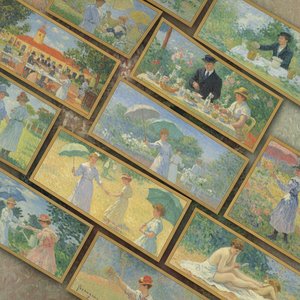
From 1876 to 1909, Hagborg remained a steadfast participant at the Salon, showcasing his evolving style and garnering critical acclaim. He particularly excelled in capturing the essence of Brittany’s coastal landscapes—a motif that would become central to his oeuvre. His paintings are characterized by meticulous realism combined with Impressionistic techniques, utilizing muted palettes dominated by yellows, grays, and blues to convey a profound sense of atmosphere and light.
The artist's fascination with the sea and its inhabitants is palpable in works like “Lady in Hat and Red Dress,” where Hagborg skillfully employs impasto—thickly applied paint—to imbue the canvas with textural richness. This technique allows for an expressive portrayal of form and color, mirroring the dynamism of the natural world.
Hagborg’s artistic legacy extends beyond his individual paintings; he established a lasting connection with Dalarna, Sweden, where he found inspiration for later compositions. His brother, Otto Hagborg, was also a painter and diver—a familial bond that undoubtedly influenced his artistic sensibilities. Hagborg's works are housed in prominent museums such as the Nationalmuseum and Göteborgs konstmuseum, ensuring that his vision continues to resonate with audiences today.
August Wilhelm Nikolaus Hagborg’s contribution to Swedish art history is undeniable. He stands as a testament to artistic independence and unwavering dedication to capturing the beauty of the natural world through masterful observation and skillful execution.