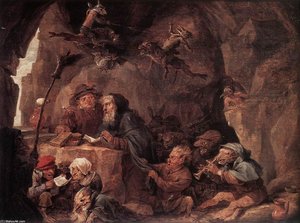
David Teniers the Younger: Life and Legacy
Early Life and Family Background
- Born: Antwerp, Belgium, December 15, 1610.
- David Teniers the Younger came from a family deeply rooted in the artistic tradition of Flanders. His father, David Teniers the Elder, was also a painter, and several of his siblings pursued careers as artists.
- Training: He initially studied under his father, receiving foundational training in painting techniques and styles.
- The family faced financial difficulties at times, leading young David to make copies of older master paintings to contribute to the household income.
Artistic Development and Influences
- Early Influences: His early work was heavily influenced by his father’s style, focusing on smaller-scale cabinet paintings. He also absorbed influences from other Flemish masters like Pieter Bruegel the Elder.
- Rubens' Impact: A pivotal moment in Teniers’ development came through his association with Peter Paul Rubens. He married Anna Brueghel, daughter of Jan Brueghel the Elder, and Rubens served as a witness at their wedding, establishing a close relationship.
- Genre Specialization: Teniers gradually specialized in genre painting – depictions of everyday life – becoming renowned for his lively scenes of peasant festivals (kermesses), tavern interiors, and village landscapes.
Major Works and Artistic Style
- Genre Scenes: His most celebrated works are his genre paintings. These often depict bustling scenes of peasant life filled with merriment, dancing, drinking, and games.
- Kermess Paintings: The “Flemish Kermess” series exemplifies his style – vibrant colors, detailed compositions, and a keen observation of human behavior.
- Landscape Painting: Teniers also produced charming landscape paintings, often incorporating figures engaged in rural activities.
- Tavern Interiors: His tavern scenes are particularly notable for their realistic portrayal of everyday life and the lively atmosphere within these establishments.
Court Painter and Curator
- Service to Archduke Leopold Wilhelm: Teniers’ talent gained recognition at the Habsburg court. He became a court painter and curator for Archduke Leopold Wilhelm, the Governor General of the Spanish Netherlands.
- Collection Management: As curator, he was responsible for managing the Archduke's extensive art collection, creating an inventory and cataloging the works.
- Founding the Antwerp Academy: Teniers played a crucial role in establishing the Antwerp Academy of Fine Arts, aiming to revitalize Flemish painting after a period of decline following the deaths of Rubens and Van Dyck.
Historical Significance and Legacy
- Leading Genre Painter: David Teniers the Younger is considered the leading Flemish genre painter of his time, capturing the essence of 17th-century life with remarkable skill.
- Influence on Later Artists: His work influenced subsequent generations of Northern European painters and even impacted French Rococo artists like Antoine Watteau.
- Prolific Output: Teniers was an incredibly prolific artist, producing a vast body of work that continues to be admired for its charm, detail, and historical insight.
- Death: He died in Antwerp on April 25, 1690, leaving behind a lasting legacy as one of Flanders’ most important Baroque painters.