Ding Fuzhi: A Master of Fruit and Calligraphy in a Changing China
Ding Fuzhi (1879-1949) stands as a pivotal figure in late 19th and early 20th century Chinese art, a period of profound transformation marked by the echoes of Western influence and a fervent desire to preserve traditional aesthetics. Born in Hangzhou, Zhejiang province, Ding’s artistic journey was deeply intertwined with the burgeoning Xiling Seal–Carving Association, an institution dedicated to refining and promoting the arts of seal carving, painting, and calligraphy – disciplines he embraced with unwavering dedication. His legacy rests primarily on his exquisite fruit still lifes and intricate calligraphy, works that seamlessly blend meticulous observation with a uniquely Chinese sensibility.
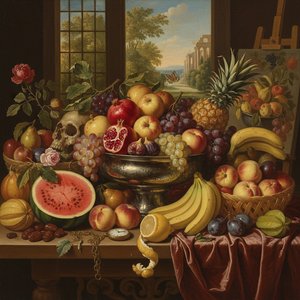
Ding’s early artistic development was significantly shaped by the Impressionist movement in Europe. He became fascinated by the pointillism of artists like Georges Seurat and Paul Signac, adopting their technique of applying tiny dots of color to create luminous effects. This approach, however, wasn't simply a mimicry of Western styles; rather, Ding masterfully integrated it with traditional Chinese painting principles. He employed this method not just for its visual impact but also as a means of exploring the relationship between form and color – a core concept in Chinese art philosophy. His paintings of fruit, particularly lychees, peaches, and persimmons, are renowned for their vibrant colors and delicate details, capturing both the beauty of the subject matter and the subtle nuances of light and shadow.
The symbolism embedded within Ding’s work is rich and layered. Fruit in Chinese culture often represents longevity, prosperity, and good fortune – themes that resonate powerfully throughout his oeuvre. His choice to depict these fruits against a backdrop of stylized oracle bone script—fragments from ancient divination texts—is particularly significant. This juxtaposition creates a compelling dialogue between the tangible world of the present and the timeless wisdom of the past. It suggests an attempt to connect with China’s rich cultural heritage while simultaneously embracing modern artistic techniques. The deliberate use of naive imagery, characteristic of his pointillist style, further emphasizes this connection, creating a visual harmony that is both captivating and intellectually stimulating.
The Influence of Calligraphy and the Xiling Seal–Carving Association
Ding Fuzhi’s artistic practice was inextricably linked to the Xiling Seal–Carving Association. Founded in 1913 by his friend, Joseph Lau, the association aimed to preserve and promote traditional Chinese arts. Ding served as a key figure within this organization, contributing significantly to its research and development efforts. His involvement with seal carving informed his painting style, fostering a deep appreciation for balance, proportion, and the interplay of line and space – qualities that are also evident in his fruit still lifes. The association’s emphasis on calligraphy profoundly influenced Ding's approach to composition and color, encouraging him to explore the expressive potential of brushstrokes and ink washes.
Furthermore, the association’s focus on oracle bone script provided a crucial conceptual framework for Ding’s work. He saw in these ancient symbols a powerful connection to China’s cultural roots, viewing them as a source of inspiration and a means of grounding his artistic practice in tradition. The deliberate incorporation of these characters into his paintings—often alongside depictions of fruit—created a visual metaphor for the enduring relationship between art, culture, and history.
Notable Works and Artistic Style
Among Ding Fuzhi’s most celebrated works is “Dish of Iced Summer Fruit” (1945), currently held by The Metropolitan Museum of Art. This painting exemplifies his signature style – a masterful blend of pointillism, meticulous observation, and symbolic resonance. The vibrant colors, delicate brushwork, and evocative composition create a captivating visual experience that draws the viewer into the heart of the scene. Other notable works include numerous depictions of lychees, peaches, and persimmons, each imbued with its own unique character and symbolism.
Ding’s artistic style is characterized by several key features: his innovative use of pointillism to create luminous effects; his meticulous attention to detail; his skillful rendering of form and color; and his deep understanding of Chinese art principles. He was a pioneer in adapting Western techniques to the Chinese aesthetic tradition, forging a unique artistic voice that resonated with both contemporary audiences and future generations.
Legacy and Historical Significance
Ding Fuzhi’s contribution to Chinese art is profound and enduring. He played a crucial role in bridging the gap between traditional aesthetics and modern techniques, demonstrating the potential for innovation while remaining firmly rooted in China's rich cultural heritage. His work reflects a period of intense intellectual ferment and artistic experimentation, as China grappled with its past and embraced the challenges of modernity.
His influence extends beyond his own paintings; he helped to shape the direction of Chinese art in the 20th century, inspiring countless artists to explore new possibilities while honoring the traditions of their ancestors. Today, Ding Fuzhi’s work is celebrated for its beauty, complexity, and enduring relevance – a testament to his artistic vision and his profound understanding of the Chinese spirit.