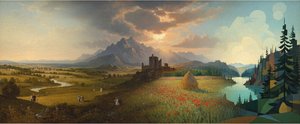
Edgar Dorsey Taylor: Weaver of the American West
Edgar Dorsey Taylor (1904-1978) wasn’t a name immediately recognized in the pantheon of American landscape painters during his lifetime, yet his evocative depictions of the American West—particularly its coastal regions and the quiet dignity of rural life—hold a unique charm and enduring appeal. Born in Grass Valley, California, into an artistic family steeped in painting traditions, Taylor's journey was one of persistent dedication, quiet observation, and a deliberate choice to capture the essence of his surroundings rather than chasing fleeting trends. His work, often characterized by a restrained palette and meticulous detail, offers a poignant glimpse into a vanishing era of American frontier life.
Taylor’s early artistic training was deeply rooted in his family's legacy. His mother, Adelaide Virginia Dorsey, and grandmother, Lillie S. Dorsey, were both accomplished painters, providing him with an invaluable foundation in technique and aesthetic sensibility. This familial influence wasn’t merely a matter of inherited skill; it fostered a deep appreciation for the natural world and a commitment to representing it truthfully. He further honed his skills at the University of California, Berkeley, earning degrees in both Arts and Literature, before pursuing studies abroad in Italy and France – experiences that broadened his artistic horizons and exposed him to diverse European styles. Crucially, he attended the Hans Hoffman School in Munich, an institution renowned for its emphasis on direct observation and a rejection of academic artifice.
The Landscapes of California
Returning to California after his international travels, Taylor established himself as a respected artist and educator. He spent many years teaching at various institutions, including the University of California, imparting not only technical skills but also a philosophy of seeing—a patient, attentive approach to capturing the subtle nuances of light, texture, and atmosphere. His paintings are most famously associated with the coastal regions of California, particularly around San Quentin State Prison and Puerto San Carlos. These weren’t romanticized vistas; instead, he presented a rugged, honest portrayal of the landscape – weathered cliffs, crashing waves, and the stark beauty of the Pacific Ocean.
The “Lath and Paper Houses” woodcut print, depicting a solitary dwelling nestled amongst the coastal scrub, exemplifies this approach. The image is not merely picturesque; it’s imbued with a sense of isolation and resilience—a testament to the lives of those who had carved out an existence in this challenging environment. Similarly, his “Sunday Riders” series, capturing cowboys and their horses against expansive skies, speaks to the enduring spirit of the West and the close relationship between humans and animals. His work is notable for its lack of dramatic flourishes; instead, he relied on careful observation and a subtle use of line and color to convey mood and atmosphere.
Technique and Style
Taylor’s artistic style can be described as quietly observational and deeply rooted in the traditions of American landscape painting. He favored a limited palette—primarily browns, grays, blues, and greens—allowing him to focus on capturing the tonal variations within his subjects. His use of line was precise and deliberate, creating a sense of depth and texture. He often employed dry brush techniques, layering thin washes of paint to build up subtle gradations of color and value. This meticulous approach demanded considerable patience and skill, resulting in paintings that possess a remarkable sense of realism and immediacy.
His work was frequently executed as woodcuts, a medium he embraced for its ability to capture the starkness and clarity of his subjects. The linear quality of woodcut printing perfectly complemented his observational style, creating images that are both detailed and evocative. The “Tricyclist” print, depicting a young boy riding a bicycle through a rural landscape, is a charming example of this technique—a simple yet poignant portrayal of childhood innocence.
Legacy and Recognition
Despite not achieving widespread fame during his lifetime, Edgar Dorsey Taylor’s work has gained increasing recognition in recent decades. His paintings are now held in collections at institutions like the Taylor Institution Library in Oxford, England, and are featured in various exhibitions and publications. His dedication to capturing the authentic beauty of the American West—without resorting to sentimentality or exaggeration—has earned him a place among the most compelling landscape artists of the 20th century. His legacy lies not in grand pronouncements or revolutionary techniques, but in his quiet, persistent commitment to observing and representing the world around him with honesty and grace.