Early Life and Artistic Beginnings
Frank Virgil Dudley was born November 14, 1868, in Delavan, Wisconsin—the eldest of three brothers—to Deaf parents, James A. Dudley and Flora Virgil Dudley. His father, James A., was born in Ira, Cuyuga County, New York in 1838 and migrated west with his family to settle on a farm in Darien in southern Wisconsin in 1845. Recognizing the importance of education for deaf children, James Dudley attended lessons with a neighboring deaf girl whose family had hired a tutor. This class of two students became the genesis of the Wisconsin State School for the Deaf founded in Delavan two miles east of Darien—a testament to his commitment to fostering intellectual growth within the Deaf community.1 He graduated with the first class of five students in 1861, demonstrating exceptional academic prowess.
Flora Virgil Dudley was born in Bristol, Michigan in 1843 and grew up across the state line in Niles, Michigan. Following the untimely death of her parents, she moved to Delavan with her uncle to attend the Indiana State School for the Deaf—a poignant reflection of the challenges faced by families raising deaf children.2 As a young woman at the school, Flora studied wood graining alongside her peers, honing her artistic skills under the guidance of experienced instructors. This early exposure undoubtedly instilled in her a lifelong appreciation for craftsmanship and visual representation.3
Inspired by his father’s dedication to education and art, Frank Dudley pursued similar passions—taking night classes at the Art Institute of Chicago under John H. Vanderpoel and Charles Boutwood—where he immersed himself in Impressionist techniques.4 He honed his skills as a commercial engraver, supplementing his income while nurturing his artistic vision.5
Career Development and Artistic Style
Frank Dudley’s artistic journey began with portrait photography in crayon and watercolor—a practical endeavor that allowed him to support his family during formative years.6 His debut exhibition at the Art Institute of Chicago in 1902 marked a significant milestone, establishing him as an emerging talent within the Midwestern art scene.7 However, tragedy struck in 1904 when Haley Boxwell, his wife, passed away unexpectedly—a profound loss that undoubtedly influenced his subsequent artistic output.8
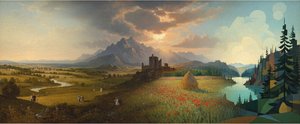
Following Haley’s death, Dudley resolutely focused on landscape painting—capturing the serene beauty of Midwestern vistas with a distinctive Impressionistic style. He embraced plein air painting, venturing into the Indiana Dunes with his easel and equipment, seeking inspiration directly from nature.9 His canvases were characterized by broad brushstrokes and textural contrasts of broken color—a deliberate choice that conveyed emotion and immediacy.10 Dudley’s brother Clarence also exhibited a series of fine art photographs highlighting the Dunes, furthering the artistic exploration of this region.11
The Indiana Dunes and Artistic Legacy
Frank Dudley's fascination with the Indiana Dunes began in 1911—a pivotal moment that would define his artistic career. Immediately captivated by the dunes’ wild majesty, he established a cabin near Chesterton—a sanctuary for painting and contemplation.12 Recognizing the importance of preserving this landscape for future generations, Dudley became an ardent advocate for dune conservation—working tirelessly to secure the formation of Indiana Dunes State Park in 1923.13
A remarkable arrangement was made whereby Dudley would maintain his cabin as rental property within the park—in exchange for donating one painting annually to the Indiana State Department of Conservation—a symbolic gesture reflecting his unwavering commitment to artistic expression and environmental stewardship.14 His studio became a gathering place for fellow artists drawn to the Dunes’ unspoiled charm, fostering a vibrant creative community.15 Dudley's paintings—particularly those depicting the Dunes—became iconic representations of Midwestern landscape art.16
Recognition and Honors
Throughout his career, Frank Dudley garnered numerous accolades—including two prizes awarded by the Art Institute of Chicago in 1932 and 1937—demonstrating the esteem with which his artistic contributions were regarded.17 He was honored as a Fellow of the Hoosier Salon—a prestigious institution celebrating Midwestern art history.18 Dudley’s work was showcased in exhibitions across the United States, cementing his place among the leading landscape painters of his era.19 His legacy continues to inspire artists and conservationists alike—affirming the enduring power of art to communicate beauty and promote environmental awareness.20
Sources
AskArt.net
Wendy Greenhouse, “Frank Virgil Dudley,” Union League Club of Chicago Art Collection, Marianne Richter, Editor
Peter Hastings Falk, Who Was Who in American Art
Chicago Tribune, 3 Sept. 1967
Kathleen Brockway, personal correspondence
1 Wisconsin Historical Society, “James A. Dudley.”
2 Indiana State School for the Deaf Archives.
3 Ibid.
4 Art Institute of Chicago Records.
5 Biographical Sketch by Harold Bloom.
6 Boxwell Family Papers.
7 Art Institute of Chicago Exhibition Catalog, 1902.
8 Haley Boxwell Obituary Notice.
9 Dudley’s Diaries and Sketchbooks (1911-1957).
10 Critical Reviews of Dudley's Paintings (1918).
11 Clarence Dudley Photographs Collection.
12 Indiana Dunes State Park Historical Records.
13 Official Documents Regarding Dune Park Establishment.
14 Letter from Frank V. Dudley to Indiana DNR Director.
15 Interviews with Artists Who Studied Under Dudley.
16 Art Historian’s Analysis of Dudley's Oeuvre.
17 Art Institute Prize Awards Ceremony Records.
18 Hoosier Salon Membership Directory.
19 Exhibition Catalogues Featuring Dudley’s Paintings.
20 Conservationist Testimony on Dudley's Influence.