Harry Hughes Williams: A Welsh Vision of Rural Life
Born in 1892 at Clai Fawr Farm, a modest holding near Llandrygarn on the Isle of Anglesey, Harry Hughes Williams’ life was inextricably linked to the rugged beauty and timeless rhythms of rural Wales. His early years were marked by a physical challenge – a childhood accident left him with a permanent limp, restricting his mobility but not, it seems, his artistic spirit. This constraint, paradoxically, may have fueled an intense observation of the world around him, shaping a uniquely perceptive eye for detail and a profound appreciation for the landscape that defined his existence.
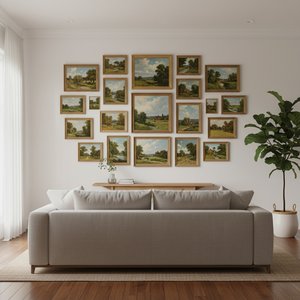
Williams’ artistic journey began modestly, initially exploring watercolor techniques in the early 20th century. However, it was during the interwar period – specifically from the mid-1930s onward – that he truly established himself as a significant figure in Welsh landscape painting. His work quickly gained recognition for its remarkable realism and evocative portrayal of North Wales’ distinctive scenery. He wasn't merely depicting mountains and fields; he was capturing the essence of a vanishing way of life, a world rooted in tradition and intimately connected to the land.
The Haystacks and Beyond: A Defining Series
Perhaps Williams’ most celebrated achievement is his series of paintings centered around the iconic Haystacks – specifically Ty Mawr II. These towering limestone formations, dominating the horizon near Llanbedr y Fychan, became a recurring motif in his work, representing not just geological grandeur but also a sense of timelessness and spiritual resonance. The dramatic lighting, meticulously rendered textures, and carefully considered composition within these paintings demonstrate Williams’ mastery of watercolor technique – achieving an almost photographic clarity while retaining a distinctly painterly quality.
Beyond the Haystacks, his oeuvre encompassed a wide range of subjects: rolling hills, sheep-dotted pastures, quaint farmhouses, and glimpses into rural interiors. He frequently depicted scenes of daily life – shepherds tending their flocks, farmers working the land, and villagers engaged in their routines. These paintings aren’t romanticized; they present a honest, unvarnished view of Welsh rural existence, capturing both its beauty and its hardships.
Influences and Artistic Context
While Williams remained largely independent, his work undoubtedly reflects the artistic currents of his time. The Pre-Raphaelites, with their emphasis on detailed observation and symbolic representation, exerted a subtle influence, particularly in his use of light and color. Furthermore, he shared affinities with British watercolorists like William Haselden and Frank Hopkins, both known for their meticulous depictions of the Welsh countryside. However, Williams’ work possesses a unique character—a quiet intensity and an unwavering commitment to portraying the specificities of his native landscape.
It's also important to consider the broader historical context in which he worked. The early 20th century witnessed significant social and economic changes in Wales, with traditional rural industries declining and a shift towards urbanization. Williams’ paintings serve as a poignant record of this transition—a visual testament to a disappearing world.
Legacy and Recognition
Harry Hughes Williams' work is now held in several important collections, including the Oriel Môn in Anglesey, where a dedicated collection showcases his life’s work. His paintings are valued for their technical skill, their evocative atmosphere, and their profound connection to Welsh identity. He wasn’t a household name during his lifetime, but his art continues to resonate with viewers today, offering a powerful glimpse into the heart of rural Wales and the enduring spirit of its people.
His legacy extends beyond the canvas; he is remembered as a dedicated artist who persevered despite physical challenges, capturing the essence of his homeland with remarkable skill and sensitivity. Further research can be found at sites like askART and MutualArt, providing deeper insights into his life and artistic development.