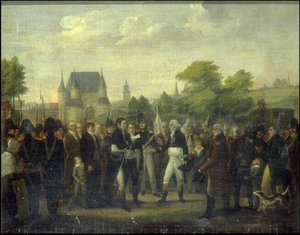
Jacques-François Momal: A Shadowy Figure of the Neoclassical Era
Jacques-François Momal, born in 1754 and passing away in 1832, remains a somewhat enigmatic figure within the landscape of French art history. While his name doesn’t resonate with the same immediate recognition as contemporaries like David or Ingres, a closer examination reveals an artist of considerable skill and a significant contribution to the elegance and detail characteristic of Neoclassical portraiture. Much of Momal's legacy is shrouded in mystery, partly due to the limited documentation surrounding his life and career, but also perhaps intentionally so – a deliberate cultivation of an aura of quiet sophistication that mirrors the subjects he so meticulously depicted. His work offers a fascinating glimpse into the artistic circles of late 18th and early 19th century France, revealing connections to prominent figures and reflecting the evolving tastes of a society transitioning from Rococo extravagance towards a more restrained, classically-inspired aesthetic.
Early Life and Artistic Training
Information regarding Momal’s formative years is scarce, contributing significantly to the air of mystery surrounding him. He was born in Worth, a small village near Valence in the Rhône Valley – a region renowned for its artistic heritage and connection to the École des Beaux-Arts in Lyon. While precise details of his early training remain elusive, it's believed he initially apprenticed under local artists before seeking further instruction in Lyon. The influence of the Lyonnaise school, known for its emphasis on meticulous draftsmanship and realistic representation, undoubtedly shaped his artistic development. Crucially, Momal’s exposure to this environment fostered a deep appreciation for classical antiquity – a cornerstone of Neoclassical art – which would become a defining characteristic of his style. Unlike many artists who sought patronage in Paris, Momal appears to have remained largely rooted in the Rhône Valley, suggesting a preference for a more independent and less overtly ambitious artistic trajectory.
A Style Defined by Elegance and Detail
Momal’s artistic signature lies in his remarkably refined portraits and historical scenes. His paintings are characterized by an extraordinary level of detail – from the intricate folds of clothing to the subtle nuances of facial expression – a testament to his exceptional draftsmanship. He eschewed dramatic gestures or overtly theatrical compositions, instead favoring a measured elegance and a sense of quiet dignity that permeated his subjects. His portraits often possess a remarkable psychological depth, capturing not just physical likeness but also conveying an underlying sense of character and personality. The use of light and shadow is particularly noteworthy; Momal masterfully employed chiaroscuro to create a three-dimensional effect, lending volume and realism to his figures. His works frequently depict members of the nobility and gentry – individuals who valued refinement and sought to project an image of wealth and status through portraiture.
Notable Works and Patronage
Among Momal’s most celebrated paintings is “Portrait de Madame de Saint Romain” (1832), a captivating example of his Neoclassical style. The painting showcases his ability to capture the grace and composure of its subject, while simultaneously conveying a sense of quiet intimacy. He also produced several historical scenes, including "Union de la Poésie et de la Musique," which likely depicts a gathering of artists and intellectuals – reflecting his own connections within the cultural circles of Lyon. While Momal’s work was not widely exhibited during his lifetime, he did receive commissions from notable patrons, suggesting a level of recognition and respect for his artistic abilities. Interestingly, some scholars believe that “Mme de Rambure,” a pseudonym used by an unknown female artist, may have been another identity adopted by Momal himself – further deepening the enigma surrounding this elusive figure.
Historical Significance and Legacy
Jacques-François Momal’s contribution to French art history is often overlooked, yet his work represents a vital link between the Rococo era and the rise of Neoclassicism. His meticulous draftsmanship, combined with an understated elegance and psychological insight, established him as a significant portraitist of his time. While he never achieved widespread fame during his lifetime, Momal’s paintings continue to be appreciated for their technical skill, refined aesthetic, and quiet dignity. He stands as a testament to the enduring appeal of Neoclassical art – an art form that continues to captivate audiences with its emphasis on beauty, order, and timelessness. Further research into surviving documents and private collections may one day shed more light on this fascinating artist and his place within the vibrant artistic landscape of 18th-century France.