Jenő Gadányi: A Hungarian Visionary of Light and Emotion
Jenő Gadányi (1896-1960) wasn’t a name that frequently echoes through the halls of international art history, yet his canvases—particularly those emerging from the turbulent years of interwar Hungary and beyond—hold a profound resonance. He was a painter deeply rooted in the landscape and memory, crafting intensely personal visions informed by Expressionism, Symbolism, and a unique Hungarian sensibility. Gadányi’s work isn't about literal representation; it’s an exploration of atmosphere, emotion, and the elusive quality of light, offering glimpses into a soul grappling with both beauty and melancholy.
Born in Budapest, Gadányi’s early life was shaped by the vibrant artistic community fostered within the Vaszary family circle. His father, a prominent art dealer, exposed him to a diverse range of artists, including influences from the burgeoning Hungarian Modernism movement. This environment proved crucial, providing a foundation for his later development and ultimately leading him to Paris in 1927 – an experience that fundamentally altered his artistic trajectory. The Parisian encounter ignited within him a fascination with pure color, a shift away from the more naturalistic tendencies of his earlier work. He began to experiment with bolder palettes and looser brushstrokes, seeking to capture not just what he saw but how he *felt* about it.
The Landscape as Inner World
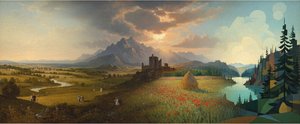
Gadányi’s landscapes are arguably his most compelling works. They aren't simply depictions of the Hungarian countryside—though they certainly possess a strong connection to its rolling hills, dense forests, and shimmering lakes – but rather projections of an inner world. He frequently painted scenes bathed in ethereal light, often utilizing a muted color palette punctuated by vibrant yellows and greens. These colors weren’t applied with precision; instead, they were blended and layered to create a sense of atmospheric depth and emotional intensity. As he himself stated, “My artistic imagination is in contact with nature while I am observing it. Naturally, this contact ceases to exist when I am formulating a picture so that I can make my experiences suitable for expression… my pictures do not originate from nature, but from experience: the deeper the experience, the more reality will change.”
Consider his “Hilly Landscape With Sundisc” (1946). The painting isn’t a photographic representation of a specific location. Instead, it evokes a feeling—a sense of quiet contemplation under an expansive sky. The loose brushstrokes and hazy atmosphere contribute to this effect, blurring the boundaries between reality and imagination. Similarly, “Autumnal Garden,” with its rich autumnal hues and subtle shifts in light, feels less like a record of a particular season and more like a distilled memory of beauty and transience.
Influences and Artistic Style
Gadányi’s artistic style is difficult to pigeonhole. While undeniably influenced by the Expressionist movement—particularly its emphasis on subjective experience and emotional intensity—he also incorporated elements of Symbolism, evident in his use of evocative imagery and symbolic color choices. The works produced during his time in Paris demonstrate a clear shift towards abstraction, with an increased focus on color relationships and the creation of mood rather than precise form. His later work, particularly after returning to Hungary, reveals a growing interest in capturing the fleeting effects of light and atmosphere, often employing techniques reminiscent of Impressionism.
It’s important to note that Gadányi's artistic journey was deeply intertwined with the political and social upheavals of his time. The rise of fascism in Europe and the subsequent turmoil within Hungary profoundly impacted his work. His paintings became increasingly introspective and emotionally charged, reflecting a sense of unease and uncertainty about the future.
Legacy and Recognition
Despite not achieving widespread international fame during his lifetime, Jenő Gadányi’s contribution to Hungarian art is significant. He remains a vital figure in the country's Modernist landscape, representing a unique synthesis of personal vision and artistic technique. His paintings are now held in several museums across Hungary, including the National Gallery in Budapest, and continue to be studied and appreciated for their emotional depth and atmospheric power.
His work offers a poignant reminder that art can transcend mere representation, becoming a vehicle for exploring the complexities of human experience—a testament to the enduring legacy of a Hungarian painter who captured the light within his soul.