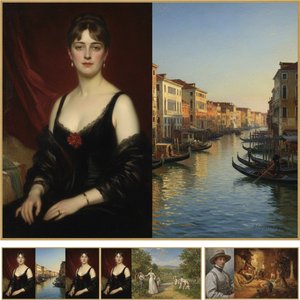
The Journey of a Visionary: The Life of John Blennerhassett Martin
The story of John Blennerhassett Martin is one of migration, metamorphosis, and the enduring pursuit of artistic truth. Born in 1797 in the scenic landscapes of Bandon, Ireland, Martin was destined for a life shaped by the fine lines of craftsmanship and the profound depth of portraiture. Raised in an environment where the arts were deeply cherished, his early years provided the foundational passion necessary to navigate the competitive art worlds of both Europe and America. In 1815, at the tender age of eighteen, Martin embarked on a transformative journey across the Atlantic, arriving in the United States with little more than his burgeoning talent and an unyielding ambition.
Upon settling in New York City, Martin immersed himself in the rigorous discipline of engraving. This period of technical training was crucial; it instilled in him a meticulous eye for detail and a mastery over light and shadow that would later define his painterly style. His move to Richmond, Virginia, marked a pivotal chapter in his career, as he transitioned from the precise world of printmaking to the more expressive realm of portrait painting. In the heart of Virginia, Martin found his calling, becoming a sought-after artist capable of capturing not just the physical likeness, of his subjects, but their very souls.
Mastery of Form and the Art of Portraiture
Martin’s artistic repertoire was remarkably diverse, spanning the delicate precision of engraving and lithography to the rich, emotive textures of oil painting. He possessed a rare ability to blend a profound realism with an almost ethereal air of mystery, a quality that made his portraits stand out in the nineteenth-century American art scene. His work often felt alive, as if the subjects were caught in a moment of quiet reflection or intense thought.
His technical prowess was most evident in his ability to manipulate medium and light. Whether he was etching fine lines into a metal plate or applying layers of pigment to canvas, Martin sought to achieve a sense of permanence. His influences were as varied as his techniques; while the dramatic chiaroscuro of Rembrandt van Rijn informed his approach to depth and shadow, elements of more modern sensibilities can be glimpsed in his handling of light, suggesting an artist who was always looking toward the future of art.
Some of his most significant achievements include his celebrated portraits of historical figures, which serve as vital windows into the American past:
- Portrait of Chief Justice John Marshall: A work that captures the gravity and intellectual weight of one of America's most influential legal minds.
- Portrait of James Armistead: A poignant depiction that showcases Martin's ability to treat his subjects with dignity and historical reverence.
A Lasting Legacy in Art History
The significance of John Blennerhassett Martin extends far beyond the frames of his individual portraits. He represents a bridge between the Old World traditions of Ireland and the emerging artistic identity of the United States. His contribution to the development of American portraiture and printmaking helped establish a standard of excellence that inspired subsequent generations of artists. Through his skilled hands, the faces of history were preserved with a level of nuance that continues to captivate viewers today.
Today, the legacy of this Irish-American master is safeguarded within prestigious institutions, most notably the National Gallery of Art in Washington D.C. His works remain much more than mere historical artifacts; they are living testaments to a life dedicated to the observation of humanity. As collectors and historians continue to rediscover his catalog, Martin’s ability to weave realism with mystery ensures that his name will forever be etched into the annals of art history, much like the very engravings he so masterfully created.