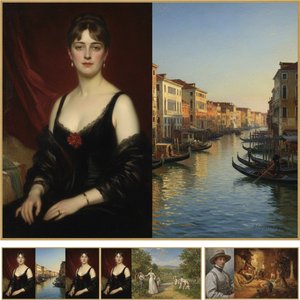
John Ewart Robertson: A Victorian Master of Portraiture
John Ewart Robertson, a name perhaps less familiar than some of his contemporaries, nevertheless stands as a significant figure in 19th-century British art. Born in Liverpool in 1820 and tragically passing away in 1879, Robertson’s legacy resides primarily within the meticulously rendered portraits he created, offering intimate glimpses into the lives and social standing of Liverpool's elite – mayors, prominent merchants, and members of wealthy families. His work isn’t merely a record of appearances; it’s a carefully constructed exploration of character, status, and the Victorian era’s obsession with propriety and detail.
Robertson’s early life provided him with an unusual blend of influences. He was born into a family deeply rooted in trade, his father, James Gladstone, being a successful merchant. This exposure to the commercial world undoubtedly shaped Robertson's eye for observation and his understanding of wealth and social hierarchy. However, he also received a formal artistic education, studying at the Glasgow School of Art, where he honed his skills under the tutelage of Rowland Williams. It was here that he began to develop his signature style – characterized by an almost photographic realism combined with a subtle sensitivity to expression and mood. His time in Glasgow also exposed him to the burgeoning Scottish art scene, which influenced his palette and approach to light.
Robertson’s artistic development can be traced through a series of commissions that increasingly focused on portraiture. Initially, he produced works for private clients, capturing their likenesses with remarkable accuracy. However, as his reputation grew, he began to undertake more ambitious projects – portraits of prominent Liverpool figures, including John Stewart, the Mayor of Liverpool at the time. These commissions demanded not only technical skill but also an understanding of social etiquette and the nuances of portraying a subject’s status. His ability to capture both physical appearance and inner character was highly valued by his patrons.
A key element of Robertson's style lies in his meticulous attention to detail. He employed a technique known as ‘veristic portraiture,’ meticulously rendering fabrics, jewelry, and even the texture of skin. This commitment to realism was not merely decorative; it served to emphasize the subject’s wealth, social standing, and personal identity. His use of light and shadow further enhanced this effect, creating a sense of depth and volume that brought his subjects to life. He often worked from live sittings, allowing him to capture subtle shifts in expression and posture – details that would have been lost with a purely observational approach.
The Liverpool Elite: Subjects and Social Context
Robertson’s most celebrated portraits depict the leading figures of Liverpool during the mid-19th century. The city was a thriving center of trade, particularly in cotton, and its merchants wielded considerable economic and social power. His subjects reflect this reality – wealthy industrialists, prominent politicians, and members of the upper echelons of society. These portraits weren’t simply representations of individuals; they were statements about Liverpool's prosperity and the values associated with it: wealth, respectability, and civic duty.
The Victorian era was deeply concerned with social order and propriety, and Robertson’s portraits perfectly captured this atmosphere. Subjects are typically posed in formal attire, often adorned with jewelry and displaying an air of dignified composure. His compositions frequently incorporate symbolic elements – a book, a family crest, or a landscape view – that reinforce the subject's status and affiliations. The careful arrangement of these details speaks volumes about the social conventions of the time.
Notable amongst his subjects are figures like John Stewart, Mayor of Liverpool, whose portrait exemplifies Robertson’s ability to convey both authority and humanity. Mrs. Joseph Robinson, a prominent figure in Liverpool society, is also represented with remarkable sensitivity, capturing her elegance and grace. These portraits offer invaluable insights into the lives and aspirations of those who shaped the city's destiny.
Technique and Influences
Robertson’s artistic technique was rooted in a combination of observation, academic training, and personal experimentation. He began his career studying under Rowland Williams at Glasgow School of Art, where he learned the fundamentals of drawing, composition, and color theory. However, Robertson quickly developed his own distinctive style, characterized by a meticulous realism and an emphasis on capturing subtle nuances of expression.
His use of light is particularly noteworthy. He employed a technique known as ‘chiaroscuro,’ using strong contrasts between light and shadow to create dramatic effects and emphasize the three-dimensionality of his subjects. He also paid close attention to detail, rendering fabrics with remarkable accuracy and capturing the texture of skin with subtle gradations of tone.
While Robertson’s work is firmly rooted in academic tradition, it also reveals influences from other artists, including Sir Thomas Lawrence, whose portraits were admired for their elegance and realism. However, Robertson's style is more restrained and psychologically astute than that of his predecessors. He was particularly influenced by the Dutch Masters, especially Rembrandt, known for his masterful use of light and shadow.
Legacy and Historical Significance
Despite his talent and dedication, John Ewart Robertson’s career was tragically cut short by illness in 1879 at the age of 59. He left behind a relatively small body of work, but his portraits are considered among the finest examples of Victorian portraiture. They offer invaluable insights into the lives and aspirations of Liverpool's elite during a period of rapid economic growth and social transformation.
Robertson’s work is now housed in various museums and private collections throughout the United Kingdom. His portraits continue to be admired for their technical skill, psychological insight, and historical significance. He represents a crucial link between academic tradition and modern portraiture, demonstrating the power of art to capture not only appearances but also the essence of human character.
Further research into Robertson’s life and work can be found through resources such as Art UK (