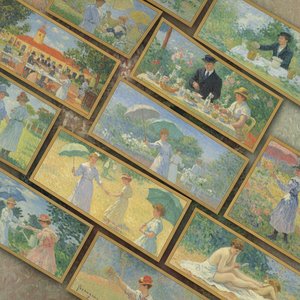
Joseph Pierre Vianey: A Nantes Painter Bridging Georgian Elegance and Romantic Symbolism
Joseph Pierre Vianey (1731-1765) emerged from the artistic landscape of Nantes, France, a city renowned for its maritime heritage and burgeoning Enlightenment ideals. Though his life was tragically cut short at just 34 years old, Vianey’s brief career nonetheless cemented his place as a significant figure in Georgian painting—specifically within the circle of artists exploring allegorical themes and capturing the refined beauty of aristocratic life.
Born into a family steeped in artistic tradition, Vianey received an early education that fostered his innate talent for visual representation. Details about his formative years remain scarce, contributing to the mystique surrounding his artistic development. However, anecdotal evidence suggests he honed his skills under the tutelage of Jean-Baptiste Oudry, a celebrated Flemish painter known for his meticulous botanical illustrations and portraits of noble ladies—a stylistic influence undeniably present in Vianey’s oeuvre.
Vianey's artistic style is characterized by a delicate blend of observation and imagination. He excelled at depicting landscapes imbued with atmospheric subtlety, favoring muted palettes and capturing fleeting moments of light and shadow. His canvases often featured idealized rural scenes—rolling hills dotted with wildflowers—reflecting the Georgian fascination for pastoral tranquility and moral virtue. Yet, crucially, Vianey wasn’t merely replicating nature; he employed symbolism to convey deeper meanings related to themes of innocence, contemplation, and spiritual aspiration.
Perhaps his most enduring legacy resides in “Allegory of Free Love,” completed in 1761. This ambitious work—a monumental canvas housed within the Pickford’s House Museum—represents a daring departure from conventional portraiture. Rather than presenting a formal likeness, Vianey depicted a nude female figure entwined with vines and blossoms, symbolizing fecundity and spiritual rebirth. The painting's innovative composition and masterful execution captivated audiences of its time and continue to inspire admiration for its artistic boldness.
Despite his untimely demise—likely due to tuberculosis—Vianey’s influence extended beyond his immediate contemporaries. His commitment to capturing the essence of Georgian aesthetics established him as a pivotal voice in shaping the visual culture of the era. Furthermore, his exploration of allegorical symbolism foreshadowed developments within Romantic art, demonstrating how artists could utilize imagery and narrative to convey profound emotional and philosophical ideas.
Today, Joseph Pierre Vianey’s paintings are treasured possessions of museums across Europe, offering invaluable insights into the artistic sensibilities of Nantes during its golden age. His work stands as a testament to the transformative power of observation combined with imaginative vision—a legacy that resonates powerfully within the broader context of eighteenth-century art history.