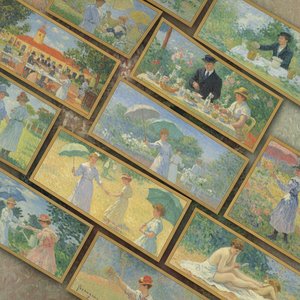
Pierre Alexis Lesage: A Painter of Regional Life and Delacroixian Spirit
Pierre Alexis Lesage (1872-1932) stands as a pivotal figure in French landscape painting, particularly renowned for his depictions of the Sarthe region – a corner of Normandy celebrated for its fertile plains and picturesque villages. Born in Saint-Denis, Paris, Lesage’s artistic journey began with an apprenticeship under Gustave Boulanger, whose monumental style profoundly impacted his early works. However, Lesage swiftly distanced himself from Boulanger's theatrical grandeur, forging instead a path toward a more nuanced observation of the natural world and human experience, heavily influenced by Eugène Delacroix – arguably France’s most celebrated Romantic painter.
- Early Influences: Boulanger instilled in Lesage a fascination for grand narratives and dramatic compositions, evident in his initial canvases exploring biblical themes and historical scenes.
- The Sarthe Landscape: Lesage's true mastery emerged when he turned his gaze inward, capturing the subtle beauty of the Sarthe countryside with remarkable accuracy and sensitivity. He meticulously rendered fields ablaze with poppies, wheat ripening under a golden sun, and quaint rural churches bathed in ethereal light.
- Delacroixian Technique: Like Delacroix, Lesage embraced loose brushwork and vibrant color palettes—techniques that conveyed emotion and dynamism rather than striving for photographic realism. This stylistic choice allowed him to infuse his landscapes with an atmosphere of poetic contemplation.
Lesage’s oeuvre encompasses a vast array of subjects beyond landscape, including portraits – notably his iconic depiction of Frédéric Chopin – and interiors adorned with Aubusson tapestries. These works demonstrate Lesage's versatility as an artist and underscore his commitment to portraying the complexities of human life alongside the grandeur of nature. His meticulous attention to detail—particularly in capturing textures and tonal gradations—became a hallmark of his style, cementing his reputation as one of France’s foremost landscape painters.
- Notable Paintings: Among Lesage's most celebrated paintings are ‘L'Eglise d'Ault Muval,’ ‘Portrait de Monsieur Pinard,’ and ‘Portrait de Mademoiselle Audemar.’ Each piece exemplifies his distinctive approach to artistic expression, blending observation with imagination.
- Critical Recognition: Lesage received considerable acclaim during his lifetime for his evocative depictions of rural France and his masterful execution of Delacroixian principles. His work continues to inspire artists today.
Lesage’s legacy extends beyond individual artworks; he helped establish a tradition of landscape painting that prioritized psychological depth alongside visual splendor. By channeling the spirit of Romanticism—characterized by emotional intensity, imaginative vision, and an appreciation for sublime beauty—Lesage elevated French art to new heights, securing his place as a cornerstone of 19th-century artistic heritage. His paintings remain treasured examples of Impressionistic influence and continue to resonate with audiences captivated by their serene grandeur.