Louis-Augustin Auguin: A Saintonge Master of Light and Landscape
Born in Rochefort, Charente-Maritime, in 1824, Louis-Augustin Auguin’s life was inextricably linked to the rugged beauty of the French coast. His early artistic training began within his family – both his father and uncle were accomplished painters, providing him with a foundational understanding of technique and observation. This familial influence, coupled with the vibrant natural world surrounding his birthplace, laid the groundwork for a career dedicated to capturing the essence of Saintonge’s landscapes and seascapes. Auguin's artistic journey took a significant turn in 1842 when he moved to Paris, seeking formal education at the prestigious Académie Julien under Jules Coignet and later Jean-Baptiste Corot. These formative years exposed him to the burgeoning Realist movement and instilled within him a deep appreciation for capturing nature’s subtleties with meticulous detail.
Corot's influence proved particularly profound. The elder painter championed a direct, unidealized approach to landscape painting, prioritizing atmospheric effects and the interplay of light and shadow. Auguin embraced this philosophy wholeheartedly, developing a distinctive style characterized by soft brushstrokes, luminous color palettes, and an almost palpable sense of atmosphere. He wasn’t interested in grand vistas or dramatic compositions; instead, he focused on intimate scenes – fishing boats bobbing on the waves, solitary figures silhouetted against the horizon, and the quiet beauty of coastal meadows bathed in sunlight. This preference for understated realism aligned him firmly within the Saintonge School, a regional artistic collective known for its commitment to depicting the local environment with honesty and sensitivity.
The Port-Berteau Group and Regional Artistic Collaboration
Following the tumultuous events of 1848 – the Revolution of July – Auguin returned to his native Saintonge. This period marked a crucial phase in his artistic development, as he immersed himself in the local landscape and began to establish connections with other artists who shared his vision. He formed part of the Port-Berteau group, alongside Hippolyte Pradelles and Corot (who spent time in Saintes during 1862 and 1863). This collective sought to break away from the rigid academic traditions of the Salon and forge a distinctly regional artistic identity. The group’s commitment to naturalism was further solidified through their joint exhibition at the Hôtel de Ville in Saintes in January 1862, showcasing 170 works – a testament to their shared dedication and influence within the local art scene.
The Port-Berteau group's dynamic proved short-lived. Auguin and Pradelles ultimately relocated to Bordeaux in 1863, continuing their artistic pursuits independently. Despite this division, their collaboration left an indelible mark on the regional art landscape, fostering a spirit of experimentation and encouraging artists to explore new approaches to depicting the natural world. The shared experiences and artistic dialogues within the group undoubtedly shaped Auguin’s evolving style and contributed to his distinctive approach to landscape painting.
A Palette of Light: Style and Technique
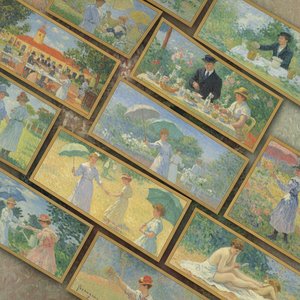
Auguin's paintings are immediately recognizable for their masterful use of light and color. He possessed an extraordinary ability to capture the fleeting effects of sunlight on water, stone, and vegetation – a skill honed through countless hours spent observing the ever-changing conditions of the Saintonge coast. His palette was predominantly muted, dominated by shades of blue, green, gray, and ochre, creating a sense of tranquility and atmospheric depth. He rarely employed harsh contrasts or vibrant hues, instead favoring subtle gradations that evoked the soft, diffused light characteristic of coastal regions.
His technique involved loose, broken brushstrokes – a deliberate departure from the smooth, polished surfaces favored by earlier generations of landscape painters. These visible marks not only conveyed the texture of the subject matter but also suggested the artist’s own engagement with the scene. He often worked *en plein air* (outdoors), directly observing and responding to the immediate environment. This direct approach allowed him to capture the ephemeral qualities of light and atmosphere with remarkable accuracy, imbuing his paintings with a sense of immediacy and authenticity. Key works like “La Pointe de Graves” and “Les derniers beaux jours (Campagne du Douhet en Saintonge)” exemplify this dedication to capturing the essence of the region’s natural beauty.
Legacy and Historical Significance
Louis-Augustin Auguin's contribution to French landscape painting is often understated, overshadowed by the more celebrated figures of Corot and Courbet. However, his work represents a vital link between these masters and the subsequent development of regionalist art in France. His commitment to depicting the natural world with honesty and sensitivity, coupled with his distinctive use of light and color, established him as a significant figure within the Saintonge School. Auguin’s paintings offer a poignant glimpse into the lives and landscapes of rural France during the 19th century – a testament to the enduring power of observation and artistic expression.
He died in Bordeaux in 1903, leaving behind a body of work that continues to resonate with viewers today. His paintings are held in numerous museums across Europe, serving as reminders of his skill and dedication to capturing the beauty of the French coast.