Matthew Ridley Corbet: A Pioneer of Italian Landscape Painting
Matthew Ridley Corbet (1850 – 1902) stands as a significant figure in Victorian art, particularly recognized for his masterful depictions of the Italian countryside and his contribution to the Macchiaioli movement. Born in South Willingham, Lincolnshire, he descended from a family steeped in religious tradition—his father was Reverend Andrew Corbet—and received an education at Cheltenham College, fostering a grounding in classical scholarship that would inform his artistic sensibilities. His formal training encompassed classes at Slade School of Art under Alexander Davis Cooper and later at the Royal Academy Schools under Frederic Leighton, cementing his connection to the established artistic circles of London.
Corbet’s journey into art began with an immersion in Italy during 1880, where he encountered Giovanni Costa, a fellow artist and close friend of Leighton, establishing a formative partnership that would propel him toward artistic innovation. Together they explored the landscapes of Tuscany and Umbria, absorbing the Impressionistic techniques championed by Costa and honing his observational skills. This collaboration proved pivotal in shaping Corbet’s distinctive style—characterized by luminous color palettes and loose brushstrokes—a stylistic hallmark of the Macchiaioli school. The Macchiaioli ("splashed" painters) sought to capture fleeting moments of light and atmosphere, rejecting academic conventions in favor of direct observation and expressive rendering.
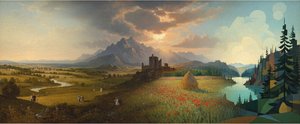
Corbet's artistic output focused predominantly on Italian landscapes, reflecting both his personal fascination with the region and the prevailing aesthetic trends of his time. He exhibited extensively throughout Europe, garnering acclaim for works like “Etruscan Scene,” a panoramic vista capturing the grandeur of the Carrara Mountains (1890), and "The Arcadian Shepherd and His Flock," an idyllic portrayal of rural tranquility imbued with Romantic idealism (1883). These paintings exemplify Corbet’s commitment to realism tempered by Impressionistic considerations, demonstrating his ability to convey emotion through color and texture. Notably, he secured a bronze medal at the Paris Exposition of 1889 for “Sunrise,” showcasing his talent in capturing atmospheric effects—a testament to his dedication to artistic experimentation.
Further cementing his legacy was Corbet’s acquisition by Tate Britain under the Chantrey bequest, where "Val d'Arno Evening" (1901) resides today. This evocative depiction of twilight over the Arno River exemplifies Corbet’s masterful use of color and light—a skill honed through years of meticulous study and artistic practice. His work continues to resonate with viewers captivated by its serene beauty and skillful execution, securing his place as a cornerstone of Victorian landscape painting and an influential voice within the Macchiaioli movement. He married Edith Murch (née Edenborough) in 1891, establishing a stable domestic life alongside his artistic pursuits.