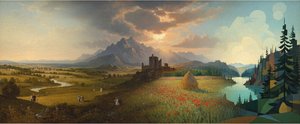
William Jabez Muckley: Weaver of Atmospheric Landscapes
William Jabez Muckley, a name perhaps less familiar than some of his contemporaries, nevertheless stands as a significant figure in 19th-century British art. Born in Kingswinford, Staffordshire, in 1829, Muckley’s artistic journey began not with formal training but through practical experience – initially as a glasscutter for the renowned Richardson firm. This early apprenticeship instilled a meticulous eye for detail and an appreciation for texture, qualities that would profoundly influence his later paintings. However, it was his transition to art school at Birmingham in 1852 that truly ignited his creative spirit, setting him on a path toward capturing the evocative beauty of the English countryside. Muckley’s life wasn't solely dedicated to painting; he held positions as headmaster of various schools of art – first Burslem, then Wolverhampton, and finally Manchester – demonstrating a commitment to nurturing artistic talent across generations.
Early Influences and Artistic Style
Muckley’s artistic style is often described as distinctly atmospheric, characterized by a profound sense of mood and an almost melancholic beauty. He drew heavily from the traditions of Dutch and Flemish still-life painting, particularly the works of artists like Jan van Eyck and Pieter Bruegel the Elder, evident in his meticulous rendering of textures – the dampness of moss, the sheen of water, the rough bark of trees. His compositions frequently featured humble subjects: bundles of grapes, solitary flowers, weathered farm implements, and glimpses of rural life. These weren’t grand landscapes intended to inspire awe; rather, they were intimate studies designed to evoke a feeling of quiet contemplation and connection with nature. The muted color palettes – dominated by browns, greens, greys, and blues – further contribute to the paintings' somber yet captivating atmosphere. A key element in his work is the skillful use of light and shadow, creating depth and drama within each scene.
Key Works and Notable Achievements
Several of Muckley’s works stand out as particularly compelling examples of his artistic vision. “Muscats,” a stunning depiction of grapes glistening with moisture on a silver salver, exemplifies his mastery of texture and color. The painting isn't merely a representation of fruit; it’s an exploration of light, reflection, and the fleeting beauty of a single moment. “After School” offers a poignant glimpse into rural life, capturing the quiet dignity of children returning from school amidst a bleak winter landscape. These paintings, along with numerous others, were exhibited at the Royal Academy between 1859 and 1904, solidifying his reputation as a respected artist within the British art world. Beyond his painting, Muckley’s “The Student's Manual of Artistic Anatomy” (1878) showcased his dedication to sharing his knowledge and expertise with aspiring artists.
Family Legacy and Continuing Influence
Muckley’s artistic lineage extended beyond himself. His brother, Joseph Fairfax Muckley, was a skilled engraver, while his son, Angelo Fairfax Muckley, followed in his father's footsteps as an illustrator. Furthermore, two of his nephews – Louis Fairfax Muckley and Ferdinando Fairfax Muckley – also pursued careers as artists and illustrators, contributing to a family legacy deeply intertwined with the visual arts. The influence of William Jabez Muckley’s work can be seen in later generations of British landscape painters who sought to capture the subtle beauty of the English countryside through atmospheric brushwork and evocative color palettes. His dedication to teaching and his meticulous approach to detail continue to resonate within art education today.
Historical Significance
William Jabez Muckley’s contribution to 19th-century British art lies not in grand, heroic narratives but rather in his quiet observation of the everyday world. He captured a sense of melancholy and beauty that resonated with Victorian sensibilities, reflecting a growing interest in nature and a shift away from overtly romanticized depictions of the landscape. His work provides valuable insight into the artistic practices and educational systems of the era, and his paintings serve as poignant reminders of a bygone time—a time when art was often deeply connected to craft, observation, and a profound appreciation for the simple beauty of life.