The Roots of Observation
Born in the serene landscape of Kosczin, Witold Jan Chmielewski’s artistic soul was deeply rooted in the rhythms of rural Poland. His journey began with a profound, quiet dedication to observing the world around him, a sensitivity that would later define his entire oeuvre. This foundational understanding was refined through rigorous academic training at the Academy of Fine Arts in Warsaw, where he studied under the guidance of masters such as Eugeniusz Lorenz and Stanisław Witkiewicz. From these mentors, Chmielewski inherited a deep respect for realism and an acute sensitivity to tonal nuances, elements that became the very heartbeat of his work. His early years were a period of absorbing the light and shadow of the Polish countryside, preparing him for a lifetime of translating the mundane into the monumental.
Under-Realism and the Tactile Canvas
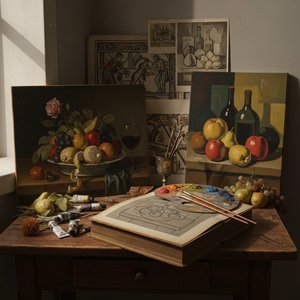
As his career matured, Chmielewski moved away from flamboyant gestures, choosing instead to cultivate a style defined by understated elegance. He became a pioneer of what he termed under-realism—a concept he proclaimed in 1974 as a soulful alternative to the official art of the PRL era. This approach was not mere imitation; rather, it was a synthesis of reality and poetic interpretation. Through his masterful use of texture, particularly the heavy application of impasto, Chmielewski breathed life into his subjects. His canvases possess a palpable materiality, where the surface of the paint itself conveys the weight of a landscape or the humble presence of an interior object. In his hands, a simple scene becomes a tactile experience, inviting the viewer to feel the very grain of the world he depicted.
A Lasting Artistic Legacy
The enduring power of Chmielewski’s work lies in its ability to find profound meaning within the everyday. Whether capturing the golden light bathing a Polish field or the psychological depth of a portrait, his art remains an intimate dialogue between the artist and his subject. One of his most hauntingly beautiful achievements, Still Life with a Skull, currently held at the National Museum in Kraków, serves as a testament to his ability to distill complex human emotions into deceptively simple forms. Through muted colors and subtle shading, he explores themes of beauty and mortality with a grace that avoids melodrama. Chmielewski’s legacy is that of a painter who did not seek to shout, but to whisper truths about the human condition, leaving behind a body of work that continues to resonate with the quiet dignity of the Polish spirit.