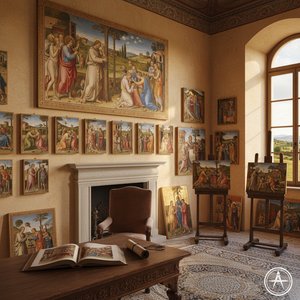


A Renaissance Revelation: The Bardi Chapel
Within the hallowed, sun-drenched expanse of the Basilica of Santa Croce in Florence, there exists a sanctuary where the boundaries between the earthly and the divine seem to dissolve. The Bardi Chapel is not merely a religious alcove; it is a profound testament to the dawn of humanism and the revolutionary genius of Giotto di Bondone. As one steps into this intimate space, the heavy weight of Byzantine tradition gives way to a new, breathing reality. Here, the fourteenth century finds its voice through a cycle of frescoes that transformed the trajectory of Western art, replacing static, symbolic icons with figures possessing weight, volume, and an unmistakable psychological depth.
The chapel’s narrative is anchored by Giotto’s masterful depiction of the life of Saint Francis of Assisi. Commissioned by the illustrious Bardi family—the powerful Florentine bankers whose economic influence mirrored the city's burgeoning political ascent—these frescoes serve as a dramatic, continuous tapestry of faith and experience. In scenes such as St. Francis before the Sultan , one witnesses the artist’s pioneering use of light and shadow to create a sense of three-dimensional space, a technique that would later become the cornerstone of Renaissance painting. The emotional resonance is palpable; Giotto captures the raw tension of a trial by fire and the quiet, somber dignity of The Transito di Francesco , where the saint's death is rendered with a sensitivity that invites the viewer into a shared moment of mourning and spiritual transcendence.
Architecturally, the chapel embodies the elegant simplicity of the Gothic style, designed to foster a sense of contemplative harmony. The spatial arrangement, though intimate, possesses an expansive spiritual reach, enhanced by original polychrome stained-glass windows that filter the Florentine light into an ethereal glow. While the chapel has weathered centuries of change—including periods of neglect and even whitewashing that temporarily obscured Giotto’s brilliance—recent, meticulous conservation efforts by the Opificio delle Pietre Dure have breathed new life into these fragile surfaces. This restoration has not only stabilized the plaster but has also reclaimed the vibrant color palettes and intricate details that once dazzled the eyes of Renaissance pilgrims.
For the art historian, the collector, or the designer seeking inspiration in the classics, the Bardi Chapel offers an unparalleled encounter with the origins of modern visual language. It is a place where the legacy of Giotto meets the grandeur of Florentine history, standing as a cornerstone of the UNESCO World Heritage site that is Santa Croce. To visit this chapel is to embark on a pilgrimage through time, witnessing the exact moment when art began to look more closely at the human soul, making it an essential destination for anyone captivated by the enduring power of the Renaissance spirit.