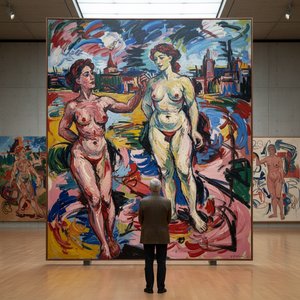
Francisco Gutiérrez Cossío (Pancho Cossío): A Cuban Visionary
Francisco Gutiérrez Cossío, known affectionately as Pancho Cossío, was a pivotal figure in Cuban art history—a painter who relentlessly pursued his own unique aesthetic vision amidst the turbulent backdrop of 20th-century Latin America. Born in Pinar del Río, Cuba, in 1894, Cossío’s artistic journey began under the tutelage of Jojo, a celebrated Cuban artist whose influence instilled in him an early appreciation for bold color palettes and expressive brushstrokes—a foundation that would shape his distinctive style.
Early Training & Influences
Cossío's formative years were marked by exposure to Post-Cubist principles, yet he swiftly transcended these movements, forging a path toward an intensely personal artistic idiom. His studies encompassed diverse techniques and styles, demonstrating adaptability and intellectual curiosity. He absorbed the lessons of Jojo, recognizing the importance of capturing emotion through color and texture—a stylistic approach that would define his oeuvre.
Distinctive Style
Cossío’s oeuvre is characterized by its striking use of vibrant hues—often juxtaposed in dramatic compositions—and imbued with a palpable sense of melancholy or impending doom. Recurring motifs included portraits capturing the essence of human emotion, marinas depicting turbulent seascapes brimming with symbolic resonance, and still lifes meticulously arranged to convey narratives of decay and beauty. His canvases pulsate with an inner luminescence—a testament to his masterful manipulation of light and shadow, transforming inanimate objects into vehicles for emotional expression.
Notable Works
Among Cossío’s most enduring creations is “Portrait of His Mother,” completed in 1942—a poignant depiction reflecting familial bonds and conveying profound psychological depth. The painting captures a moment of quiet intimacy, rendered with meticulous detail—a masterful demonstration of his ability to distill complex feelings into visual form. Similarly, “Still Life with Porcelain” (1945) exemplifies his masterful manipulation of light and shadow, transforming inanimate objects into vehicles for emotional expression. The porcelain fragments shimmer under a diffused glow, symbolizing fragility and remembrance—a subtle yet powerful narrative conveyed through artistic technique.
Museum Collections & Recognition
Cossío’s artwork gained considerable acclaim and secured a prominent place within prestigious museum collections—most notably the Museo Nacional de Bellas Artes de La Habana in Cuba, where it serves as an invaluable testament to Cuban artistic heritage. Furthermore, his paintings were showcased in the colección Andrés Blaisten in Mexico, highlighting the breadth of his influence across Latin American art circles.
Contemporary Artists Influenced
Cossío’s stylistic innovations resonated deeply with subsequent generations of artists—including Carlos Mérida, Federico Cantú Garza, and Casimiro Castro—who acknowledged Cossío's profound impact on their artistic sensibilities. Their works bear witness to the enduring legacy of Cossío’s distinctive approach to color, composition, and emotional portrayal—a testament to his unwavering commitment to exploring the complexities of human experience through art.