Ivan Konstantinovich Aivazovsky (Hovhannes Aivazian): Embodies the Romantic Spirit of the Sea
Ivan Konstantinovich Aivazovsky, born Hovhannes Aivazian in 1817, was more than just a painter; he was inextricably linked to the soul of the Black Sea—a vast expanse that would dominate his artistic vision and propel him to unparalleled fame. His existence seemed to unfold alongside its turbulent currents, mirroring its unpredictable beauty and inherent danger. Born in Feodosia, Crimea – a city he would spend much of his life inhabiting – Aivazovsky possessed an innate connection to the sea that transcended mere observation; it was felt deeply within his artistic sensibility. This formative influence began early on, nurtured by architect Jacob Koch who recognized his prodigious talent and solidified by the rigorous academic training afforded him at Saint Petersburg’s Imperial Academy of Arts. Yet, formal education alone couldn't fully capture the essence of Aivazovsky’s understanding; it was the ceaseless wind whipping across the Black Sea shore and the cries of gulls circling overhead that truly sculpted his artistic spirit.
Early Life and Artistic Foundations
Hovhannes Aivazian’s Armenian heritage played a crucial role in shaping his worldview and informing his artistic pursuits. Baptized at St. Sargis Armenian Church in Feodosia, he maintained strong ties to his cultural roots throughout his life—occasionally incorporating Armenian motifs into his expansive oeuvre. From humble beginnings, fueled by unwavering determination and supported by the patronage of influential figures like Czar Nicholas I, Aivazovsky ascended to become one of Russia’s most celebrated artists. His formative years were marked by a fascination with European art movements, particularly Romanticism – an aesthetic that championed emotion, imagination, and the sublime grandeur of nature—influences evident in his stylistic choices and thematic explorations. The Imperial Academy instilled in him meticulous technique and fostered a disciplined approach to artistic creation, equipping him with the tools necessary for achieving mastery over his medium.
The Rise of a Naval Painter: Patronage and Artistic Transformation
A pivotal moment arrived when Aivazovsky was appointed official painter of the Russian Navy—a position that granted him unparalleled access to maritime life, naval battles, and firsthand observation. This wasn’t merely an honorific title; it was transformative – providing him with invaluable material for his art and cementing his reputation as a visionary artist. He became intimately acquainted with the daily rhythms of seafaring existence, immersing himself in the sights, sounds, and smells of shipyards and naval maneuvers. These experiences profoundly impacted his artistic perspective, fueling his passion for depicting dramatic scenes of maritime heroism and conveying the raw power of the ocean. The patronage of the Imperial family further bolstered his career, affording him considerable financial stability and allowing him to dedicate himself entirely to his craft.
A Master of Romantic Seascapes: Style and Technique
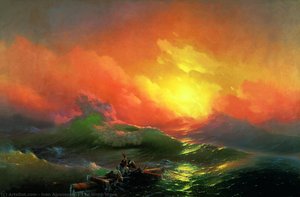
Aivazovsky’s artistic style is instantly recognizable for its dramatic compositions, masterful use of color, and evocative rendering of atmospheric effects—characteristics firmly rooted in the Romantic movement. He excelled at capturing the sublime beauty of nature, particularly the turbulent seascapes that defined his oeuvre. His technique involved painstaking attention to detail, employing thin layers of paint to achieve luminous textures and conveying a palpable sense of dynamism. Like Turner before him, Aivazovsky sought to evoke emotion rather than simply documenting reality—capturing not just what he saw but what he felt when confronted with the immensity and majesty of the ocean. His paintings are characterized by bold brushstrokes, vibrant hues, and dramatic lighting—elements that contribute to their enduring power and beauty. Notable works include *The Ninth Wave*, a harrowing depiction of shipwreck survivors battling colossal waves—a testament to his ability to convey terror and resilience simultaneously.
## Legacy and Enduring Influence
Ivan Konstantinovich Aivazovsky remains one of Russia’s most revered artists—a figure whose influence extends far beyond the realm of painting. His prolific output – approximately 6,000 canvases—established him as a titan among his contemporaries and cemented his place in art history. He profoundly impacted subsequent generations of Russian painters, inspiring them to embrace Romantic ideals and explore the expressive potential of landscape painting. Beyond artistic achievement, Aivazovsky’s unwavering dedication to his craft embodies the spirit of perseverance and ambition—a legacy that continues to resonate with audiences worldwide. His paintings are exhibited in museums across continents, captivating viewers with their breathtaking beauty and conveying a timeless message about humanity's relationship with nature. He is remembered not only for his artistic brilliance but also for his patriotic fervor – celebrating Russian naval victories and bolstering national pride. Aivazovsky’s enduring fame testifies to the power of art to transcend time and inspire awe—a testament to the genius of a man who truly understood how to capture the soul of the sea.