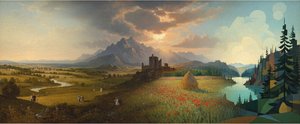
The Serene Vision of Carl Frederik Peder Aagaard
In the golden era of Danish landscape painting, few artists captured the quiet majesty of the natural world with as much understated elegance as Carl Frederik Peder Aagaard. Born in 1833 to a humble shoemaker’s family, Aagaard’s journey from the modest surroundings of Odense to the prestigious halls of the Royal Danish Academy of Fine Arts is a testament to a life defined by meticulous study and an unwavering devotion to his craft. His early years were marked by a burgeoning talent that eventually led him to Copenhagen in 1852, where he sought to refine his skills alongside his brother, Johan. This period of transition was not merely a change in geography but a profound immersion into the technical rigors of etching, wood drawing, and decorative painting, disciplines that would later infuse his landscapes with a unique structural depth and ornamental grace.
Aagaard’s artistic evolution was deeply shaped by the mentorship of masters. Under the guidance of Georg Hilker, he mastered the intricate nuances of decorative arts, a skill set that allowed him to bridge the gap between fine art and architectural embellishment. However, it was his study under the renowned P.C. Swovgaard that truly unlocked his potential as a landscape painter. This partnership enabled Aagaard to move beyond mere representation, allowing him to capture the atmospheric soul of the Danish countryside. His work often focused on idyllic, sun-drenched spots frequented by travelers, transforming popular tourist locations into timeless, emotive scenes that resonated with the romantic sensibilities of the 19th century.
A Legacy of Decorative Splendor and Civic Art
While his landscapes are celebrated for their tranquility, Aagaard’s contribution to the decorative landscape of Denmark was equally monumental. He possessed a rare versatility, capable of applying his delicate touch to both intimate canvases and grand public spaces. His collaborative spirit led to significant historical achievements, such as:
- The Royal Veterinary and Agricultural University: Working alongside Hilker, he helped adorn the entrance hall, bringing artistic beauty to an institutional setting.
- Roskilde Cathedral: In a magnificent display of craftsmanship, Aagaard and Heinrich Hansen contributed intricate decorative borders for the murals of Wilhelm Marstrand, leaving a lasting mark on one of Denmark's most sacred sites.
- Theatrical and Civic Commissions: His reputation for excellence earned him independent commissions to decorate prestigious venues including Frijsenborg, the Dagmar Theater, and the National Scala.
These endeavors demonstrate that Aagaard was not merely a painter of scenery, but an artist of environments, understanding how art could elevate civic identity and communal spaces. His ability to navigate between the delicate precision of decorative borders and the expansive, breathing vistas of nature set him apart as a true polymath of the Danish art scene.
Accolades, Recognition, and Final Years
The trajectory of Aagaard’s career was marked by prestigious honors that reflected his growing stature within the European art community. His first exhibition in 1857 brought immediate attention, leading to the receipt of the Neuhausenske Prize. In 1865, he achieved a historic milestone as the first recipient of the Sødringske Opmuntrings Prize, an honor bestowed for his evocative depiction of an autumn morning at the Jægersborg Dyrehave—a work so profound it was acquired by the National Gallery of Denmark. His technical mastery and dedication were further recognized when he was elected a member of the Royal Academy in 1874 and eventually appointed as a professor.
Beyond the canvas, Aagaard’s life was intertwined with the cultural fabric of his era. He lived in a home designed by the celebrated architect Vilhelm Dahlerup, a structure built from the very stones of the original Royal Danish Theater, symbolizing his deep connection to the heritage of his nation. Even as he traveled to Italy in the 1870s to capture the Mediterranean light, his heart remained rooted in the soft, evocative landscapes of his homeland. When he passed away in 1895, he left behind a legacy of tranquil beauty and decorative brilliance, having successfully elevated the Danish landscape into a realm of poetic permanence.