Early Life and Training
Benozzo Gozzoli, born circa 1420 in Florence, Italy, descended from a family of prosperous farmers—a lineage that instilled in him an appreciation for meticulous craftsmanship and detailed observation. His father was a doublet maker, providing him with invaluable experience in manipulating fabrics and achieving textural harmony – skills that would later translate into his distinctive artistic style. While precise details about his formative years remain elusive, Gozzoli’s early training centered around the tutelage of Fra Angelico, arguably Florence's most celebrated painter of the Early Renaissance. This influential mentorship profoundly shaped his artistic sensibilities, exposing him to Angelico’s refined aesthetic and fostering a dedication to capturing spiritual beauty with unparalleled precision. Notably, Gozzoli’s initial works mirrored Angelico’s designs, demonstrating an unwavering commitment to stylistic continuity and establishing a foundational connection between their artistic visions. Notable Works and Collaborations
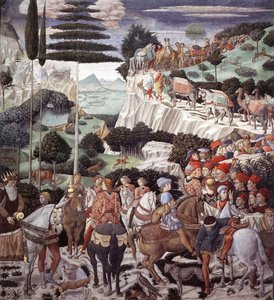
Benozzo Gozzoli's prolific output spanned across Tuscany and Umbria, cementing his reputation as one of the Renaissance's foremost muralists. Among his most iconic achievements is “The Journey of the Magi” (1459-1461), executed in the Magi Chapel of Palazzo Medici Riccardi—a fresco cycle that exemplifies Gozzoli’s mastery of International Gothic style. The chapel’s vibrant colors, intricate draperies, and meticulously rendered figures convey a palpable sense of grandeur and evoke the atmosphere of a medieval pilgrimage. Furthermore, he collaborated seamlessly with Lorenzo Ghiberti on the third bronze door of the Baptistery in Florence (1444-1447), contributing to this monumental artistic endeavor—a testament to his collaborative spirit and technical prowess. Gozzoli’s involvement extended beyond individual projects; he served as a crucial assistant to Fra Angelico during the decoration of San Marco Monastery, furthering his stylistic dialogue with Angelico's oeuvre. His contribution to Pope Nicholas V’s chapel in Rome (1447) showcased his ability to adapt to diverse artistic contexts and maintain a consistently high level of artistic excellence. Artistic Style and Legacy
Gozzoli’s distinctive style—characterized by its meticulous attention to detail, harmonious color palettes, and subtle incorporation of International Gothic influences—stands apart from many of his contemporaries. Unlike Michelangelo or Leonardo da Vinci, who favored dramatic compositions and expressive gestures, Gozzoli prioritized elegance and refinement, achieving a remarkable balance between decorative splendor and psychological depth. His frescoes frequently depict processions with figures dressed in sumptuous robes and adorned with elaborate jewelry—a stylistic choice that reflects the opulent patronage of Florentine elites during his lifetime. However, Gozzoli’s artistic legacy transcends mere stylistic imitation; he championed a humanist vision of art rooted in observation and naturalism—a departure from medieval conventions that anticipated developments in later Renaissance painting. His unwavering dedication to capturing the beauty of the human form and landscape—as evidenced by “The Procession of the Magi”—established him as a pivotal figure in shaping the aesthetic sensibilities of his era. Key Dates
* Born: Circa 1420, Florence, Italy
* Active: Florence, Umbria, Rome (1444-1497)
* Died: Oct. 4, 1497, Pistoia