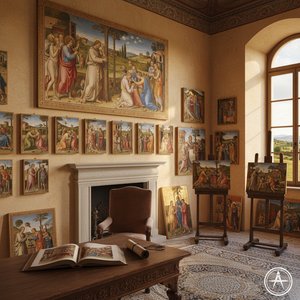
The Baroque Visionary of Naples: The Life and Legacy of Andrea di Leone
In the sun-drenched, tumultuous landscape of seventeenth-century Naples, a period defined by dramatic contrasts and spiritual intensity, Andrea di Leone emerged as a master of the Baroque soul. Born in 1610, Leone was not merely a painter but a chronicler of movement, conflict, and divine intervention. His life’s work serves as a bridge between the disciplined classical traditions of his mentors and the burgeoning theatricality that would define the Neapolitan school. To study Leone is to witness the evolution of an artist who could capture both the thunderous clash of steel in a battlefield scene and the quiet, profound sanctity of a biblical narrative with equal, breathtaking precision.
The foundations of Leone’s artistry were laid under the watchful eyes of two titans of the Neapolitan era: Belisario Corenzio and Salvator Rosa. From Corenzio, Leone inherited a talent for large-scale allegorical compositions and the technical rigor required for monumental fresco work. It was during his early years that he collaborated with Corenzio on the frescoes for the Viceroy’s palace, a prestigious commission that signaled his arrival as a significant figure in the royal circles of Naples. However, it was the influence of Salvator Rosa—a master of wild, emotive landscapes—that likely infused Leone’s work with a sense of atmospheric drama and spiritual depth. This early training provided him with a dual mastery of structured grandeur and expressive, untamed emotion.
A Journey Through Light, Shadow, and Academic Rigor
As his career progressed, Leone sought further refinement, eventually entering the studio of Aniello Falcone. This period of rigorous academic training was transformative, as Falcone’s emphasis on idealized forms and the dramatic use of chiaroscuro—the interplay of light and shadow—became a cornerstone of Leone’s mature style. Through this lineage, Leone’s work began to mirror the stylistic innovations sweeping through Italy, blending a distinctly Neapolitan sensibility with the broader currents of Venetian and Roman art. His ability to manipulate light allowed him to breathe life into his subjects, making the textures of armor, the softness of skin, and the heavy atmosphere of a storm feel tangibly present to the viewer.
Leone’s artistic development was further enriched by his encounters with other masters of the age. The influence of Giovanni Benedetto Castiglione is particularly evident in Leone's more romantic and detailed works. Inspired by Castiglione’s The Voyage of Jacob, Leone produced masterpieces such as his own Voyage of Jacob (1635–40), which showcased an elegant integration of Old Testament drama with lush, still-life details and softly atmospheric landscapes. This ability to weave genre elements—such as animals and intricate objects—into grand historical narratives gave his paintings a unique psychological depth and a richness that captivated both local patrons and international collectors.
Monumental Achievements and Historical Significance
The true greatness of Andrea di Leone lies in his capacity to command the vast spaces of the era's most important religious and civic institutions. His legacy is etched into the very walls of Naples and Milan, where his frescoes and canvases served as windows into the divine and the historical. His contributions to the decoration of San Paolo Maggiore in Milan and the Cathedral of Naples stand as testaments to his status as a premier decorator of the Baroque period.
Beyond his religious commissions, Leone’s work captured the political pulse of his time. Whether depicting the monumental battles that shaped empires or the more intimate, often turbulent, moments of local history—such as his portrait of the rebel leader Masaniello—Leone possessed a rare ability to translate historical upheaval into visual poetry. His career, which saw him succeed Corenzio as the director of painting for the royal palace, represents a vital link in the continuity of Neapolitan art. Today, we remember Andrea di Leone not just as a painter of scenes, but as an architect of emotion, whose brush captured the fleeting, magnificent drama of the Baroque age.