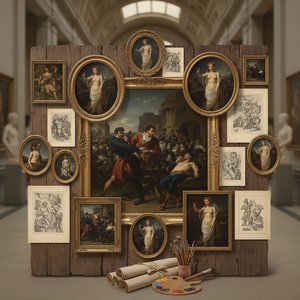
A Life Bathed in Light: The World of Juan van der Hamen
Juan van der Hamen y León (1596 – 1631) stands as a singular beacon within the tapestry of Spanish Baroque art, an artist whose brief but brilliant career irrevocably shaped the visual landscape of Madrid and cemented his place among the most influential painters of his era. Born in Madrid on April 8, 1596, into a lineage steeped in cultural heritage – his father, Jan van der Hamen, a Flemish courtier who had established himself in Spain decades prior, and his mother, Dorotea Witman Gómez de León, descended from noble Toledan ancestry – Juan’s upbringing instilled within him an appreciation for both Northern European precision and the expressive fervor of Iberian tradition. This dual influence would subtly permeate his artistic style, creating a distinctive aesthetic that transcended geographical boundaries. While definitive biographical details remain scarce—scholarly research continues to illuminate facets of his life—evidence suggests he enjoyed considerable patronage from Philip III and Philip IV, affording him the freedom to pursue his creative vision without constraint. The family’s deliberate embrace of Spanish identity – incorporating “Gómez de León” into their names – symbolized a harmonious integration into Iberian society.
From Versatility to Mastery: The Artistic Journey
Van der Hamen's artistic trajectory commenced in 1619 with a commission for a still life destined for the royal palace of El Pardo, marking an early foray into what would become his defining preoccupation: *bodegones*. However, confining him solely to this genre overlooks the remarkable breadth of his talent. He demonstrated proficiency across diverse stylistic domains – religious history paintings imbued with solemn grandeur, allegorical scenes exploring moral and philosophical concepts, landscapes rendered with atmospheric subtlety—even portraits capturing the psychological nuances of individual subjects. This versatility speaks to an inquisitive spirit and unwavering dedication to honing his craft, qualities that propelled him to unparalleled heights of artistic accomplishment. Serving both monarchs fostered a vibrant intellectual milieu where he engaged in spirited debates about art and literature, mirroring the humanist sensibilities prevalent throughout Spain at the time. He absorbed influences from Flemish masters like Sánchez Cotán, adopting asymmetrical compositions that injected dynamism into his paintings—a departure from more rigid conventions—and mastering techniques of dramatic lighting to create strikingly contrasting shadows. This stylistic evolution signaled a decisive move toward a uniquely Spanish Baroque aesthetic, characterized by an intense realism and profound emotional resonance.
Still Life, Portraiture, and Allegory: Defining Achievements
Van der Hamen’s contribution to the *bodegón* genre is unparalleled; he elevated it from mere decorative embellishment to a vehicle for contemplation on mortality and beauty—a testament to his artistic sensitivity. His meticulous attention to detail—capturing textures with astonishing accuracy—transformed commonplace objects into symbols of profound significance. Unlike many artists of his time who prioritized spectacle, Van der Hamen focused on conveying inner truth through visual representation. Beyond still life, he achieved considerable renown as a portraitist, producing psychologically astute depictions of prominent intellectuals and writers – figures like Lope de Vega, Francisco de Quevedo, and Luis de Góngora—who engaged in spirited dialogues about art and philosophy. These portraits weren’t merely representations of physical appearance; they were explorations of character and intellect, reflecting the humanist ideals that dominated Spanish culture during his lifetime. His magnum opus, *Offering to Flora*, painted in 1627, exemplifies his mastery of Flemish compositional principles while simultaneously conveying a deeply symbolic message about fertility and renewal. The painting’s luminous palette and masterful use of light—particularly its dramatic interplay with fabrics—demonstrate Van der Hamen's unparalleled technical skill. Furthermore, he secured the prestigious commission to portray Cardinal Francesco Barberini in 1626—a project initially undertaken by Velázquez but ultimately deemed unsatisfactory—solidifying his reputation as one of Spain’s foremost artists.
A Legacy Illuminated: Influence and Artistic Significance
Juan van der Hamen's tragically premature demise in 1631 at the age of thirty-five curtailed his artistic career, yet his legacy endured—inspiring generations of Spanish painters who followed. He fundamentally reshaped the visual landscape of Madrid by establishing still life painting as a respected genre, challenging prevailing artistic hierarchies and advocating for stylistic innovation. His meticulous technique—characterized by painstaking observation and masterful execution—became a cornerstone of Baroque art in Spain. More importantly, he bridged the gap between Flemish artistic traditions and the burgeoning Spanish Baroque aesthetic, synthesizing elements from both to forge a distinctive Iberian visual language. Van der Hamen’s paintings continue to captivate audiences today with their beauty, realism, and profound emotional depth—a testament to his enduring genius and his indelible contribution to art history. He remains an artist whose work embodies the spirit of intellectual curiosity and artistic experimentation that defined the Spanish Baroque era.