Nicola De Maria: A Symphony of Color and Emotion
Born in Foglianise, Italy, in 1954, Nicola de Maria’s artistic journey is a compelling narrative of transformation – from medical studies to the vibrant explosion of color and layered imagery that defines his signature style. Initially drawn to the precision of medicine, he found himself increasingly captivated by the expressive potential of paint, ultimately abandoning his formal training to pursue a path dictated by intuition and emotion. This pivotal shift marked the genesis of a career dedicated to creating immersive environments where the boundaries between art and life blur, inviting viewers into a world rich with symbolism and psychological depth.
De Maria’s early work, emerging in the late 1970s within the influential Transavanguardia movement, established his core aesthetic. This Italian artistic collective, spearheaded by Achille Bonito Oliva, rejected the strict formalism of Minimalism and Conceptualism, instead embracing a return to figurative representation infused with historical references, mythological allusions, and a distinctly Baroque sensibility. Alongside artists like Sandro Chia, Francesco Clemente, and Enzo Cucchi, De Maria sought to synthesize diverse influences – from classical painting to Pop Art, and even elements of psychoanalysis – into a unified visual language. This period saw him experimenting with large-scale wall paintings, often executed in public spaces, creating communal experiences that challenged traditional notions of the gallery setting.
The Language of Color and Symbol
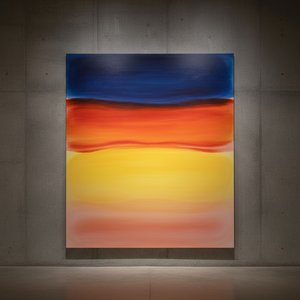
At the heart of De Maria’s oeuvre lies an extraordinary command of color – a palette dominated by intense primaries: red, blue, and yellow. These hues aren't merely decorative; they are imbued with profound symbolic weight, representing fundamental human emotions and psychological states. Red, frequently employed in his later works, embodies passion, energy, and even violence, while blue evokes contemplation, melancholy, and the subconscious. Yellow, often layered beneath these dominant colors, suggests optimism, joy, and a yearning for transcendence. His technique is equally significant; De Maria employs thick impasto layers of paint, creating tactile surfaces that invite physical engagement. He frequently incorporates elements of collage – fragments of fabric, paper, and other materials – into his compositions, adding further textural complexity and hinting at the fragmented nature of human experience.
Beyond color, De Maria’s work is replete with recurring motifs: musical instruments, stars, and celestial imagery. These symbols resonate deeply within his personal mythology, reflecting a lifelong fascination with music and spirituality. The inclusion of instruments – violins, trumpets, pianos – suggests the power of art to evoke emotion and connect individuals through shared experience. Stars, often depicted in swirling patterns, represent aspiration, hope, and the search for meaning in an uncertain world. His 1987 painting, “Giardino azzurrino Foglianise,” exemplifies this symbolic richness, transforming his childhood home into a vibrant landscape brimming with these potent emblems.
Wall Paintings and Immersive Environments
A defining characteristic of De Maria’s practice is his exploration of wall paintings. These monumental works, often executed on vast surfaces in public spaces – from churches to museums – create immersive environments that envelop the viewer. Unlike traditional murals, De Maria's wall paintings are not merely decorative; they function as portals into a psychological landscape, inviting contemplation and emotional resonance. The scale of these pieces is deliberately overwhelming, designed to disrupt the viewer’s sense of space and time, fostering a feeling of being transported to another realm.
His 1980 Venice Biennale contribution, “Space Paintings,” further solidified his reputation as a pioneer in this medium. These works, characterized by their dynamic composition and layered textures, demonstrated De Maria's ability to manipulate space and create a sense of movement within the confines of a two-dimensional surface. The influence of these early wall paintings continues to shape his practice today, informing his approach to large-scale installations and site-specific projects.
Legacy and Critical Reception
Nicola de Maria’s work has garnered significant critical acclaim over the course of his career. He is recognized as a key figure in the Transavanguardia movement and a leading contemporary painter, celebrated for his bold use of color, evocative symbolism, and innovative approach to wall painting. His art has been exhibited extensively throughout Europe and North America, including retrospectives at the Turin Civic Gallery of Modern and Contemporary Art and the Stedelijk Museum in Amsterdam. De Maria’s work continues to be studied and appreciated for its ability to evoke profound emotional responses and challenge conventional notions of artistic representation.
His art is held in prestigious collections worldwide, including those of the Castello di Rivoli Museo d'Arte Contemporanea in Turin and the Stedelijk Museum in Amsterdam. De Maria’s legacy extends beyond his individual creations; he has inspired a generation of artists to embrace emotional expression and explore new possibilities within the realm of painting.