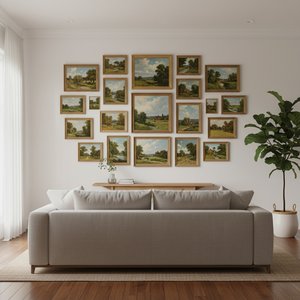
The Visionary of the English Wild: The Life and Art of Edmund George Warren
In the heart of the Victorian era, a period defined by both rapid industrial progress and a profound longing for the pastoral, Edmund George Warren emerged as a master of the English landscape. Born in London in 1834, Warren’s artistic soul was deeply rooted in the shifting tides of British Romanticism. While his beginnings were urban, his gaze was perpetually drawn toward the untamed beauty of the countryside. His early training at Marlborough College and the prestigious Slade School of Fine Art provided him with a rigorous academic foundation, particularly under the guidance of Frederic Leighton. This classical discipline allowed him to master the technical complexities of both oil and watercolor, yet it was his departure from the studio into the breathing, living world that would ultimately define his legacy.
Warren’s artistic evolution was marked by a unique synthesis of styles. While he drew significant inspiration from the atmospheric mastery of J.M.W. Turner and the pastoral sincerity of John Constable, he also became a pioneer in integrating the burgeoning ideals of the Pre-Raphaelite movement into landscape painting. He was among the first to adopt their devotion to "truth to nature," utilizing an intense color palette and a meticulous, almost scientific observation of detail. Unlike many of his contemporaries who remained tethered to studio-bound compositions, Warren sought out the raw essence of the land. His later move to Chudleigh, Devon, placed him at the doorstep of Dartmoor, a landscape that would become his greatest muse. Here, amidst rugged tors and shimmering streams, he found the perfect canvas for his explorations of light, texture, and seasonal change.
A Tapestry of Light and Earth
To observe a Warren landscape is to experience the quiet drama of the natural world. His technique was characterized by an extraordinary ability to capture the subtle nuances of atmosphere—the way mist clings to a valley or how the golden light of autumn transforms a wheat field. In his celebrated watercolor works, he employed delicate gradations of pigment to evoke the damp, heavy air of the moorlands, creating scenes that felt less like static images and perhaps more like captured moments in time. His approach to color was both vibrant and controlled, reflecting a deep understanding of how light interacts with organic surfaces, from the rough granite of a tor to the soft, swaying heather.
His oeuvre is populated by themes of seasonal rhythm and rural tranquility. Some of his most evocative works include:
- Harvest Time On The Dart: A breathtaking depiction of the River Dart, where the golden hues of ripening wheat meet the tranquil, reflective waters of the river, embodying the peaceful prosperity of Victorian agricultural life.
- Riverside Village with figures fishing: A charming portrayal of a small hamlet, capturing the idyllic and timeless connection between human settlement and the flowing artery of the river.
- Harvest Time By The Sea (detail): A serene exploration of coastal landscapes, where the terrestrial bounty of the fields meets the vast, rhythmic expanse of the ocean.
- Rest in the Cool and Shady Wood: A large-scale work that served as a centerpiece for his exhibitions, demonstrating his ability to create immersive, shaded environments that invite the viewer into the forest's embrace.
Legacy and the Enduring Spirit of the Moor
Though his critical reception during his lifetime was occasionally divided—with even the formidable John Ruskin questioning the "deceptive" nature of his technical skill—Warren’s impact on British landscape art remains undeniable. He successfully bridged the gap between the sweeping, emotive landscapes of the early 19th century and the precise, detail-oriented realism that would follow. As a member of both the New Society of Painters in Watercolours and the Royal Institute of Oil Painters, he helped shape the institutional landscape of British art, pushing for more inclusive exhibition standards.
Today, the works of Edmund George Warren serve as vital historical windows into a vanished era of England. His paintings do more than merely document the geography of Devon or the aesthetics of the Victorian countryside; they preserve the emotional resonance of a landscape before the full weight of modernity altered its face. Through his meticulous devotion to the textures of the earth and the fleeting qualities of light, Warren ensured that the rugged, romantic spirit of Dartmoor would remain eternally vibrant for generations to come.