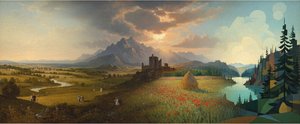
Johann Jakob Biedermann: A Pioneer of Swiss Landscape Painting
Johann Jakob Biedermann (August 7, 1763 – April 10, 1830) stands as a pivotal figure in the history of Swiss art, particularly recognized for his contribution to landscape painting during the Romantic era. Born in Winterthur, Switzerland, he embarked on an artistic journey shaped by formative influences from prominent artists like Johann Rudolph Schellenberg and Heinrich Rieter, establishing himself initially in Bern before venturing into broader European explorations that fueled his creative vision. His oeuvre embodies a distinctive blend of Neoclassical precision and Romantic sensitivity, capturing the grandeur of the Swiss Alps with unparalleled detail and conveying profound emotional resonance.
- Early Life & Artistic Training:
Biedermann’s formative years were marked by rigorous instruction under Schellenberg and Rieter, masters of Bernese Neoclassicism.
- Swiss Alps Landscapes:
His most celebrated works depict breathtaking vistas of the Bernese Oberland, showcasing meticulous observation of geological formations, vegetation patterns, and atmospheric conditions. These paintings exemplify the Romantic preoccupation with sublime beauty and evoke a sense of awe in viewers.
- European Travels & Artistic Development:
Driven by an insatiable curiosity for artistic innovation, Biedermann traversed Europe – Zurich, Paris, Frankfurt, Basel, Konstanz – absorbing stylistic trends from artists like Caspar David Friedrich and Eugène Delacroix.
Technique & Style: Bridging Neoclassicism and Romanticism
Biedermann’s artistic style represents a fascinating convergence of two dominant aesthetic currents. While rooted in the geometric clarity and idealized forms characteristic of Neoclassical painting, he skillfully incorporated elements of Romantic expressionism—particularly dramatic lighting and emotive brushwork—to imbue his landscapes with palpable atmosphere and psychological depth. He favored oil paints on canvas, applying thin glazes to achieve luminous tonal gradations that faithfully reproduced the subtleties of Alpine light. His meticulous attention to detail—evident in depictions of rocks, trees, and water surfaces—underscored his commitment to scientific accuracy alongside artistic artistry.
- Color Palette:
Biedermann’s palette leaned heavily on muted earth tones – ochres, siennas, umbers – complemented by splashes of vibrant blues and greens to convey the dynamism of Alpine environments.
- Brushwork:
His brushstrokes were characterized by a deliberate layering technique, creating textured surfaces that captured the ruggedness of mountain terrain and conveying an impression of movement.
Notable Works & Legacy
Among Biedermann’s most iconic paintings include “Blick vom linken Seeufer auf die Stadt Zürich und das Grossmünster,” a panoramic view capturing the cityscape alongside the serene waters of Lake Zurich, and “Stiftskirche St. Johann,” an impressive depiction of the cathedral in Regensburg, Bavaria—a testament to his artistic prowess and ability to convey architectural grandeur with emotional impact. These paintings continue to inspire admiration for their technical brilliance and aesthetic beauty.
- Influence on Romantic Landscape Painting:
Biedermann’s approach profoundly influenced subsequent generations of Swiss landscape painters, establishing a precedent for combining scientific observation with expressive artistic vision.
Recognition & Historical Significance
Johann Jakob Biedermann's contribution to Swiss art history is cemented by his inclusion in the UNESCO World Heritage Site designation of Stiftskirche St. Johann and Dortmund’s Propsteikirche, highlighting the enduring relevance of his artistic endeavors. His legacy extends beyond individual masterpieces—he represents a cornerstone of Romantic landscape painting and embodies the spirit of exploration and innovation that defined the era.