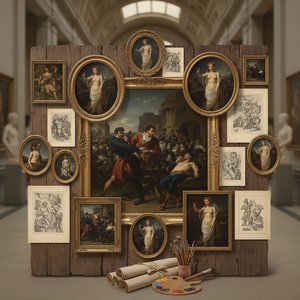
The Baroque Visionary of Granada
Teodosio Sánchez de Rueda stands as a pivotal figure in the artistic landscape of Granada and wider Spain during the height of the Baroque period. Born in 1676 into a family deeply steeped in artistic tradition, his life was shaped by the fervent religious atmosphere that defined Andalusia in the late seventeenth and early eighteenth centuries. As a master retablista—an artist specializing in the intricate decoration of altarpieces—and a skilled sculptor, Sánchez de Rueda possessed a rare ability to translate spiritual devotion into tangible, breathtaking grandeur. His legacy is not merely measured by the volume of his output, but by the profound emotional intensity and masterful execution that continue to captivate those who encounter his work today.
The foundations of his extraordinary talent were laid through rigorous classical training and prestigious apprenticeships. Educated within the esteemed Escuela Real de San Fernando in Granada, he was exposed to the burgeoning patronage of royal courts, which sought to foster an era of unparalleled artistic excellence. This formal education instilled in him a deep understanding of classical ideals, which he would later blend seamlessly with the dynamic energy of the Baroque style. His development was further refined under the guidance of masters such as Jerónimo Sánchez Ruéda and Tomás Jerónimo Pedraxas. These formative relationships were essential, providing him with the technical vocabulary and stylistic sensibilities that allowed him to establish himself as a respected craftsman within the competitive artistic community of Granada.
A Mastery of Light, Ornament, and Emotion
The artistic essence of Sánchez de Rueda is undeniably rooted in the Baroque aesthetic, a style defined by its theatricality and dramatic tension. His compositions are characterized by a masterful use of chiaroscuro, where the interplay of deep shadows and brilliant light creates a sense of movement and spiritual presence. He possessed a particular talent for opulent ornamentation, decorating altarpieces with such complexity that they seemed to vibrate with life. This penchant for theatrical staging and expressive color was influenced by contemporaries like Francisco Hurtado Izquierdo, yet Sánchez de Rueda transcended mere imitation to develop a singular, personal vision.
His work often functioned as a visual bridge between the earthly and the divine. By utilizing dramatic compositions and emotionally charged figures, he sought to convey the profound spiritual fervor of his era. His mastery extended beyond simple sculpture into the realm of architectural integration, where his altarpieces became central, transformative elements of the sacred spaces they inhabited. The following elements define his stylistic hallmarks:
- Dramatic Chiaroscuro: The use of intense light and shadow to sculpt form and evoke mystery.
- Opulent Ornamentation: A rich, detailed approach to decoration that reflects the grandeur of the Baroque era.
- Emotional Depth: A focus on capturing the raw, spiritual intensity of religious narratives.
- Theatricality: The creation of immersive, stage-like environments within church interiors.
Legacy and Historical Significance
Though his life was relatively short, ending in 1730, the impact of Teodosio Sánchez de Rueda on Spanish Baroque art remains significant. He belonged to a lineage of artists who shaped the visual identity of Andalusia, contributing to a period where art served as the primary medium for religious and cultural expression. His work helped define the aesthetic of the retablo, turning altarpieces into monumental masterpieces of wood, gold, and sculpture. Through his dedication to both form and feeling, he ensured that the spiritual narratives of his time were etched permanently into the architectural fabric of Spain.