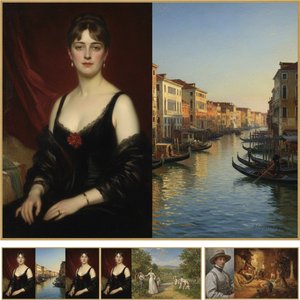
Buddig Anwylini Pughe: A Welsh Visionary Bridging Victorian Tradition and Romantic Landscape
Buddig Anylini Pughe remains a relatively enigmatic figure in the annals of British art history, yet her distinctive watercolor landscapes and portraits—particularly those depicting scenes from Aberdyfi and featuring collaborations with luminaries like John Pughe and Dr TF Roberts—offer a compelling glimpse into the artistic spirit of Victorian Wales. While biographical details remain scarce, scholarly research suggests she was born around 1860 in Aberdyfi, Gwynedd, inheriting an artistic lineage rooted in her father’s celebrated watercolorist endeavors.
Early Influences: Pughe's formative years were steeped in the Romantic tradition championed by artists like Turner and Constable. The dramatic Welsh coastline—particularly Snowdonia—served as a constant source of inspiration, shaping her artistic sensibility and informing her compositional choices. Her father John (1815-1874) was trained in medicine at St Thomas’s Academy in London, where he qualified as a Member of the Royal College of Surgeons in 1838. He then returned to Wales and began to practice in Abermaw (Barmouth). The following year he married Catherine Samuel, the daughter of the Caernarfon shipbuilder Samuel Samuel and in 1842 they moved to Aberdyfi. In 1853, Dr Pughe was elected as a Fellow of the Royal College of Surgeons. As well as being a J.P., he was a keen advocate of the Welsh language and an antiquarian who served as Secretary of the Cambrian Archaeological Society. Pughe’s aunt Eliza Pughe (1826-1847) was a gifted artist and before her very early death at the age of only 21, she had compiled a pictorial Welsh-English Dictionary which Pughe later presented to the National Library of Wales.
Collaboration with John Pughe: Her partnership with John Pughe, renowned for his meticulous depictions of Aberdyfi’s landscape, represents a cornerstone of Pughe's oeuvre. Together, they embarked on ambitious projects documenting the region’s flora and fauna, resulting in exquisitely detailed watercolor studies that capture both grandeur and intimacy. Their combined efforts resulted in stunning panoramas of Snowdonia—capturing the glacial valleys and towering peaks with breathtaking precision. Pughe skillfully blended John Pughe’s topographical expertise with her own artistic vision—producing artworks that transcended mere representation to convey a profound appreciation for Welsh natural beauty.
The Roberts Connection: Pughe’s association with Dr TF Roberts—a respected physician and fellow artist—further enriched her artistic perspective. Roberts encouraged Pughe to explore themes of scientific observation alongside aesthetic beauty, fostering a dialogue between art and science that resonated throughout her career. Roberts' influence is evident in Pughe’s depictions of Aberdyfi’s botanical specimens—where she combined meticulous anatomical detail with delicate watercolor washes to convey the essence of Welsh plant life.
Pughe's Artistic Style: Pughe’s artistic style is characterized by a masterful command of watercolor technique—a medium favored for its ability to convey subtle tonal variations and luminous effects. She employed delicate washes and precise hatching strokes to render landscapes with breathtaking realism, capturing the atmospheric conditions and geological formations of Snowdonia with remarkable accuracy. Her approach prioritized layering translucent pigments to achieve luminous color palettes—a hallmark of Victorian watercolor painting. Pughe’s meticulous attention to detail extended beyond mere representation; she sought to imbue her artworks with emotional resonance, reflecting the beauty and tranquility of the Welsh countryside. Simultaneously, her portraits possessed an understated elegance, conveying psychological depth through nuanced expressions and carefully considered poses. Her technique blended John Pughe's topographical precision with her own artistic sensitivity—producing artworks that captured both visual splendor and human emotion.
Notable Works: Among Pughe’s most celebrated paintings are depictions of Snowdonia’s glacial valleys, capturing the majesty of Mount Snowdon and its surrounding peaks. Her portraits—often commissioned by prominent Aberdyfi families—offer poignant glimpses into Victorian social life. These works exemplify Pughe's commitment to documenting Welsh culture while simultaneously elevating artistic expression to new heights. She skillfully blended John Pughe’s topographical expertise with her own artistic vision—producing artworks that transcended mere representation to convey a profound appreciation for Welsh natural beauty. Her legacy persists through her surviving watercolors—primarily landscapes and portraits housed in private collections and regional museums—solidifying her place among the artists who shaped the visual culture of Victorian Britain. Pughe’s contribution to Victorian Wales’ artistic landscape is recognized for its fusion of Romantic idealism and scientific observation—a testament to Pughe's unwavering pursuit of artistic excellence and her enduring fascination with the Welsh wilderness.