The Master of Light and Line: The Life of Rudolf von Alt
Born amidst the cultural splendor of Vienna on August 28, 1812, Rudolf von Alt emerged as one of the most profound chroniclers of the Austrian landscape and architectural grandeur. His journey into the heart of artistry was paved by a family legacy deeply rooted in visual expression; his father, Jakob Alt, was a skilled lithographer, and his brother, Franz, followed a similar path into painting. This early immersion in the technical nuances of printmaking and pigment allowed Rudolf to develop an extraordinary eye for detail from a tender age. His formal education at the Akademie der Bildenden Künste in Vienna provided the academic rigor necessary to transform raw talent into a sophisticated mastery of both watercolor and oil, setting the stage for a career that would eventually earn him the noble title of Ritter in 1889.
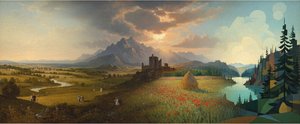
The soul of von Alt’s work lies in his profound connection to the natural world. Driven by an insatiable curiosity, he embarked on extensive hiking expeditions through the rugged majesty of the Austrian Alps and the sun-drenched vistas of Northern Italy. These travels were more than mere excursions; they were essential pilgrimages that fueled his creative spirit. Through his delicate use of watercolors, he captured the ephemeral qualities of nature—the way mist clings to a mountain peak or how sunlight dances across a valley floor. His ability to render the atmosphere of a landscape, making the viewer feel the crispness of the alpine air or the warmth of an Italian afternoon, remains one of his most enduring legacies.
Architectural Grandeur and Artistic Evolution
While his landscapes captured the wild beauty of Europe, von Alt’s architectural paintings offered a meticulous study of human achievement and historical permanence. He possessed a rare ability to marry the structural precision of architecture with the fluid, emotive qualities of light. His works often serve as windows into a bygone era, documenting the intricate facades and soaring spires of European landmarks with a reverence that borders on the poetic. This technical prowess is perhaps most evident in his mastery of oil painting, where he could manipulate texture and shadow to give stone and mortar a breathing, living quality.
As his career progressed, von Alt’s style underwent a fascinating metamorphosis. While his early works were grounded in a rigorous realism and a devotion to topographical accuracy, his later compositions began to embrace the softer, more fragmented light characteristic of Impressionism. This evolution demonstrates an artist who was never stagnant, but rather one who continuously sought new ways to interpret the sensory experience of the world around him. His later works move away from mere documentation toward a more subjective, emotional interpretation of light and color, bridging the gap between classical tradition and modern sensibility.
Legacy and Enduring Influence
The historical significance of Rudolf von Alt extends far beyond the borders of Austria. His meticulous records of landscapes and architecture have become invaluable historical documents, preserving the visual identity of much of Central Europe before the upheavals of the 20th century. His presence in prestigious institutions, such as the Albertina in Vienna, ensures that his contributions to the art canon are studied and celebrated by scholars and enthusiasts alike. The retrospective exhibition held at the Albertina between 2005 and 2006 served as a poignant reminder of his enduring relevance to the global art community.
Today, the works of von Alt continue to resonate with a modern audience, offering a sense of tranquility and a profound appreciation for the beauty of the physical world. Whether through the precise lines of his architectural studies or the atmospheric washes of his landscapes, his art invites us to pause and observe the intricate details of our environment. His life, marked by both artistic triumph and personal nobility, remains a testament to the power of observation and the timeless allure of the natural and built landscapes.