Olja på dukVäggkonstPost-Impressionism
 1895Modernism
 73.0 x 92.0 cm
Handmålad olja på duk i din valda storlek och ram, tillverkad efter beställning av våra konstnärer. ( Beställ tryck Byt till bild)





























Välj bland våra förinställda storlekar som motsvarar konstverkets ursprungliga proportioner.

Du kan ange egna mått för att passa en specifik ram eller yta. Om den valda storleken inte matchar originalbildens proportioner kommer vi antingen att beskära konstverket eller utöka målningen med ytterligare handmålade element. En digital skiss skickas till dig för godkännande innan produktionen påbörjas.
Observera att förhandsvisningen på skärmen inte återspeglar den faktiska beskärningen eller utökningen. Endast skissen visar den slutgiltiga kompositionen korrekt.
Även om anpassade storlekar är möjliga, rekommenderar vi att du väljer en dimension från den fördefinierade listan för att bevara originalproportionerna.
Leverans över hela världen () på 3–4 veckor istället för standard 5 veckor. (11 augusti). Inga kompromisser med kvaliteten.


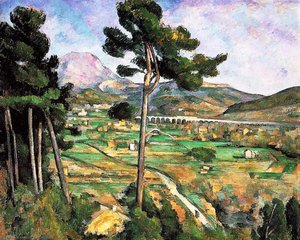
Mont Sainte-Victoire: Ett eko av berget – Paul Cézannes mästerverk
Reproduktionsstorlek
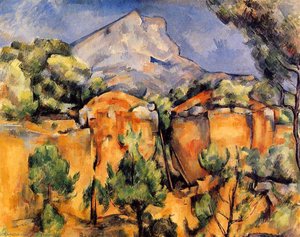
The Geometry of Perception: Cézanne wasn't interested in replicating what the eye sees; he sought to represent how the mind *understands* sight. He meticulously analyzed Mont Sainte-Victoire, breaking it down into its fundamental shapes—rectangles, cylinders, and cones—and then rebuilding it on the canvas with a deliberate, almost architectural precision. This is evident in the simplified forms of the mountain itself, reduced to their essential geometric components. Imagine Cézanne’s mind dissecting the mountain, meticulously charting each angle and dimension – this wasn't about capturing beauty as Impressionists did; it was about revealing its fundamental order.
A Fragmented Light: The painting’s fragmented quality isn’t accidental. Cézanne believed that light wasn’t a uniform entity but rather existed as a collection of individual planes and colors. He employed broken brushstrokes—often applied in contrasting hues—to suggest the way sunlight interacts with surfaces, creating a shimmering, almost iridescent effect. Think of dappled sunlight filtering through the trees – Cézanne captured this elusive quality not by blending colors seamlessly, but by layering them strategically, mimicking the way light dances across the mountain’s slopes.
The Foreground’s Depth: Notice the trees in the foreground – not rendered as individual leaves but rather as dark, solid masses that anchor the composition and create a sense of depth. These aren't merely decorative elements; they are crucial to Cézanne’s strategy for conveying spatial relationships within the painting. Consider how Cézanne uses these dark shapes to draw your eye inward, emphasizing the solidity and permanence of the mountain against which it stands.
Post-Impressionism’s Roots: *Mont Sainte-Victoire* stands as a cornerstone of Post-Impressionism, a movement characterized by its rejection of strict Impressionist conventions and its emphasis on subjective expression and formal experimentation. Cézanne's work moved beyond the fleeting effects of light and color to explore the underlying structure of objects and the essential qualities of form. This shift paved the way for Cubism’s deconstruction of perspective and Abstraction’s focus on pure visual elements.
The painting's current location within the Philadelphia Museum of Art is significant, representing one of ten views of Mont Sainte-Victoire dispersed after Cézanne’s death. Its acquisition in 1907 by Ambroise Vollard and the Galerie Bernheim-Jeune marked a turning point in the artist’s recognition, solidifying his place within the art world. The story of its dispersal—from Cézanne's studio to various collectors—adds another layer of intrigue to this already compelling artwork.
Ambroise Vollard’s Role: Vollard, a prominent art dealer and collector, played a crucial role in promoting Cézanne’s work during his lifetime, recognizing the artist’s unique talent and vision. He championed Cézanne's innovative style, ensuring that his paintings reached audiences eager to embrace new artistic horizons.
Symbolism Beyond Sight: More than just a depiction of a mountain, *Mont Sainte-Victoire* embodies Cézanne’s belief in the transformative power of art. It represents an attempt to capture not merely what is seen but also what is felt—a profound connection with nature and a celebration of its enduring beauty.
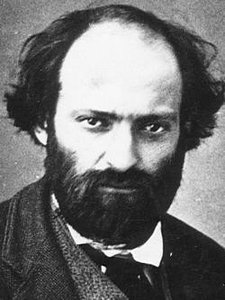
1839 - 1906 , Frankrike

Explore the profound evolution of art from Impressionism to Post-Impressionism. Discover how masters like Van Gogh revolutionized color and emotion, shaping modern art history through structural innovation and expressive technique.


Håll dig uppdaterad med de senaste konstnyheterna, exklusiva erbjudanden och inredningsidéer.
Berätta om ditt projekt så kommer våra konstexperter att ge dig 3 personliga konstförslag.
Vi skapar ett urval av 3 alternativ helt anpassat för dig – gratis!


 Visa i rummet
 Skicka
 Dela
Dela
 Detaljer

 Ladda ner
 Liknande objekt
 Röntgen
 Bildspel
 Läs mer







 Glasalternativet är endast tillgängligt i storlekar under 110 cm.