The Soul of the Sarthe: The Artistic Journey of Pierre Alexis Lesage
Pierre Alexis Lesage (1872-1932) remains a profound voice in the tapestry of French art, a painter whose brush captured not merely the scenery of his homeland, but its very heartbeat. Born in Saint-Denis, Paris, Lesage’s early years were shaped by the rigorous academic traditions of late 19th-century France. His formative training began under the watchful eye of Gustave Boulanger, a master of monumental and theatrical compositions. While this apprenticeship instilled in him a foundational respect for grand narratives and dramatic structure, Lesage possessed an artistic temperament that yearned for something more intimate. He eventually moved away from the staged grandeur of his mentor, seeking instead to find the extraordinary within the ordinary, a transition that would define his legacy as a chronicler of regional life.
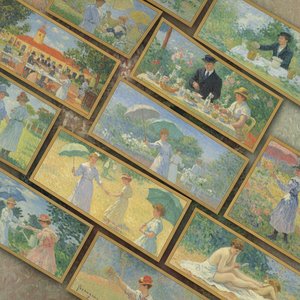
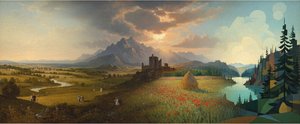
The true essence of Lesage’s mastery is found in his devotion to the Sarthe region. In these landscapes, he moved beyond mere topographical recording to achieve a poetic resonance. His canvases serve as windows into a Normandy characterized by fertile plains and tranquil villages, where the light seems to possess its own weight and warmth. Through his eyes, we witness fields of poppies ablaze with color and wheat ripening under a golden sun, all rendered with a sensitivity that suggests a deep, spiritual connection to the earth. This period of his work represents a harmonious marriage between meticulous observation and emotional expression, as he captured the ethereal light bathing rural churches and the quiet dignity of the French countryside.
A Legacy of Color and Emotion
The stylistic evolution of Lesage was profoundly shaped by the Romantic spirit of Eugène Delacroix. Eschewing the cold precision of photographic realism, Lesage embraced a more fluid, expressive technique. He utilized loose brushwork and a vibrant, emotive color palette to convey the dynamism of nature and the fleeting nuances of atmosphere. This Delacroixian influence allowed his work to transcend simple landscape painting, turning each piece into an exercise in poetic contemplation. Whether he was depicting the melancholic beauty of a still life, such as his hauntingly beautiful Nature morte bécasse, or capturing the textured richness of interiors adorned with Aubusson tapestries, his technique remained focused on the sensory experience of the subject.
Beyond the sweeping vistas of the Sarthe, Lesage demonstrated an extraordinary versatility through his portraiture. His ability to capture the psychological depth of his subjects is evident in works such as Portrait de Monsieur Audemar and the delicate Portrait d'Honorine Viaux. Perhaps most famously, his iconic depiction of Frédéric Chopin stands as a testament to his ability to merge historical reverence with artistic intimacy. Through these portraits, Lesage explored the complexities of human identity, much like he explored the textures of the natural world. His oeuvre remains a vital bridge between the academic traditions of the past and the expressive freedom of modernism, ensuring his place as a significant figure in the history of French painting.