Купи картина Купи картинаКупи изображение Купи изображение ИзпратиИзпрати
ДетайлиДетайли Добавяне към любими Добавяне към любими ИзтеглянеИзтегляне ПодобниПодобни Рентгенова снимкаРентгенова снимка СлайдшоуСлайдшоу

Objet-Dard

Marcel Duchamp’s ‘Objet-Dard,’ a rusted pipe with a deliberate hole, embodies Dadaist principles and challenges traditional notions of artistic creation. Explore this iconic assemblage and own a piece of art history.

Марсел Дюшан: Революционен художник, който предизвика определението за изкуство с Дадаизъм и редимейд обекти като "Фонтан". Разгледайте неговите емблематични творби и философско влияние.

Жикле / Художествен принт

Giclée печат или принт върху платно с музейно качество, бързо производство и гъвкави опции за завършен вид.

P118B $10
P118H $10
P118W $10
P438Z $10
P508JH $12
P508YH $12
P805H $10
P805Z $10
P919BZ $10
P919G $10
P919XJ $10
P959ZH $10
P968JZ $12
W106C $8
W218G $10
W218JH $8
W218Y $10
W307PJ $10
W316G $10
W316PJ $8
W316Y $10
W398PJ $8
W4111J $10
W500HY $15
W500JH $15
W692G $12
W849H $8
W940BG $15
W953PJ $8

Standard
custom
CM
INCH

Изберете от предварително зададените размери, които съответстват на оригиналните пропорции на произведението.

ширина
височина

Можете да въведете собствени размери, за да паснат на конкретна рамка или пространство. Ако избраният от Вас размер не съвпада с пропорциите на оригиналното изображение, ние ще изрежем произведението или ще разширим изображението с огледален или едноцветен ръб. Дигитален макет ще бъде изпратен за Ваше одобрение преди започването на производството.
Моля, имайте предвид, че предпрегледът на екрана не отразява реалното изрязване или разширяване. Само макетът ще покаже точно финалната композиция.
Въпреки че са налични персонализирани размери, препоръчваме да изберете размер от предварително дефинирания списък, за да запазите оригиналните пропорции.

Доставка по целия свят () в рамките на 2 седмици вместо стандартните 4/5 седмици. (20 Юли)

why_choose_icon
Безплатна експресна доставка по целия свят
why_choose_icon
Висококачествено ленено платно
why_choose_icon
Пълно застраховане при доставка
why_choose_icon
Гаранция за възстановяване на митнически такси
why_choose_icon
Гаранция за цветова точност
why_choose_icon
60-Дневен период за връщане (Само при дефекти)
why_choose_icon
100% Гаранция за връщане на парите
why_choose_icon
Предложение за отстъпка при поръчка на едро

Обща цена

-

reproduction

Objet-Dard

Жикле / Художествен принт

Размер на репродукцията

-

Обща цена

-

Бързи факти

  • Medium: Wood & Rust
  • Movement: Dada
  • Notable elements: Pipe with hole
  • Influences:
    • Cubism
    • Avant-garde
  • Title: Objet-Dard
  • Artist: Marcel Duchamp

Описание на колекционерския предмет

A Study in Rust and Rebellion: Marcel Duchamp’s *Objet-Dard*

Marcel Duchamp's *Objet-Dard*, or "Little Object," is not merely a photograph of a rusted pipe; it’s a meticulously crafted provocation, a cornerstone of the Dada movement, and a profound meditation on the very definition of art. Captured with an almost clinical precision, the image confronts us with a commonplace object – a simple wooden pipe – transformed into something unsettlingly significant through Duchamp's deliberate framing and selection. This seemingly insignificant detail holds within it a potent critique of artistic convention and a radical assertion of the artist’s role in shaping perception.

  • Subject Matter: The core subject is undeniably a pipe, yet its inherent ordinariness is deliberately destabilized. Duchamp elevates this discarded item to the status of artwork through his act of selection and presentation.
  • Composition & Technique: The close-up shot emphasizes the pipe’s texture – the rough grain of the wood, the intricate patterns of rust, and most crucially, the perfectly circular hole at its center. This focus draws the viewer's eye directly to this point of vulnerability, a deliberate disruption of traditional artistic representation.
  • Historical Context: Created in 1917, *Objet-Dard* emerged during a period of immense social and political upheaval – World War I had shattered established norms, and the rise of Dada challenged all notions of beauty, reason, and order. Duchamp’s work perfectly embodies this spirit of rebellion against artistic dogma.

The Seeds of Dada: Challenging Artistic Boundaries

Duchamp's creation of *Objet-Dard* aligns directly with the core tenets of Dadaism, a movement born from disillusionment and anti-rationality. Dada artists rejected traditional aesthetic values, embracing chance, absurdity, and irony as tools for dismantling established artistic hierarchies. Duchamp’s “readymades,” such as this pipe, were not created through conventional artistic processes – there was no painting, sculpting, or crafting involved. Instead, he selected an existing object from the everyday world and presented it as art, effectively declaring that the artist's role could be simply to choose and display.

  • Conceptual Art Precursor: *Objet-Dard* is widely considered a seminal work in the development of conceptual art. It shifted the emphasis from the physical object itself to the idea behind it – the questioning of artistic value, the role of the artist, and the nature of perception.
  • Symbolism of Ruin: The rusted pipe carries symbolic weight, representing decay, obsolescence, and perhaps even the futility of war. The hole within the pipe can be interpreted as a void, an absence, or a point of vulnerability – mirroring the anxieties of the era.

A Legacy of Provocation

*Objet-Dard* continues to resonate today because it remains profoundly relevant to contemporary debates about art and its purpose. Duchamp’s work forces us to confront our own assumptions about what constitutes “art” and who gets to decide. It's a testament to the power of simple objects, when presented with intention, to provoke thought and challenge convention. BuyPopArt.com offers meticulously crafted hand-painted reproductions that capture the essence of this iconic piece, allowing you to experience Duchamp’s revolutionary vision firsthand.
  • Hand-Painted Reproduction: Our reproduction utilizes traditional artistic techniques, ensuring a faithful representation of Duchamp's original intent while benefiting from the artistry of skilled hand-painters.
  • Material Quality: Printed on archival quality canvas with fade-resistant inks for lasting beauty and preservation.

Биография на художника

Marcel Duchamp (1887–1968): A Revolutionary Spirit

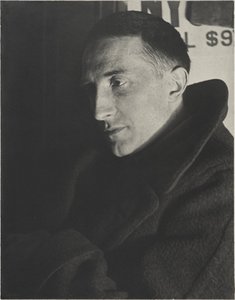
Marcel Duchamp, Henri-Robert-Marcel Duchamp, was born in Blainville-sur-Mer, Normandy, France, on July 28, 1887. His artistic lineage traced back to his father, a notary, and his brother Jacques Villon, who established himself as a successful painter – a familial encouragement that nevertheless wouldn’t fully encapsulate the rebellious spirit that would define Duchamp's life and career. Initially drawn to formal training in Paris, he mastered traditional techniques and experimented with Post-Impressionist styles, absorbing influences from artists like Cézanne and Gauguin. However, this grounding in academic art served as a crucial catalyst for his profound questioning of artistic conventions. He recognized that mere visual representation wasn’t sufficient to grapple with the existential anxieties of the era—specifically, the devastating impact of World War I on European society. This disillusionment fueled his embrace of Dadaism, a movement born from utter rejection of logic and reason, marking a decisive break from established artistic paradigms.

Early Artistic Explorations: Cubism and Impressionism

Duchamp’s initial foray into art began with an exploration of Cubism alongside Jacques Villon. Their collaborative efforts yielded works like *Portrait of Chess Players* (1911), demonstrating a fascination for fragmented forms and multiple perspectives—a radical departure from the single viewpoint championed by earlier artistic traditions. While acknowledging the aesthetic merits of Cubist principles, Duchamp swiftly transcended purely visual concerns, perceiving that artistic expression demanded more than just rearranging elements on canvas. He sought to engage with deeper philosophical questions about perception and reality. This intellectual curiosity would propel him toward Dadaism and beyond.

The Dadaist Rebellion: Challenging Artistic Boundaries

Duchamp’s involvement in Dadaism solidified his commitment to dismantling conventional notions of art. Rejecting the values of beauty, craftsmanship, and emotional expression—characteristics deemed paramount by mainstream artistic circles—he championed a stance of deliberate provocation. Dada artists aimed not to create aesthetically pleasing objects but rather to disrupt established hierarchies and expose the absurdity inherent in societal norms. Duchamp’s Dadaist output included provocative collages and assemblages that questioned accepted standards of taste and challenged viewers to confront uncomfortable truths. The movement's manifesto proclaimed “Anti-art,” asserting that art should be conceived as a negation of everything it represented.

The Birth of Conceptual Art: ‘Ready-Made’ Sculpture

Duchamp’s most enduring contribution to the history of art arrived in 1917 with his groundbreaking concept of the ‘ready-made.’ Recognizing that artistic creativity extended beyond mere manual skill, he questioned whether an object could be considered art if it was simply presented as such—without any transformative intervention. His seminal work, *Fountain* (1917), consisted of a porcelain urinal signed “R. Mutt,” submitted anonymously to Marcel Duchamp’s own exhibition in New York City. This audacious act deliberately undermined the distinction between artwork and everyday object, sparking intense debate about authorship, originality, and the very definition of artistic value. It established Conceptual Art as a dominant force in postwar art, prioritizing ideas over visual form.

Later Works: The Large Glass and Beyond

Duchamp continued to push boundaries throughout his career, culminating in *The Large Glass* (1915–1923), an ambitious multi-faceted project incorporating glass panels, enamel paint, and intricate sculptural elements. This monumental artwork explored themes of illusion, perception, and the subconscious—reflecting Duchamp’s lifelong fascination with psychoanalysis and his desire to delve into the complexities of human consciousness. His later explorations encompassed film, poetry, and graphic design, demonstrating a multifaceted artistic sensibility that defied categorization. Marcel Duchamp died October 2, 1968, leaving behind an unparalleled legacy as one of the most influential figures in modern art—a testament to his unwavering conviction that art should provoke thought and challenge accepted conventions. His influence persists today, inspiring artists to question assumptions about creativity and artistic expression.
Марсел Дюшан

Марсел Дюшан

1887 - 1968 , Франция

Бързи факти

  • Artistic Movement Or Style:
    • Кубизъм
    • Дадаизъм
    • Концептуален изкуство
  • Artists Or Movements Influenced By This Artist:
    • Концептуално изкуство
    • Поп арт
    • Минимализъм
  • Date Of Birth: Юли 28, 1887
  • Date Of Death: Октомври 2, 1968
  • Full Name: Marcel Duchamp
  • Nationality: Френски-Американски
  • Notable Artworks:
    • Фонтан
    • Л.Х.О.О.К.
    • Голям стъкло
  • Place Of Birth: Блейнвил, Франция
Разгледайте произведения на изкуството, организирани по теми, стилове и характеристики.