

Giclée- eller lærredstryk i museumskvalitet med hurtig produktion og fleksible muligheder for finish. ( Køb håndlavet maleri Køb billede)





























Vælg mellem vores forudindstillede størrelser, der matcher kunstværkets originale proportioner.

Du kan indtaste dine egne mål for at passe til en specifik ramme eller et bestemt område. Hvis den valgte størrelse ikke stemmer overens med det originale billedes proportioner, vil vi enten beskære kunstværket eller udvide billedet med en spejlet eller ensfarvet kant. En digital mockup vil blive sendt til din godkendelse, før produktionen påbegyndes.
Bemærk venligst, at forhåndsvisningen på skærmen ikke afspejler den faktiske beskæring eller udvidelse. Kun mockuppen vil nøjagtigt vise den endelige komposition.
Selvom specialmål er tilgængelige, anbefaler vi at vælge et mål fra den foruddefinerede liste for at bevare de originale proportioner.
Verdensomspændende levering () på 2 uger i stedet for de sædvanlige 4/5 uger. (22 august)


Jumping Horse
Størrelse på reproduktion
Franz Marc's "Jumping Horse," painted in 1913, isn’t merely a depiction of an equine leap; it’s a profound distillation of the Expressionist movement’s core tenets – a vibrant exploration of emotion, instinct, and the interconnectedness of nature. This artwork transcends simple representation, becoming a visual embodiment of freedom, energy, and the spiritual yearning that defined Marc's artistic vision. The painting pulsates with an almost palpable dynamism, inviting the viewer into a world where color isn’t just decorative but fundamentally expressive.
Marc, deeply influenced by his early exposure to Vincent van Gogh’s emotionally charged brushwork and his own contemplation of religious themes, sought to capture not just what he *saw*, but what he *felt*. “Jumping Horse” exemplifies this pursuit. The horse itself—a powerful, almost mythical figure—is rendered with bold, simplified forms and a palette dominated by fiery reds, oranges, and yellows. These colors aren’t applied realistically; instead, they are used to convey the horse's raw energy, its untamed spirit, and the sheer force of its movement. The distorted perspective and flattened planes contribute to an overall sense of immediacy and intensity, pulling the viewer directly into the heart of the action.
The composition of “Jumping Horse” is remarkably balanced despite its energetic subject matter. The horse, positioned slightly off-center, dominates the scene but isn’t isolated. A scattering of carefully placed elements—a bird soaring towards the upper right corner, a cactus reaching upwards on the left, and a potted plant grounding the composition—create a miniature ecosystem within the frame. These seemingly disparate objects aren't merely decorative; they contribute to the painting’s overall sense of harmony and balance, suggesting a deeper connection between the horse and its environment.
The bird, often interpreted as a symbol of freedom and transcendence, adds a touch of serenity to the scene, while the cactus represents resilience and endurance. The potted plant grounds the composition, anchoring the dynamic energy of the horse within a more stable reality. Marc’s genius lies in his ability to weave these individual elements into a cohesive whole, creating an artwork that speaks to both the wildness of nature and its inherent order.
“Jumping Horse” is a quintessential example of Expressionist art. The movement, emerging in early 20th-century Germany, rejected traditional academic painting techniques in favor of subjective expression. Artists like Marc sought to convey their inner emotional states through distorted forms, exaggerated colors, and simplified compositions. In this painting, the horse’s elongated neck, its blurred form, and the vibrant hues all contribute to a sense of heightened emotion—a feeling of exhilaration, perhaps even primal instinct.
Marc's use of color is particularly noteworthy. He employs a technique known as “color symbolism,” assigning specific meanings to different colors based on their emotional associations. Red often represents passion and energy, while yellow symbolizes joy and optimism. The careful orchestration of these colors in "Jumping Horse" creates a powerful visual narrative that resonates deeply with the viewer.
“Jumping Horse” is more than just a beautiful painting; it’s a testament to Franz Marc's artistic vision and his profound belief in the power of art to communicate spiritual truths. His exploration of the animal kingdom—particularly horses, which he saw as embodiments of freedom and vitality—reflects a deep yearning for connection with nature and a desire to transcend the limitations of human experience. As a cornerstone of early 20th-century art, “Jumping Horse” continues to inspire awe and wonder, inviting us to contemplate the beauty and mystery of the natural world.
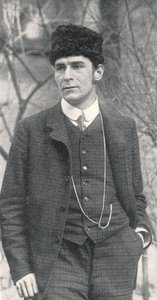
1880 - 1916 , Tyskland

Oplev de 10 mest ikoniske værker fra Tysk Ekspressionisme! Lær historierne bag Kirchner, Nolde & Kandinsky. Find museumskvalitets kunsttryk og inspiration til din indretning på BuyPopArt.com – udforsk samlingen online.

Explore the profound world of Franz Marc's Expressionist paintings. Discover his spiritual connection to animals, innovative use of color, and lasting impact on modern art history. Learn more at BuyPopArt.

Explore the rich history of horses in fine art! From ancient depictions to Renaissance masterpieces & beyond, discover iconic artworks and artists. Learn about symbolism, techniques, and find museum-quality reproductions at BuyPopArt.

Oplev kubismens og ekspressionismens 10 mest ikoniske værker! Dyk ned i Picassos, Braques & Gris' revolutionerende kunst. Find inspiration til dit hjem med BuyPopArt.coms museumskvalitets reproduktioner. Udforsk samlingen online!

Explore the rich history of horse painting! Discover masterpieces from Stubbs to Munnings & learn about symbolism, techniques & artists. Find museum-quality reproductions at BuyPopArt.


Hold dig opdateret med de seneste kunstnyheder, eksklusive tilbud og indretningsideer.
Fortæl os om dit projekt, og vores kunsteksperter vil give dig 3 personlige kunstforslag.
Vi kuraterer 3 valgmuligheder kun til dig – Gratis!


 Se i fuld skala
 Del
Del Del
Del
 Detaljer

 Download
 Lignende værker
 Røntgenundersøgelse
 Diasshow

 Se mere







 Glasmulighed er kun tilgængelig i størrelser under 110 cm


