Acrylic On CanvasWallArtAbstract Expressionism
 1969Contemporary
 70.0 x 70.0 cm
Giclée- eller lærredstryk i museumskvalitet med hurtig produktion og fleksible muligheder for finish. ( Køb håndlavet maleri Køb billede)





























Vælg mellem vores forudindstillede størrelser, der matcher kunstværkets originale proportioner.

Du kan indtaste dine egne mål for at passe til en specifik ramme eller et bestemt område. Hvis den valgte størrelse ikke stemmer overens med det originale billedes proportioner, vil vi enten beskære kunstværket eller udvide billedet med en spejlet eller ensfarvet kant. En digital mockup vil blive sendt til din godkendelse, før produktionen påbegyndes.
Bemærk venligst, at forhåndsvisningen på skærmen ikke afspejler den faktiske beskæring eller udvidelse. Kun mockuppen vil nøjagtigt vise den endelige komposition.
Selvom specialmål er tilgængelige, anbefaler vi at vælge et mål fra den foruddefinerede liste for at bevare de originale proportioner.
Verdensomspændende levering () på 2 uger i stedet for de sædvanlige 4/5 uger. (16 august)


Star Picture
Størrelse på reproduktion
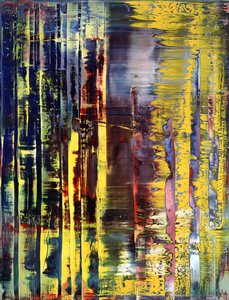
Gerhard Richter's ‘Star Picture,’ created in 1969, is not an invitation to gaze upon the cosmos with romantic wonder, but rather a profound meditation on perception, representation, and the very nature of painting itself. Emerging from a period defined by both technological advancement – the year humanity first walked on the moon – and lingering post-war anxieties, this work embodies Richter’s characteristic blurring of boundaries between abstraction and reality. It isn't a depiction *of* stars, but an exploration of how we see, remember, and translate images into the language of paint. The canvas, measuring 70 x 70 cm, feels surprisingly intimate despite its vast implied subject matter; it’s as if Richter has contained a universe within a manageable frame.
Richter's technique in ‘Star Picture’ is central to understanding its impact. He doesn’t meticulously plan or sketch, but rather embraces chance and gesture. Layers of oil paint are applied, scraped, and blurred, often utilizing a squeegee-like tool to create flattened areas and dynamic streaks. This process isn’t about achieving a precise representation; it's about revealing the inherent qualities of the medium itself – its texture, viscosity, and capacity for both control and accident. The limited palette—predominantly black, grey, and subtle gradations in between—further emphasizes this focus on materiality. These somber tones aren’t depressing, but rather create a sense of quiet contemplation, inviting the viewer to lose themselves within the painting's surface. The absence of distinct forms or focal points encourages a wandering eye, discovering new details with each viewing. It is an artwork that resists easy categorization, existing somewhere between abstract expressionism and photorealism – a hallmark of Richter’s diverse oeuvre.
Born in Dresden in 1932, Gerhard Richter's life was deeply shaped by the tumultuous history of 20th-century Germany. Growing up through war and division instilled a skepticism towards grand narratives and idealized representations. This distrust is palpable in ‘Star Picture.’ While seemingly abstract, the work can be seen as a response to the era’s fascination with space exploration, subtly questioning the utopian promises associated with technological progress. The blurred, indistinct stars might symbolize the elusiveness of truth or the limitations of human perception. Richter's artistic journey was also influenced by movements like Zero, which sought a fresh start after the devastation of war, embracing abstraction and experimentation as pathways to renewal. However, unlike the optimistic fervor of some Zero artists, Richter maintains a critical distance, refusing to offer easy answers or embrace simplistic ideologies.
‘Star Picture’ possesses an enduring quality that transcends its historical context. Its monochromatic palette and abstract composition make it remarkably versatile in contemporary interiors. The painting's subtle textures and dynamic energy can add depth and sophistication to a minimalist space, while its contemplative mood complements more traditional settings. A reproduction of this work isn’t merely a decorative element; it’s an invitation to engage with complex ideas about art, perception, and the human condition. It speaks to those who appreciate intellectual rigor alongside aesthetic beauty—a piece that rewards sustained contemplation and offers new discoveries with each encounter. The artwork's power lies in its ability to evoke emotion without relying on explicit imagery, making it a truly timeless addition to any collection.


1932 - , Tyskland

Dive into the high-voltage world of Abstract Expressionism. Explore the raw energy of Action Painting and the legendary masters of the New York School through a visual journey of pure chaos and color. Discover how to bring bold, high-impact abstract art into your modern space.

Master the high-impact world of contemporary abstraction. Discover how bold colors, textures, and modern movements like Abstract Expressionism can transform your space with premium, high-energy art curated for the design-conscious professional.

Dive into the high-energy world of Lyrical Abstraction. Explore how bold colors, fluid motion, and emotional depth define this modern masterpiece movement. Discover iconic artists and learn to bring this vibrant, soulful energy into your contemporary space.

Dive into the raw power of Abstract Expressionism. Explore the high-octane energy of action painting and color field mastery. Discover how these bold, visceral movements redefine modern interiors with high-impact, premium abstract art for the contemporary collector.

Discover the power of Neo-Abstract art. Explore how bold geometric forms and high-impact visual energy are redefining modern design. Learn to curate sophisticated, high-energy spaces with the latest trends in contemporary abstraction and structural color.


Hold dig opdateret med de seneste kunstnyheder, eksklusive tilbud og indretningsideer.
Fortæl os om dit projekt, og vores kunsteksperter vil give dig 3 personlige kunstforslag.
Vi kuraterer 3 valgmuligheder kun til dig – Gratis!


 Se i fuld skala
 Del
Del Del
Del
 Detaljer

 Download
 Lignende værker
 Røntgenundersøgelse
 Diasshow
 Se mere







 Glasmulighed er kun tilgængelig i størrelser under 110 cm