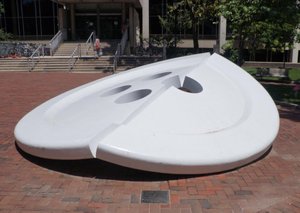
Contemporary Minimalism
 2020
2020 193.0 x 127.0 cm
 Biennale of Sydney
Håndmalet olie på lærred i din valgte størrelse og ramme, udført efter bestilling af vores kunstnere. ( Køb print Køb billede)
Vælg mellem vores forudindstillede størrelser, der matcher kunstværkets originale proportioner.

Du kan indtaste dine egne mål for at passe til en bestemt ramme eller plads. Hvis den valgte størrelse ikke stemmer overens med det originale billedes proportioner, vil vi enten beskære kunstværket eller udvide maleriet med yderligere håndmalede elementer. En digital skitse sendes til din godkendelse, før produktionen påbegyndes.
Bemærk venligst, at forhåndsvisningen på skærmen ikke afspejler den faktiske beskæring eller udvidelse. Kun skitsen vil nøjagtigt vise den endelige komposition.
Selvom specialmål er mulige, anbefaler vi at vælge en dimension fra den foruddefinerede liste for at bevare de originale proportioner.
Levering i hele verden () på 3/4 uger i stedet for de standard 5 uger. (15 august). Ingen kompromiser med kvaliteten.


Function Begets Form\n\nInstallation Image
Størrelse på reproduktion

The year 1990 stands as a pivotal moment, not just in music – marked by the rise of grunge and hip-hop’s burgeoning dominance – but also within the broader cultural landscape. It was an era grappling with shifting social norms, technological advancements, and a profound sense of uncertainty that found powerful expression through art and music alike. Within this context emerges Felix Gonzales-Torres, an artist whose work, though gaining significant recognition in the early 1990s, began to articulate themes of memory, loss, and the ephemeral nature of existence – concerns deeply resonant with the anxieties of a generation.
Gonzales-Torres’ artistic trajectory, while relatively brief, is characterized by a deliberate simplicity and an almost unsettling quietude. Born in 1990 (a fact that seems particularly poignant given his thematic explorations), he quickly established himself within the burgeoning Miami art scene, drawing heavily from the city's vibrant Latin American heritage and its complex relationship with the United States. His early works often featured meticulously arranged stacks of photographs – a technique he would later refine into his signature “melted” sculptures – creating layered narratives that resisted easy interpretation. These initial pieces weren’t simply visual exercises; they were meditations on the passage of time, the fragility of identity, and the lingering presence of the past.
The influence of music during this period is undeniable. The raw energy of Nirvana, the introspective lyrics of Tori Amos, and the politically charged anthems of Rage Against the Machine all contributed to a cultural atmosphere ripe for artistic exploration. Gonzales-Torres’ work can be seen as mirroring this shift – moving away from overt representation towards a more conceptual approach, utilizing repetition and subtle shifts in form to evoke emotional responses. The deliberate slowness of his process, often involving the gradual melting of photographs under heat lamps, reflects a similar sensibility to the ambient music gaining popularity at the time, prioritizing atmosphere over immediate impact.
Gonzales-Torres’ most recognizable technique – the “melted” sculpture – is both technically demanding and conceptually rich. He began by photographing everyday objects – often personal items like photographs of family members, postcards, or discarded documents – and then meticulously arranging them in a grid-like formation. These arrangements were then coated with a thin layer of wax, creating a surface susceptible to heat. Using carefully controlled heating lamps, he would slowly melt the wax, distorting the images beneath and transforming them into amorphous, ghostly shapes.
This process isn’t merely about destruction; it's about transformation. The melting represents the erosion of memory, the blurring of boundaries between past and present, and the inevitable decay of all things. The resulting sculptures are not portraits in the traditional sense, but rather fragments of narratives – echoes of lives lived and moments experienced. The subtle shifts in color and form invite viewers to contemplate the stories behind these distorted images, prompting a deeper engagement with themes of loss, nostalgia, and the subjective nature of recollection.
Several works from this period stand out as particularly significant examples of Gonzales-Torres’ evolving style. “Untitled (Family)” (1990), for instance, features a grid of photographs depicting his family – a poignant reminder of the fleeting nature of familial bonds and the difficulty of preserving memories over time. Similarly, "Untitled (Postcards)" explores the themes of travel, distance, and the longing for connection through the melting of postcards from various destinations. These pieces demonstrate a growing interest in exploring personal history and its relationship to broader cultural narratives.
Beyond his own artistic practice, Gonzales-Torres was influenced by a diverse range of artists and movements. The minimalist sculptures of Donald Judd and Eva Hesse provided a framework for his early explorations with repetition and form. The conceptual art of Sol LeWitt encouraged him to prioritize ideas over traditional notions of representation. And the work of photographers like Robert Frank and Walker Evans, known for their fragmented perspectives and exploration of urban landscapes, informed his approach to image manipulation and composition.
While Felix Gonzales-Torres’ career was tragically cut short by his untimely death in 2008, his work continues to resonate with contemporary audiences. His “melted” sculptures have become iconic symbols of the late 20th century, capturing the anxieties and uncertainties of a rapidly changing world. The themes he explored – memory, loss, and the fragility of identity – remain profoundly relevant in an era defined by digital technology and the constant bombardment of information.
Looking back at 1990, it’s clear that Gonzales-Torres was not simply documenting a specific year; he was articulating a broader cultural sensibility. His art serves as a powerful reminder of the enduring power of memory and the importance of confronting the complexities of human experience. His work stands as a testament to the ability of art to capture the essence of a moment in time, transforming it into something both hauntingly beautiful and deeply thought-provoking.

1990 - , People's Republic of China

Discover the art of minimalist living with our expert guide to curating sophisticated interiors. Learn how to use sculptural depth, intentional color palettes, and timeless statement pieces to transform your home into a serene, high-end sanctuary of modern elegance.


Hold dig opdateret med de seneste kunstnyheder, eksklusive tilbud og indretningsideer.
Fortæl os om dit projekt, og vores kunsteksperter vil give dig 3 personlige kunstforslag.
Vi kuraterer 3 valgmuligheder kun til dig – Gratis!


 Se i fuld skala
 Del
Del Del
Del
 Detaljer

 Download
 Lignende værker
 Røntgenundersøgelse
 Diasshow
 Se mere




































 Glasmulighed er kun tilgængelig i størrelser under 110 cm