

Køb et højopløst, forbedret digitalt billede, der er langt bedre end online-forhåndsvisningen.
Hver fil er omhyggeligt forberedt af vores interne specialister ved hjælp af avancerede værktøjer og ekspertmæssig manuel retuschering. Vi sikrer, at hvert billede har enestående klarhed, præcis farvegengivelse og fine detaljer.
Den endelige fil leveres via e-mail inden for 72 timer og er optimeret til øjeblikkelig brug i professionelle, redaktionelle og trykte miljøer. Det er den samme kvalitet, som førende designstudier, forlag og gallerier har tillid til.
Download en højopløselig fil til personlig fremvisning, print og kreative projekter. ( Køb print Køb håndlavet maleri)
Når du vælger BuyPopArt.com, får du ikke blot et billede – du modtager et professionelt optimeret digitalt kunstværk, skabt med præcision og sikret med en tilfredshedsgaranti. Her er alt, hvad din ordre automatisk indeholder:

Din højkvalitets digitale billedfil vil blive sendt til din e-mail inden for 72 timer efter bestilling – klar til øjeblikkelig brug.

Dit kunstværk optimeres professionelt ved hjælp af avancerede AI-værktøjer og manuel redigering, hvilket sikrer maksimal detaljegrad, klarhed og farvenøjagtighed.

Har du ved en fejl slettet eller mistet din fil? Ingen bekymring – vi sender den igen til enhver tid, helt gratis.

Nyd dit kunstværk med det samme uden told, afgifter eller leveringsgebyrer – digitale downloads er altid skattefrie.

Vi sikrer, at dit digitale billede gengiver de originale farver så præcist som muligt ved hjælp af professionelle værktøjer og farvestyring.

Hvis du ikke er tilfreds med dit digitale billede, vil vi revidere det eller refundere 100% inden for 60 dage – uden spørgsmål.

Ik tilfreds? Få fuld refusion inden for 60 dage efter modtagelse af din digitale fil – uden spørgsmål.

Køb 3 billeder, spar 10% - Køb 5, spar 15% - Køb 10+, spar 20%. Ideelt til kreative projekter, gallerier og bureauer.
Marcel Duchamp, a name synonymous with artistic revolution, consistently challenged the very definition of art throughout his prolific career. While celebrated for audacious “readymades” like *Fountain*, a porcelain urinal presented as sculpture, his explorations extended far beyond shock value. ‘Chessboard (Echiquier)’ from around 1937 offers a quieter, yet equally profound glimpse into Duchamp’s intellectual and artistic preoccupations. This isn't merely a depiction of a game; it is an embodiment of the artist’s lifelong fascination with strategy, intellect, and the dematerialization of art itself.
Duchamp’s relationship with chess was far from casual. He didn't simply play the game; he immersed himself in it, even contemplating a professional career as a chess master after largely abandoning painting in the early 1920s. This wasn’t a flight *from* art, but rather a redirection of artistic energy into a realm demanding logic, foresight, and abstract thought – qualities Duchamp increasingly valued over purely aesthetic concerns. ‘Chessboard (Echiquier)’ therefore becomes symbolic of this shift. The worn wood, the missing pieces, suggest not a game in progress, but a contemplation *of* the game, a frozen moment representing endless possibilities and strategic calculations. It’s a visual metaphor for the artist's own creative process: a deliberate arrangement of elements, a calculated disruption of expectations.
The simplicity of ‘Chessboard (Echiquier)’ is deceptive. Duchamp wasn’t interested in virtuoso painting or sculptural skill; his focus lay elsewhere. The work consists of sixty-four wooden squares nailed and glued onto plywood, a deliberately unrefined construction that emphasizes the object's conceptual nature over its aesthetic qualities. This deliberate lack of traditional artistic flourish aligns with Duchamp’s Dadaist principles – a rejection of bourgeois values and conventional artistic standards. By presenting a commonplace object—a chessboard—in an almost rudimentary form, he forces the viewer to question what constitutes art. Is it skill? Beauty? Or simply the artist's intention?
Duchamp’s impact on 20th and 21st-century art is immeasurable. He paved the way for Conceptual Art, Minimalism, and countless other movements that prioritize ideas over execution. ‘Chessboard (Echiquier)’ encapsulates this legacy perfectly. It's a work that doesn't demand to be *looked at* in the traditional sense; it demands to be *thought about*. Its enduring appeal lies not in its visual splendor, but in its ability to provoke questions and challenge assumptions. For collectors and interior designers alike, a reproduction of this piece offers more than just an aesthetic addition—it’s an invitation to engage with a pivotal moment in art history and a testament to the power of intellectual curiosity.
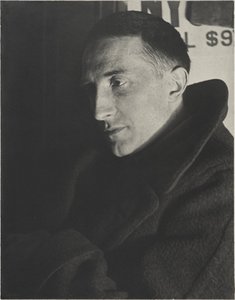
1887 - 1968 , Frankrig


Hold dig opdateret med de seneste kunstnyheder, eksklusive tilbud og indretningsideer.
Fortæl os om dit projekt, og vores kunsteksperter vil give dig 3 personlige kunstforslag.
Vi kuraterer 3 valgmuligheder kun til dig – Gratis!


 Se i fuld skala
 Del
Del Del
Del
 Detaljer

 Download
 Lignende værker
 Røntgenundersøgelse
 Diasshow
 Se mere